
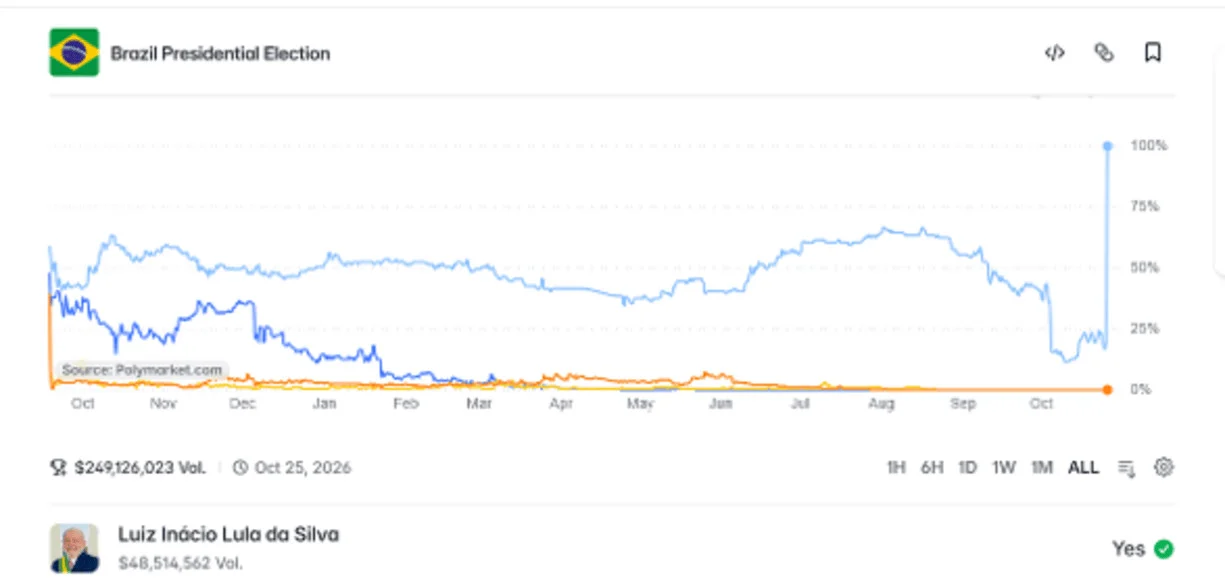
Over the weekend, Brazil's incumbent President Luiz Inácio Lula da Silva garnered substantial support from working-class suburban voters, resulting in a startling triumph over Flávio Bolsonaro in the nation's presidential election.
This victory marks a historic moment, as Lula is the first candidate since 1989 to win the presidency after finishing second in the first round of voting. His win seemed unlikely after Bolsonaro, representing the Liberal Party, secured around 47% of the votes on October 4. Following this, Lula's odds on the prediction market Polymarket plummeted to 13.5%.
In a surprising twist, Lula's fortunes improved slightly just before the election. Savvy traders on Polymarket were able to take advantage of this mispricing, with one individual earning a profit of $47,595, while another, known as "timetowander," faced losses of about $27,100. This striking outcome may highlight significant discrepancies in prediction market pricing leading up to a major election.
However, analysts caution against making broad assumptions about systemic flaws in prediction markets based on the Brazilian case. Lula's victory arrives less than two weeks before the U.S. midterm elections, which have been dubbed by Kalshi's Tarek Mansour as the "first prediction market election." Renowned researcher David Lawant from Anchorage Digital remarked on X that the public misinterpreted prediction markets’ behavior regarding Brazil’s electoral results.
"Despite dramatic late twists and turns, they repriced to the new reality before the expert consensus," he stated. "Prediction markets show you where consensus is, in real-time. What to do with that data, to predict and price the future, is still your job."
While prediction markets have existed for decades, they gained intensity with the 2024 U.S. presidential contest. Recently, Kalshi won a pivotal court ruling allowing it to offer contracts related to Congressional Control in elections, spurring a surge in political trading.
On election night, Kalshi facilitated millions in trading volume, including several trades worth seven figures related to U.S. President Donald Trump post 10 p.m. ET. In the weeks leading up to the election, trading activities reached over $4.2 billion across Kalshi and Polymarket, according to the Pew Research Center.
In the buildup to election night, while most major U.S. networks predicted a close race, Polymarket's odds gave Trump nearly a 58% chance of defeating Kamala Harris. Polymarket CEO Shayne Coplan later expressed that this forecast was validating, as it endowed prediction markets with a "level of credibility" that transformed the industry.
However, in the two years since, notable miscalculations have occurred. A prominent example was witnessed in New York City’s mayoral primary last year when former governor Andrew Cuomo's odds soared to 93% weeks ahead of voting. As the polls closed at 9 p.m. on primary night, top prediction markets granted Cuomo a 57% likelihood of winning, only for Zohran Mamdani to secure a resounding victory amid ranked-choice voting.
More recently, prediction markets misjudged sentiments during primaries in Michigan and Wisconsin, where traditional polls also faltered; in Wisconsin, an underdog unexpectedly triumphed despite trailing by over 20% in last polls.
Internationally, prediction markets in last October’s Netherlands election displayed similar inaccuracies. Dutch centrist Rob Jetten’s D66 party overtook far-right leader Geert Wilders’ Party for Freedom, despite prediction markets giving them slim chances.
Following the release of exit polls, D66's odds surged from approximately 5% to nearly assured victory, showcasing what Sam Reynolds of Coinbase described as "a test of conviction rather than foresight."
As anticipated, social media buzzed with analysis following the surprising Brazilian election result. Nic Carter, a noteworthy commentator with over 785,000 followers on X, suggested that prediction markets are designed to incentivize analysts to seek alternative data and produce more accurate odds.
Before the election, three major Brazilian polls projected a win for Bolsonaro, including a two-point victory forecast by the respected Datafolha pollster.
Several variables suggest that the Brazilian election outcomes might not indicate a trend. Notably, prediction markets are not widespread in Brazil, a country with a population exceeding 200 million. Bruno Centurion, a political analyst at Fatto Inteligência Política, pointed out that predicting the election results is mainly of interest to insiders in financial markets who may also entertain some wishful thinking based on trends from the first round. Centurion had accurately anticipated Lula’s upset.
On Monday, Carter responded to a former White House aide's post, which noted that the Brazilian results underline the unreliability of polls. Eric Wallerstein, now chief macro strategist at The Clocktower Group, stated that “there’s no signal from betting odds, just more opportunity to speculate.”
Prediction markets should clarify misconceptions regarding their role in significant elections. According to Smarkets CEO Jason Trost, these markets do not determine whether an outcome is correct; instead, they provide a "real-time price gauge." As the voting concluded, prediction markets estimated Lula's chance of winning at around 20%, with Bolsonaro leading polls closely at 51%-49%.
Trost likened this to a weather forecast where a prediction of a 20% chance of rain does not imply the forecast was incorrect when no rain falls. At 20%, it reflects a probability—Lula's victory illustrates this occurrence.
Post-election, Wallerstein noted that Brazilian futures dropped 11% on Monday, erasing much of this year's prior gains. He anticipates more "surprises" in the upcoming U.S. midterms.
Chuck Todd moderated a panel last week titled "Who Calls the Midterms: Polls, Models or the Markets?" cautioning that retail traders might be blindsided if they disregard complexities, such as varying reporting times.
Columbia University economics professor Rajiv Sethi indicated that, while prediction markets typically outperform models for presidential outcomes, they better predict down-ballot results, especially in House races.
Sethi warned that markets can be prompt but also markedly incorrect in some instances. Sam Henry Lazarus, deputy director of the Council on Foreign Relations’ Project on Prediction Markets and the Public Interest, expressed that the Brazilian results highlight a broader issue in statistical literacy prevalent among prediction market users.
A contract exhibiting an 80% probability should occur 80% of the time; however, most assume near certainty (99%).
Lazarus noted the prediction markets had assigned approximately an 80% chance to Bolsonaro's victory, emphasizing that the discourse surrounding their inaccuracy in Brazil highlights a more significant misunderstanding of probabilistic thinking.
Marci Harris, co-founder of POPVOX, monitored Brazilian market fluctuations and reflected on the "beauty of democracy," remarking that the unpredictability of voters is a valuable aspect of the electoral process.
As the U.S. voters prepare for the midterms on November 3, prediction market activity is projected to surpass $1 billion in notional volume. Harris believes even seasoned political analysts could misjudge election outcomes, embracing the idea that human unpredictability will always prevail over automated predictions.

