
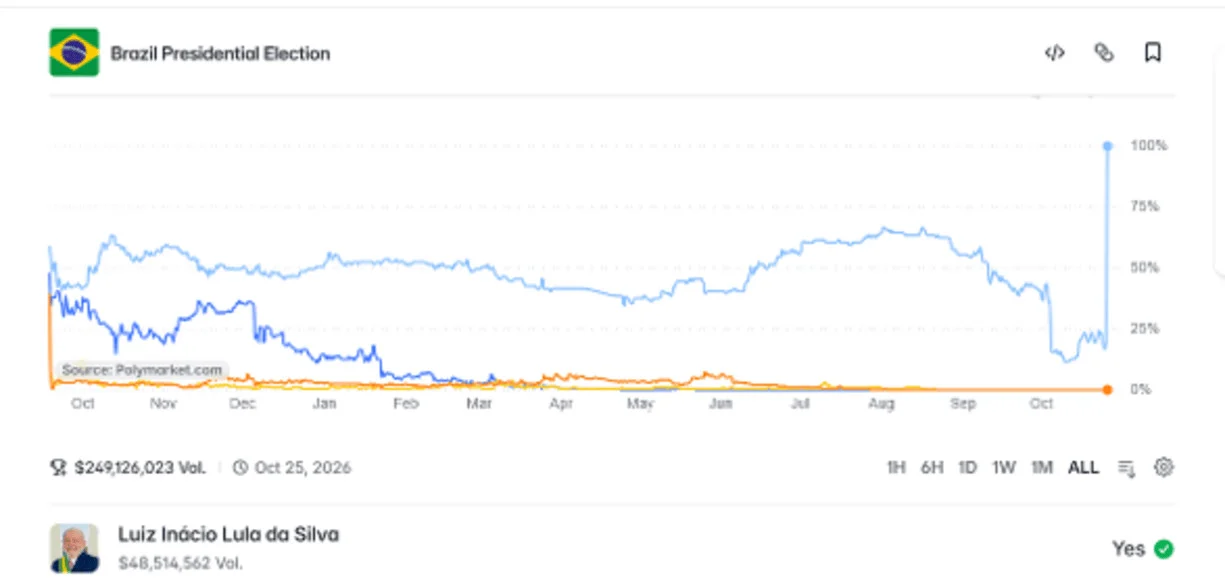
This weekend, Luiz Inácio Lula da Silva secured a surprising win in Brazil's presidential election, defeating Flávio Bolsonaro thanks to significant backing from working-class suburban voters. Lula’s triumph marks the first time since 1989 that a candidate has won after finishing second in the initial round of voting. Following Bolsonaro's strong performance—securing about 47% of the vote in the October 4 first round—Lula’s chances seemed slim, causing his odds on the prediction market Polymarket to drop to just 13.5%.
However, in the days leading up to the election, Lula saw a modest increase in his odds. Some savvy traders on Polymarket recognized the mistake, with one netting a profit of $47,595. Conversely, another trader known as "timetowander" faced a significant loss of around $27,100. This unexpected turn of events highlights a notable instance of mispricing in prediction markets ahead of a major election.
Despite the shocking nature of Lula's victory, experts caution against hastily dismissing prediction markets as flawed based solely on this outcome. With U.S. midterm elections approaching—described by Kalshi's Tarek Mansour as "the first prediction market election"—there is still much to evaluate regarding predictive accuracy. David Lawant, an analyst at Anchorage Digital, pointed out on X that the public may be misinterpreting how prediction markets functioned during this pivotal election.
"Despite dramatic late twists and turns, they repriced to the new reality ahead of the expert consensus," he wrote. "Prediction markets reflect real-time consensus; how you use that data for future predictions is your responsibility."
The concept of prediction markets has been around for decades, gaining momentum particularly during the lead-up to the 2024 U.S. presidential election. Kalshi landed a significant court ruling allowing it to offer various Congressional Control contracts, greatly enriching the trading landscape. On election night, Kalshi reported millions in trading volume, with several trades surpassing seven figures concerning President Donald Trump.
While traditional media outlets forecasted a close race, Polymarket estimated Trump had almost a 58% chance of winning against Kamala Harris—an assessment that Polymarket CEO Shayne Coplan later called "gratifying," stating it enhanced the credibility of prediction markets.
However, many instances over the past two years suggest that predictions can diverge widely from actual results. The New York City mayoral primary last year saw former Governor Andrew Cuomo's likelihood soar to 93% weeks before the event, yet he lost to Zohran Mamdani, who triumphed with 56.4% in the ranked-choice final round. Similarly, prediction markets did not accurately reflect the sentiment in Michigan or Wisconsin during recent primaries.
A previous election in the Netherlands also revealed flaws, as the D66 party led by Rob Jetten unexpectedly outperformed against Geert Wilders, significantly shifting market odds after exit polls were released.
Social media reactions flooded in after Brazil's results, with Nic Carter noting that prediction markets should incentivize diligent research into alternative data. Prior to the election, three major polls—including one from Datafolha—predicted a Bolsonaro victory, highlighting a disconnect in expectations.
Bruno Centurion, a political analyst, mentioned that Brazil's prediction markets are relatively underdeveloped, suggesting that much of the prediction focus resides within financial markets, which may have contributed to a misreading of voter intent. He precisely anticipated Lula’s upset.
Following the election, Wallerstein, a former White House aide, asserted on X that the Brazilian election seemed to prove that prediction markets merely reflect polls, which are becoming less reliable. He postulated that the odds are less about predicting outcomes and more about speculative opportunities.
Understanding the role of prediction markets is essential, as they are not designed to declare what the outcome should be, according to Smarkets CEO Jason Trost. He explained that odds are essentially real-time price assessments; Lula had about a 20% chance of winning when polls closed despite having trailed slightly with 51%-49% margins.
In the aftermath, Brazilian futures dropped 11% on Monday, erasing nearly all gains for the year. Wallerstein anticipates further surprises in the upcoming U.S. midterms, while a discussion at the Next Predicts conference underscored the risks retail traders might face by neglecting late-reporting nuances. Columbia University professor Rajiv Sethi noted that prediction markets tend to outperform models in some contests, particularly those for down-ballots in House races.
Sam Henry Lazarus from the Council on Foreign Relations pointed out that the discrepancy in predictions often stems from the public's misunderstanding of probability. He emphasized that a market probability of 80% illustrates a 20% likelihood of an event not happening, making it clear that misjudgment is rooted in a lack of statistical literacy.
POPVOX co-founder Marci Harris observed the market shifts during the Brazilian election and appreciated the unpredictability inherent in democratic choices. As U.S. voters gear up for the midterms on November 3, prediction market activity is anticipated to exceed $1 billion, indicating that even seasoned analysts may misread electoral outcomes.
This election has reiterated that human unpredictability can sometimes render algorithmic forecasting ineffective, revealing deeper complexities in electoral predictions.

