
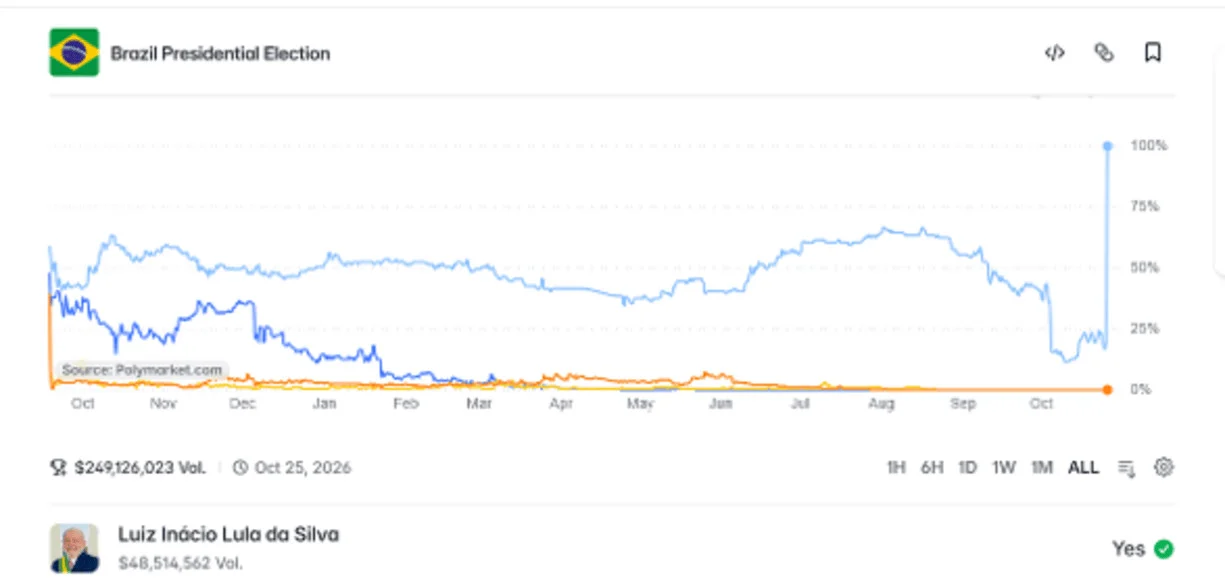
This past weekend, Luiz Inácio Lula da Silva, the incumbent President of Brazil, secured a surprising victory against Flávio Bolsonaro in the national presidential election, buoyed by strong support from working-class suburban voters. Lula accomplished a feat not seen since 1989, becoming the first candidate to win after finishing second in the initial round of voting. The odds of his victory appeared bleak after Bolsonaro led the first ballot on October 4 with roughly 47% of the vote, which led to Lula's odds plummeting to 13.5% on Polymarket immediately afterward.
As election day approached, Lula saw a modest recovery in his odds, with some traders on Polymarket profiting as they recognized the undervaluation. One trader earned $47,595 from the bet while another, known as "timetowander," faced a loss of about $27,100. This outcome is highlighted as a significant instance of mispricing in prediction markets ahead of a key global election.
However, experts caution against assuming that this result signals a systemic issue with prediction market accuracy. Lula’s win comes right before the U.S. midterms, which Tarek Mansour of Kalshi calls "truly the first prediction market election." David Lawant from Anchorage Digital remarked that many misinterpreted the predictive capabilities of these markets based on the events in Brazil, asserting that prediction markets adapted to late-breaking news sooner than traditional expert analyses.
While prediction markets have existed for decades, their influence surged during the campaigning for the 2024 U.S. presidential election. Recently, Kalshi achieved a legal victory allowing a range of prediction contracts, enabling millions in trade volume during election night, including several trades exceeding seven figures on Donald Trump after 10 PM ET. During this period, combined trading engagement on Kalshi and Polymarket crossed $4.2 billion, as reported by the Pew Research Center.
While many U.S. media outlets projected a tight race toward election night, Polymarket suggested Trump’s odds of winning surpassed 58%. Shayne Coplan, CEO of Polymarket, later expressed satisfaction with their forecast, claiming it enhanced the credibility of prediction markets.
Despite these notions of success, there have been notable deviations in predictions in various elections. A stark example was last year’s New York City mayoral primary when former Governor Andrew Cuomo held a 93% probability of victory weeks prior to the primary. As voting concluded on primary night, prediction markets suggested a 57% likelihood for Cuomo, yet he suffered a significant defeat to Zohran Mamdani, who garnered 56.4% in the final ranked-choice vote.
In recent primary contests in Michigan and Wisconsin, prediction markets similarly failed to align with actual results. In Wisconsin, an underdog candidate prevailed despite trailing by over 20% in pre-election polling.
Similar discrepancies appeared internationally, as evidenced during the Netherlands elections last October, where the centrist D66 party won against Geert Wilders’ far-right party despite predictions to the contrary. After exit polls were released, the odds for D66 surged from around 5% to nearly certain.
Social media has ignited discussion among analysts regarding these surprising outcomes. Nic Carter, a prominent figure with a wide following, remarked that prediction markets are designed to incentivize investments in alternative data to generate more accurate odds.
Prior to the Brazilian election, multiple major polls predicted a win for Bolsonaro, including a two-point advantage forecasted by Datafolha.
Yet, factors like the nascent state of prediction markets in Brazil could indicate that the result may not represent a larger trend. Bruno Centurion of Fatto Inteligência Política observed that the primary interest in forecasting the election was among financial markets, which at times reflected "wishful thinking" based on initial outcomes, although he successfully predicted Lula's victory.
Following the election, Wallerstein, a former White House advisor, noted on social media that Brazilian futures dropped 11% on Monday, indicating the aftermath of Lula's win. He anticipates more surprises in the upcoming U.S. midterms and emphasizes the need for retail traders to heed the intricacies of late vote counting.
During the Next Predicts conference panel moderated by Chuck Todd, insights gathered suggested that while prediction markets often outperform traditional polling, they can also be incorrect. Rajiv Sethi, an economics professor, acknowledged that prediction markets provided clearer insight into presidential outcomes while showing promise in capturing the results in House races as well.
Sam Henry Lazarus of the Council on Foreign Relations articulated that the results in Brazil accentuate a misunderstanding of statistical probabilities linked to prediction markets. He explained that while a contract showing an 80% chance of occurrence should statistically happen as expected over time, it does not guarantee success each time an event takes place—a crucial takeaway from both domestic and international election results.
Marci Harris from POPVOX noted the beauty of democratic unpredictability had a profound impact on her understanding of human behavior, predicting that election activity for the U.S. midterms may surpass $1 billion, as even seasoned political analysts may misjudge outcomes.
As U.S. voters prepare for the ballot on November 3, the Brazilian election outcome serves as a significant reflection on the predictive limitations, not only within prediction markets but also in broader public perception of electoral forecasts.

