
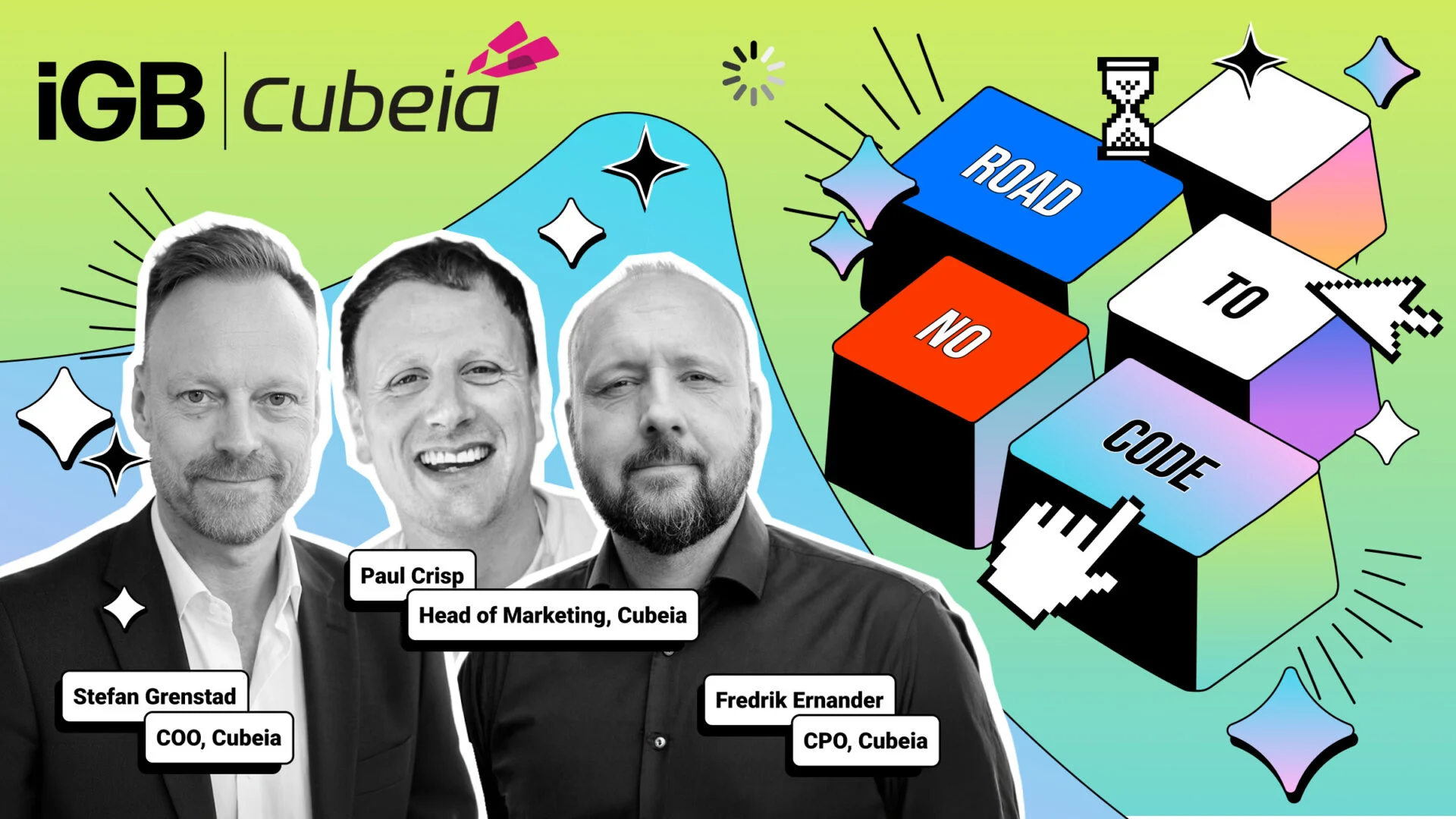
Cubeia, a Swedish software company, is advancing through its third phase of AI-assisted development by transitioning from a freeform adoption of AI tools to implementing a structured AI-driven development process. This shift raises a fundamental question: what will the organization look like when coding is no longer its main limiting factor?
"We’re doing this 100%,” stated Stefan Grenstad, COO of Cubeia, in reference to their transition to an AI-driven development model.
The focus has now shifted to how Cubeia can leverage the additional capacity created by AI. Six months prior, the company was primarily focused on substituting human-generated code with AI-generated alternatives. Now, it has evolved into a comprehensive redesign of its development pipeline, necessitating a new approach to team organization and quality assurance (QA), as well as fostering a different relationship with customers.
In its initial phase, Cubeia maintained an open policy towards AI usage, allowing developers to utilize AI as they saw fit. The second phase imposed structure, ensuring all team members worked with the same AI agents within a unified pipeline. This transition required resolving issues relating to quality and reliability and introducing employees to this new workflow. Grenstad believes that this groundwork has been effectively laid.
He noted, "During the hybrid period in Q1, Cubeia solved 259 issues. Once it moved to the AI-driven process, that figure rose to 421 – a 62% increase. Larger projects increased from 17 to 58. So the answer is yes: moving to AI-driven development has increased our output tremendously.”
However, the more pressing question is how Cubeia will utilize this newfound capacity. “Because we’re not spending as much time coding, we’re spending more time on the business: talking about value and understanding the domain,” Grenstad explained.
Instead of merely responding to requests, teams are now expected to grasp the rationale behind their projects and the value they aim to deliver. Paul Crisp, Cubeia’s head of marketing, elaborated on this point, expressing, “If the objective is 10% more traffic, for example, how do we measure it? We need to establish a baseline, implement the change, measure it and see whether it goes up by 10%. If it only goes up by 1%, maybe we need another iteration because we haven't fulfilled the objective.”
The driving force behind future developments is increasingly the customers themselves, as Grenstad noted. The company has started to ask, “What does this mean for the customer? What can the customer actually do with this?” Recently, some customers approached Cubeia with requests, such as allowing their AI agents to interact with Cubeia’s data streams and integrate with its platform.
Grenstad cited an example where a client developed its own casino landing page, intending to utilize Cubeia’s APIs for platform compatibility. Another customer sought to manipulate Cubeia’s player account management system to create personalized features. “The concept isn’t just about Cubeia providing another AI tool,” he remarked, “but about making our platform and data accessible to AI infrastructures that our customers are developing themselves.” Currently, Cubeia is piloting a project based on the landing page scenario.
This shift toward customer-driven development was not on the immediate horizon just six months ago, but Grenstad now believes it is essential for Cubeia to enable customers to build their products using their AI tools. “We’ve realized we’re going to be part of it,” he concluded.
As the company’s capacity increases, so does the need to reimagine its development team setup. Cubeia is exploring the creation of rapid-response teams that focus on smaller client demands while maintaining separate teams for larger projects and long-term goals. Currently, these teams consist of five to eight members, but Grenstad envisions them growing smaller.
“In my dream, it would be two- or three-person teams,” he commented. Developers will have the opportunity to shift between rapid-response and long-term projects based on their interests and strengths. However, despite increased capacity, Cubeia has not completely eradicated bottlenecks. With AI agents generating multiple workstreams simultaneously, the challenge now lies in determining how much work individual team members can efficiently handle and review.
“The bottleneck becomes the person reviewing everything. That does not mean we never review the code itself,” Grenstad added. While code review remains crucial, particularly for sensitive or critical systems, it is no longer uniformly applied across all outputs. Grenstad also acknowledged that this transition influences recruitment strategies. For roles focused on the player journey, expertise in casinos and iGaming is increasingly prioritized over conventional programming skills. “I would not necessarily prioritize senior Java or front-end specialists in the same way as before,” he explained.
This raises questions about the future of incoming developers in the industry. If traditional entry-level positions for Java developers diminish, the typical progression from junior programmer to senior engineer becomes less defined.
“How do we avoid ending up with lots of old Java developers and nobody who understands Java because the juniors were never hired? That’s a super-interesting question. How do we fill up with younger people over time? That’s something we’ve been discussing,” Grenstad remarked.
Cubeia is also shifting away from the long-standing model in which a developer completes a project and subsequently hands it to QA. Grenstad explained the prior approach: product owners decided what to build and how, QA then tested the product, and finally, operations released it.
As previously mentioned, QA has transitioned into an integrated aspect of development rather than a concluding phase. Product engineers now contemplate the automation possibilities during the planning stage, while QA specialists work to enhance automation and pinpoint gaps. The responsibility now includes everything from problem identification to construction, release, and evaluation.
Though Cubeia’s transformation does not eliminate all concerns, some developers find it difficult to adjust to these changes. “We still have people who loved the coding part – solving problems with code and writing beautiful code. They’re struggling with the change. For some, an important aspect of their work that they genuinely enjoyed is now gone,” Grenstad stated.
Concerns surrounding reliance on AI providers also persist, particularly as Cubeia currently leverages Claude for its operations. Grenstad expressed apprehension about possible price hikes or quality changes from AI providers. Nevertheless, he views this uncertainty as manageable. “We’re confident that the question marks will be solved as we work through them. We’ll see the problems, learn how to manage them, and adapt.”
When Cubeia embarked on its journey toward AI-assisted development, the goal was straightforward: eliminate coding as a constraint in software development. However, in pursuing this, the company learned that coding was merely one limitation within a much larger framework. As each bottleneck shifts, so too do the organizational demands, now focusing on domain knowledge, product insight, quality assurance, prioritization, and understanding customer needs. Thus, the technology itself has gradually become less central to their narrative. What Cubeia chooses to do with this technology moving forward is now of primary importance.

