
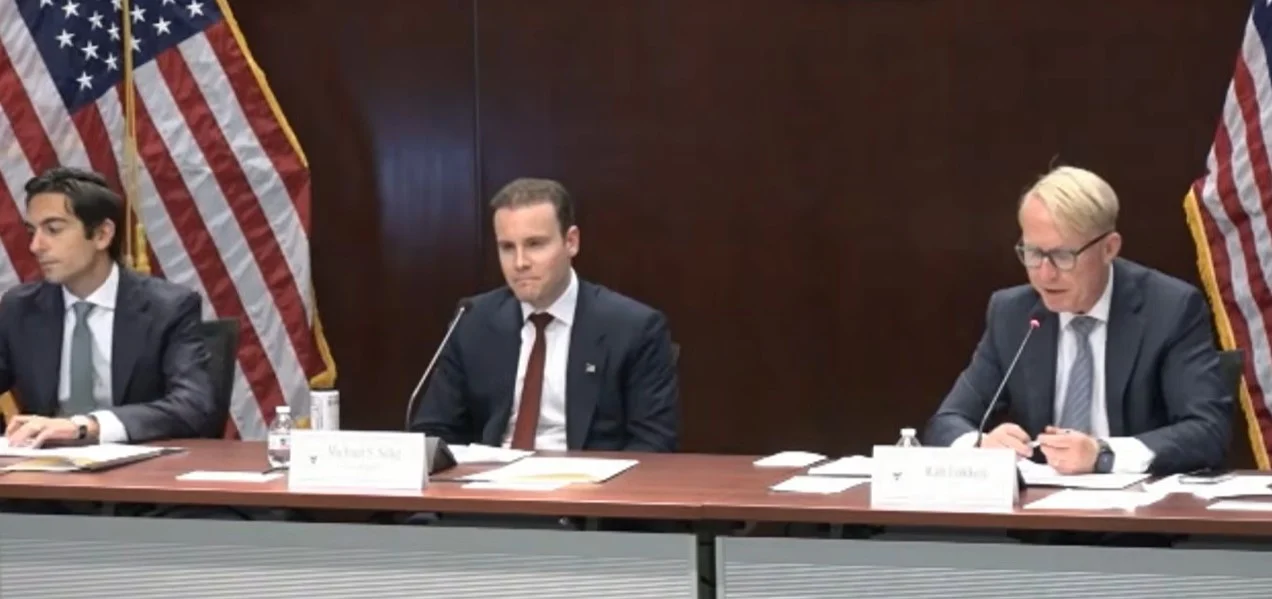
At a prominent conference in Washington, D.C., on Thursday, top executives from the derivatives market gathered to witness a heated debate as the U.S. Commodity Futures Trading Commission (CFTC) tackled regulations on sports event contracts. This inaugural advisory committee meeting featured notable figures including Vlad Tenev, CEO of Robinhood, and Tyler Winklevoss, co-founder of Gemini, alongside prominent sports betting leaders like Jason Robins, Matt King, and Christian Genetski.
The session began with several hours devoted to topics in crypto asset management and agentic finance. However, tensions escalated quickly during a discussion on prediction markets. CME Group CEO Terrence Duffy sparked a contentious back-and-forth with CFTC Chairman Michael Selig, following Duffy's remarks on market manipulation risks associated with certain contracts.
Duffy raised concerns that some derivatives products, particularly a contract regarding the ousting of Venezuelan President Nicolás Maduro and another linked to a former teleprompter operator for President Donald Trump, could undermine market integrity. He emphasized these contracts violate CFTC’s Core Principle 3, which stipulates that Designated Contract Markets should not list products vulnerable to manipulation.
In defense, Selig noted that these products are traded offshore, not in the U.S., underscoring the challenges ahead for effective regulation. As the meeting continued without a planned follow-up, uncertainties lingered about any substantive outcomes regarding the rulemaking process.
One touchpoint of interest was related to the teleprompter operator, Gabriel Perez, who is reportedly facing scrutiny for allegedly trading on insider information linked to Trump’s remarks. These transactions reportedly exceeded $100,000 and caught the attention of Kalshi’s surveillance team, which alerted the CFTC about potential irregularities. Luana Lopes Lara, co-founder of Kalshi, represented the firm at the meeting in place of CEO Tarek Mansour.
Selig made an error during the discussion by stating that trades had been made outside the U.S., though he correctly identified that the Maduro contract was on an offshore platform. U.S. special forces soldier Gannon Van Dyke is currently facing criminal charges for using classified intel to make trades regarding a Maduro operation.
In addition to the Maduro case, Duffy criticized other self-certified contracts that he felt were vulnerable to manipulation. While he refrained from naming specific sports-related trades, he cautioned against eroding industry standards that might drive participants away from regulated markets. "We are not a bunch of carnival barkers at a circus," Duffy declared. "We are running the most envious markets in the world."
Selig responded by outlining various strategies to create a clear roadmap for prediction markets. Proposed amendments to Rule 40.11 would empower the CFTC to assess whether contracts focused on issues like war or terrorism align with public interest. Furthermore, he mentioned potential guidelines for product governance and market design.
The conference also saw Duffy question the CFTC's rationale for permitting Kalshi to offer "compute contracts"—binary contracts based on AI processing unit prices—while CME's application for similar derivatives remains under review. In a pointed exchange, Lara challenged Duffy on whether the CME had dealt with instances of manipulation, to which he retorted that CME's regulatory staff is larger than Kalshi's total workforce, prompting her to jab back about efficiency.
Amidst the clashes, DraftKings CEO Jason Robins attempted to foster collaboration, urging fellow executives to avoid infighting that could hinder constructive discussions. Despite the potential for conflict, Robins and his counterparts did not engage deeply with regulatory issues like market-making rules or federal preemption. King emphasized the need for a principle-based framework focused on consumer protection, while Genetski highlighted the importance of building consumer trust in predictive models.
As the meeting concluded, Selig did not provide answers about future sessions or the timing of final regulations regarding sports event contracts ahead of the football season. He expressed optimism, indicating that prediction markets, along with AI and blockchain technology, will play significant roles in shaping the future of financial markets. "We’ve crossed the Rubicon and are standing at a new frontier of finance," Selig stated.

