
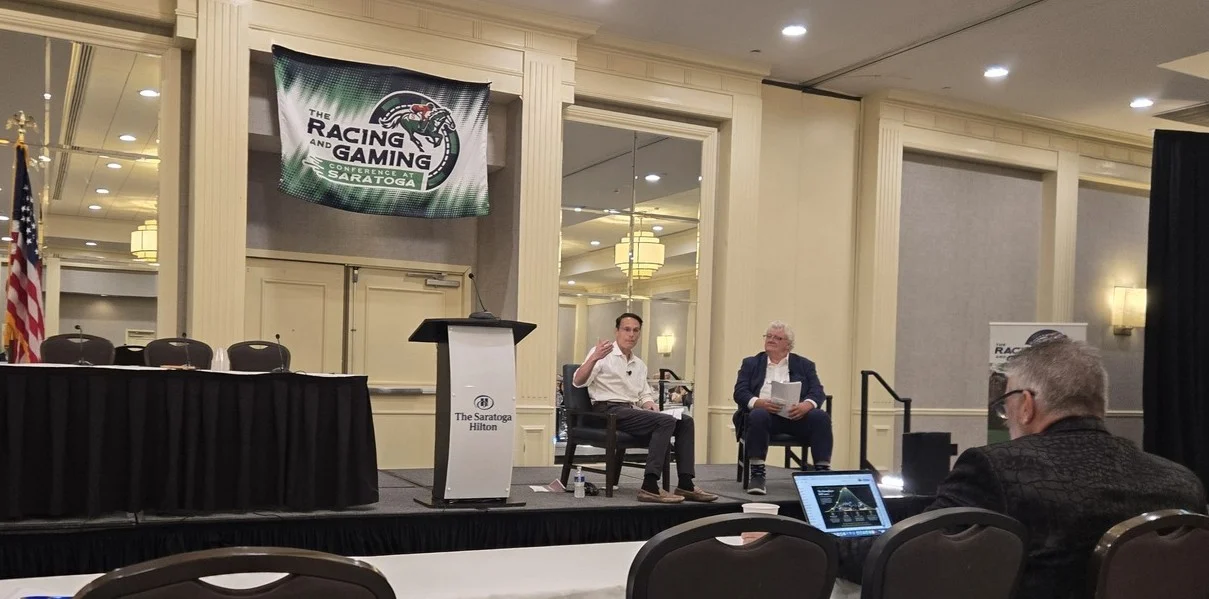
Steve Kornacki worked late into the night on Primary Night this week as an unexpected result in Wisconsin’s gubernatorial primary kept him on a livestream past 1 a.m. Despite getting fewer than four hours of sleep, Kornacki, NBC News’ chief data analyst, flew to upstate New York in time for a 9 a.m. keynote at The Racing and Gaming Conference in Saratoga. He delivered an engaging presentation covering pressing issues like ownership concentration in racing and a steady decline in foal populations, alongside the waning television ratings for the Triple Crown.
The drop in viewership and racing handle is concerning, with Kornacki revealing that annual wagering in the U.S. has fallen from approximately $15 billion in 2003 to about $11.8 billion last year. He highlighted the viewership figures from the previous year's Breeders' Cup World Championships, which offered a total purse of $34 million across 14 Grade I stakes. The event, held on November 1, saw a significant decline in viewers, down from 4.3 million at its inception in 1984 to below 1 million last year on Day 2.
Kornacki suggested that rising college football popularity might be a factor in diminishing racing viewership, noting that at least eight college football games performed better in ratings, including a game between Oregon State and Washington State, despite the teams finishing the season with a combined record of 9-16.
Although Kornacki did not offer specific solutions to improve Breeders' Cup ratings, he floated the idea of scheduling the championship during a time with fewer college football games, potentially moving it to a midweek date when the NFL and most college teams are off. Meanwhile, the Triple Crown has mostly avoided these declines, with this year's Kentucky Derby achieving record ratings, peaking at 24.4 million viewers. Despite only three Derby entrants competing in the Preakness, Kornacki noted that it still attracted an audience of 6 million, albeit labeled a low-key event.
In early August, Maryland Governor Wes Moore announced a schedule change, moving The Preakness back eight days in 2027 to encourage more Kentucky Derby entries due to the extended break. The newly established Thoroughbred Championship Series will include the Kentucky Derby and Belmont Stakes but will not feature The Preakness. Kornacki and NYRA executive Andrew Offerman did not comment on the series during Wednesday's discussion.
Kornacki advocated for expanded wagering options as a means to attract Millennials to the racetrack, comparing potential betting on trainer wins to prop bets common in other sports. He expressed confidence that offering such options could engage the same bettor demographic.
The conference also saw discussions on New York Attorney General Letitia James’ significant lawsuit against Kalshi, announced on July 31, which alleges the company is conducting illegal gambling activities in the state. The suit defines Kalshi’s event contracts as a form of wagering, prompting discussions about regulatory rights over prediction markets. Carrie Woerner, chair of the New York State Assembly Committee on Racing and Wagering, emphasized the need for states to regulate these markets in light of ongoing litigation with the Commodity Futures Trading Commission.
Governor Kathy Hochul and attorney general James garnered support for their regulatory stance, with Chair Brian O'Dwyer of the New York State Gaming Commission expressing confidence that state interests would prevail if the case reaches the Supreme Court.
Additionally, a betting investigation by the Horseracing Integrity and Safety Authority was launched this week concerning Fair Hill Training Facility horses that won multiple races despite long layoffs. Trainer Angel Quiroz was noted for his connection to the horses involved in the recent races at Monmouth Park and Saratoga.
Quiroz faced a charge from the Horseracing Integrity and Welfare Unit for violating substance regulations due to a positive test involving a horse trained by him. While addressing the situation, Quiroz appeared to downplay the allegations and question the scrutiny his group has received. He pointed out the prior performance limitations of the winning horses, asserting that they should not be penalized for finally achieving success.

