
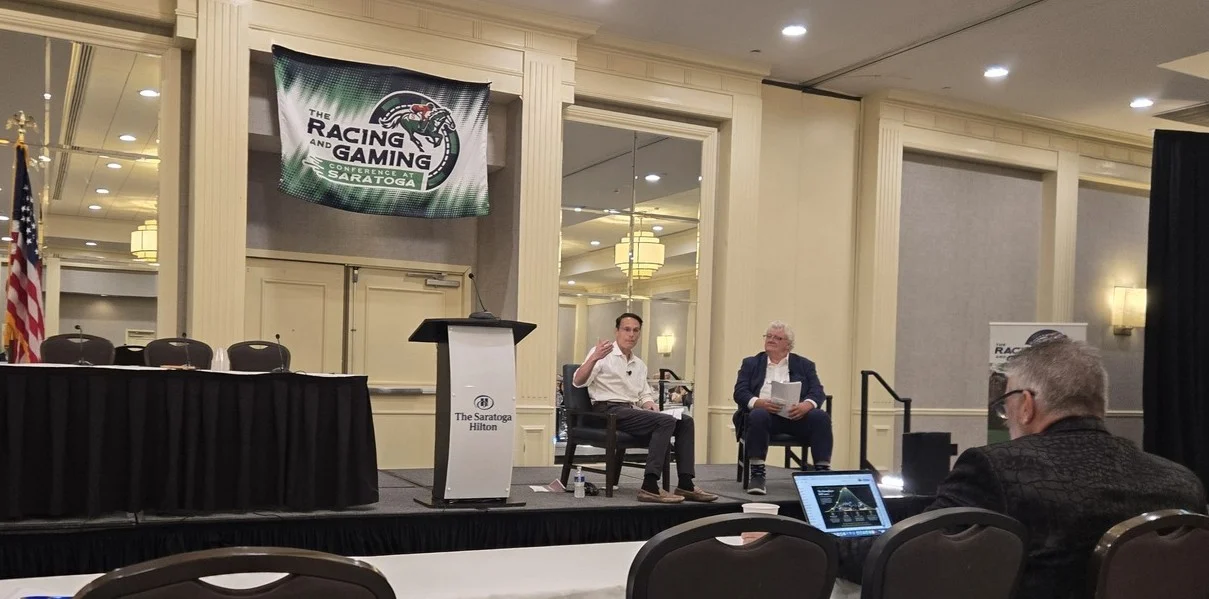
Steve Kornacki, chief data analyst at NBC News, worked late into Primary Night recently, covering unexpected results in the Wisconsin gubernatorial primary that kept him streaming online past 1 a.m. After barely four hours of rest, he boarded a flight to Upstate New York and arrived for his 9 a.m. keynote speech at The Racing and Gaming Conference in Saratoga. Kornacki captivated the audience with his insights on critical issues, including rising ownership concentration in major races, the worrisome decline in foal populations, and troubling television ratings for the Triple Crown. His presentation was a striking example of dedication and professionalism.
The significant drop in both television viewership and racing handle is a pressing concern in the industry. Kornacki highlighted that the annual handle in the U.S. has plummeted from approximately $15 billion in 2003 to about $11.8 billion in 2022. This trend extends beyond the Triple Crown, as demonstrated by the viewership statistics for last year's Breeders' Cup World Championships. This prestigious event featured a total purse of $34 million over 14 Grade I stakes, yet saw its average viewership fall under 1 million on the second day, compared to nearly 4.3 million viewers during its inaugural edition in 1984. The most significant race, the $7 million Classic, concluded on November 1, with Forever Young claiming victory.
Kornacki proposed that the increasing popularity of college football might be impacting horse racing viewership. Data showed that at least eight college football games attracted higher ratings, including a match between Oregon State and Washington State, two teams that finished the season with a combined record of 9-16.
While Kornacki did not offer specific solutions for improving Breeders' Cup ratings, he suggested potential adjustments to the event's scheduling to avoid clashes with college football games. Traditionally, the Army-Navy game on the second Saturday of December is the only major contest that weekend, following the conference title games. Another option could be to move the Breeders' Cup to a weekday when both NFL and college football are not in action.
In contrast, the Triple Crown remains relatively insulated from the drop in viewership. The Kentucky Derby in May achieved record ratings, reaching a peak of 24.4 million viewers. Notably, only three entrants from the Derby participated in the Preakness, which still managed to attract 6 million viewers, despite being described as a low-profile event.
In a recent announcement, Maryland Governor Wes Moore revealed plans to shift the Preakness Stakes back eight days in 2027, intending to encourage more Kentucky Derby participants through a longer interval between the races. The newly established Thoroughbred Championship Series, which includes the Kentucky Derby and Belmont Stakes but excludes the Preakness, aims to streamline racing for three-year-olds. However, neither Kornacki nor NYRA executive Andrew Offerman addressed this series during the conference.
Kornacki also advocated for expanded wagering options to appeal to younger bettors. He pointed out that on August 1, noted trainer Todd Pletcher won five races at Saratoga, culminating with Renegade's victory in the Jim Dandy. Currently, parimutuel tracks do not permit prop bets related to trainer performances, which Kornacki compared to prop bets in football regarding player statistics, emphasizing that fostering such wagers could attract a new generation of gamblers.
The conference also spotlighted a significant legal matter as New York Attorney General Letitia James' suit against prediction market Kalshi garnered attention. Announced on July 31, the $36 billion lawsuit alleges that Kalshi is conducting illegal gambling, as the state's definition of gambling applies to the uncertain outcomes of its event contracts.
During the conference, key New York officials voiced their support for James' lawsuit. Carrie Woerner, Chair of the New York State Assembly Committee on Racing and Wagering, remarked on the urgency for states to maintain regulatory authority over prediction markets. Many states are currently in litigation with the U.S. Commodity Futures Trading Commission regarding federal oversight of this asset class. An 11 August statement from the CFTC indicated that Kalshi must continue operations under the Commodity Exchange Act in New York.
New York State Senator Joseph Addabbo mentioned previously that he would explore regulating and taxing prediction market operators, but it remains unclear if he has shifted his stance following the lawsuit.
New York State Gaming Commission Chair Brian O'Dwyer echoed support for Attorney General James, particularly given Kalshi's current valuation estimates reaching $44 billion. He also recognized the efforts of Governor Hochul in addressing underage betting, as most prediction markets permit participation from individuals aged 18 and older. O'Dwyer expressed belief that the Supreme Court will ultimately side with the states in this case.
Meanwhile, a racing betting investigation was initiated by the Horseracing Integrity and Safety Authority following an incident involving horses from the Fair Hill Training Facility in Maryland last weekend. A group of these horses won four races at northeastern tracks, including Saratoga, after extended layoffs and with unanticipated odds. The investigation focuses on trainer Angel Quiroz and the performance of horses he trained, which yielded significant losses for various UK bookmakers, initially estimated between £600,000 and £800,000.
Additionally, the Horseracing Integrity and Welfare Unit charged Quiroz with a substance violation concerning a July 10 positive test for albuterol in Bonita Rough, a filly which raced at Gulfstream Park. Quiroz declined the opportunity for the analysis of a B sample. Testing results for the five Fair Hill horses that raced last weekend are pending, with standard turnaround times for such tests reported at around 10 business days.
Despite the allegations related to the Fair Hill situation, Quiroz defended his horses, asserting that most had performed poorly in previous races. Competition results indicated that The Great Amira, initially a longshot at odds of 17/1, won decisively after finishing last in prior starts. Classic Rock, victorious at Saratoga with odds of 8/1, also showed a notable improvement in performance. Quiroz expressed his confusion over the controversy, questioning the concerns surrounding his race strategies.

