
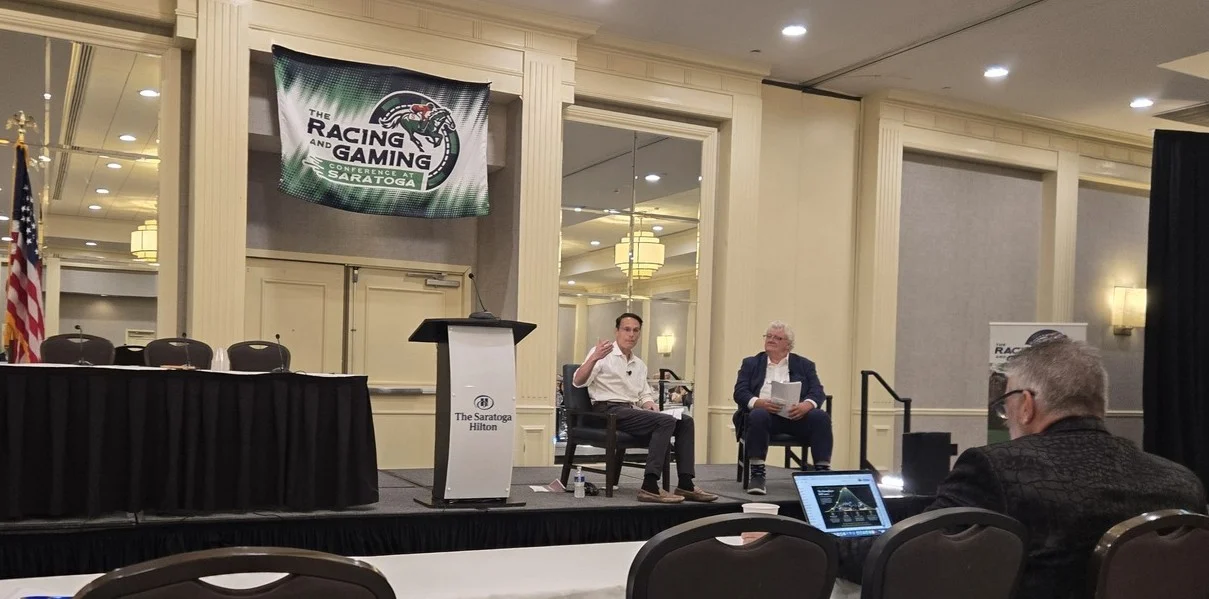
Steve Kornacki, NBC News' chief data analyst, pushed through the early hours of Primary Night recently, staying on a livestream past 1 a.m. due to an unexpected outcome in Wisconsin's gubernatorial primary. After just under four hours of sleep, he boarded a flight to upstate New York, arriving in time for his 9 a.m. keynote address at The Racing and Gaming Conference in Saratoga. Kornacki delivered a compelling presentation, addressing critical issues such as ownership concentration in horse racing, the decreasing foal populations, and troubling television ratings for the Triple Crown events.
During his talk, Kornacki highlighted significant declines in television viewership and racing handle, noting that the annual handle in the U.S. fell from about $15 billion in 2003 to approximately $11.8 billion last year. Equally concerning was the drop in viewers for non-Triple Crown races.
He cited the Breeders’ Cup World Championships from the previous year, which featured a substantial combined purse of $34 million across 14 Grade I stakes. Concluded on November 1, the event saw Forever Young win the $7 million Classic. In 1984, the inaugural Breeders' Cup attracted an estimated 4.3 million viewers, but last year’s viewership averaged below 1 million on Day 2 of the event.
Kornacki suggested that the growing popularity of college football might be impacting racing viewership, citing that at least eight college games recorded higher ratings, including a matchup between Oregon State and Washington State, despite the teams ending the season with a 9-16 record combined.
While Kornacki did not offer concrete solutions for increasing Breeders' Cup ratings, some informal suggestions included rescheduling the championships to avoid conflict with college football games. The Breeders’ Cup could be moved to a more favorable date, particularly when fewer college games are scheduled, like the second Saturday of December, traditionally reserved for the Army-Navy game. Another consideration was hosting the event midweek when the NFL and most college teams are off.
Contrasting with the declining ratings in other racing events, the Triple Crown has largely maintained its audience. NBC data indicated that this year’s Kentucky Derby achieved record ratings, peaking at 24.4 million viewers. Kornacki noted that only three Derby entrants, none of whom finished in the Top 3, participated in the Preakness. Despite this, the Preakness managed to garner an audience of 6 million viewers.
In a recent announcement, Maryland Governor Wes Moore stated that the Preakness would be moved back by eight days in 2027. This adjustment aims to entice more Kentucky Derby horses to compete by allowing for a longer layover. Moreover, the newly introduced Thoroughbred Championship Series includes the Kentucky Derby and Belmont Stakes but excludes the Preakness, a topic that neither Kornacki nor NYRA executive Andrew Offerman addressed during the conference.
Kornacki advocates for expanding wagering options to draw in more Millennials. Notably, on August 1, trainer Todd Pletcher celebrated a remarkable day at Saratoga with five race wins, capped by Renegade's victory in the Jim Dandy. However, parimutuel tracks still do not offer wagering options on trainer wins for a particular day. Kornacki compared these types of bets to prop bets found in other sports, such as whether a quarterback will achieve over 300 passing yards in a game.
"If we can create prop bets and parlays, we can attract the same bettors," he noted.
The conference also featured discussions surrounding New York Attorney General Letitia James' recent lawsuit against Kalshi, which has made headlines due to its significant implications for prediction markets. On July 31, James and New York Governor Kathy Hochul announced a $36 billion suit against Kalshi, accusing it of illegal gambling due to the uncertain outcomes of its event contracts.
During the conference, Carrie Woerner, chair of the New York State Assembly Committee on Racing and Wagering, emphasized the necessity for states to assert regulatory controls over prediction markets. Multiple states are currently embroiled in litigation with the U.S. Commodity Futures Trading Commission regarding the regulation of this asset class, which is at the heart of the ongoing legal debates.
In a related context, New York State Senator Joseph Addabbo previously indicated a willingness to explore regulatory and taxation solutions for prediction market operators, though it's uncertain if his stance has changed following the recent lawsuit.
On the second day of the conference, Brian O’Dwyer, chair of the New York State Gaming Commission, praised James for her lawsuit against Kalshi, highlighting the sizable valuation the company seeks at $44 billion. He pointed out that Polymarket, another leading prediction market, is also seeking financing that could value it at around $20 billion. O'Dwyer expressed hope that the upcoming Supreme Court case on sports event contracts would confirm states' rights to regulate these markets.
O'Dwyer expressed concerns about minors engaging with prediction markets, bringing up prior issues with illegal sportsbooks that targeted underage bettors before the passing of PASPA. "The answer is not in replacing criminal thuggery with corporate avarice and greed," he remarked.
Another topic of discussion was an ongoing investigation by the Horseracing Integrity and Safety Authority into betting irregularities involving horses trained at Fair Hill Training Facility in Maryland. A group of horses shipped from Fair Hill achieved four wins at various northeast tracks, including Saratoga, despite many having long layoffs before competing.
Trainer Angel Quiroz, linked to this group of horses including The Great Amira and Tepeyac, garnered attention after both won races at Monmouth Park, inciting concerns among bookmakers, particularly in the UK, who suffered reported losses estimated between £600,000 and £800,000. Another horse, Scootaloo, finished fourth in a Saratoga race, stumbling out of the gate initially.
Pat Cummings, executive director of the National Thoroughbred Alliance, remarked on the unusual situation of hearing more from UK bookmakers than from U.S. betting representatives regarding the outcomes from these events.
On Thursday, the Horseracing Integrity and Welfare Unit charged Quiroz with a substance violation linked to a positive test from a race on July 10 involving Bonita Rough. This 4-year-old filly tested positive for albuterol, a substance prohibited for use in horses. Quiroz opted not to have a B sample analyzed. Post-race test results for the five Fair Hill horses from their recent races are still pending, with the typical wait for such results being around 10 business days.
Quiroz downplayed concerns regarding the performances of his horses at the Fair Hill facility, noting that many had not been competitive in previous races. He cited the surprise of the horses’ performances, particularly highlighting The Great Amira’s victory by 9 1/2 lengths as a significant turnaround. His other horse, Classic Rock, also triumphantly added to the day's successes, winning at Saratoga.

