
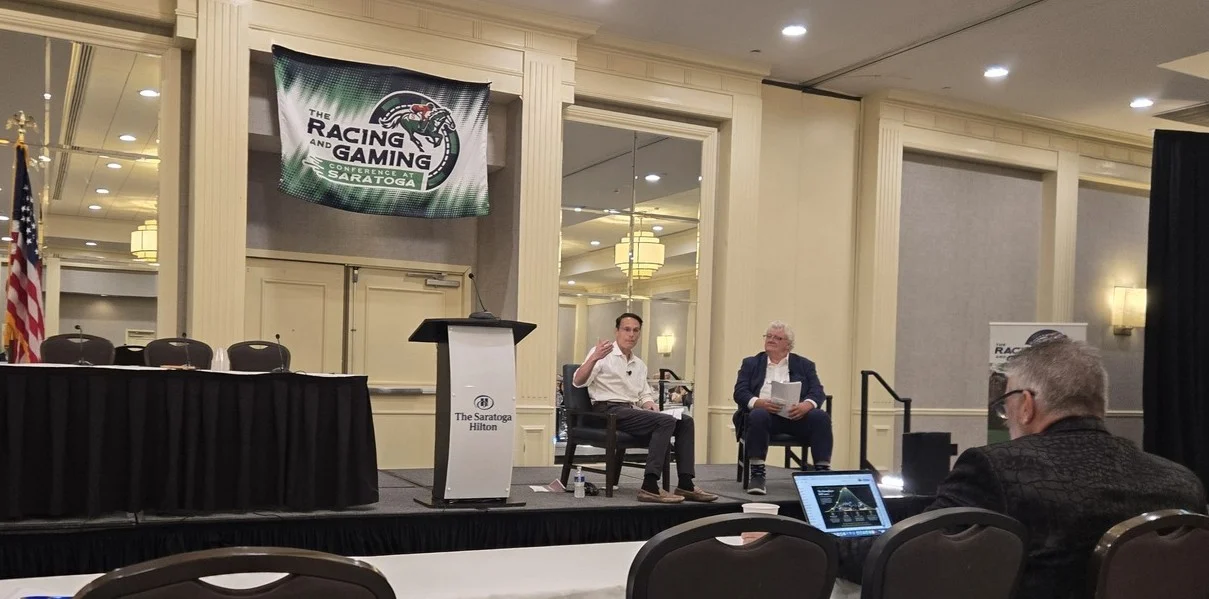
Steve Kornacki worked late into the night on Primary Night as surprising results in the Wisconsin gubernatorial primary kept him engaged on a livestream past 1 a.m. Despite having less than four hours of sleep, Kornacki caught an early flight to upstate New York, making it just in time for a 9 a.m. keynote speech. As NBC News' chief data analyst, he delivered a compelling presentation at The Racing and Gaming Conference in Saratoga, addressing significant issues like ownership concentration in major races, the downfall of foal populations, and the declining television ratings for the Triple Crown events.
Kornacki addressed a concerning trend in viewership and racing handle, illustrating that the annual handle in the U.S. has dropped from around $15 billion in 2003 to approximately $11.8 billion last year. He also pointed out the alarming decline in viewership for events outside of the Triple Crown.
Highlighting statistics from last year's Breeders' Cup World Championships, which had a total purse of $34 million across 14 Grade I stakes and concluded on November 1, Kornacki noted that the inaugural Breeders' Cup in 1984 attracted about 4.3 million viewers, whereas last year's average audience on Day 2 fell below 1 million.
Kornacki speculated that the increasing popularity of college football could be influencing the drop in racing viewership, observing that several college games, including one featuring a matchup between Oregon State and Washington State, achieved higher ratings.
At the conference, Kornacki refrained from offering explicit solutions for enhancing Breeders' Cup ratings, but entertained the idea of rescheduling the championships to avoid direct competition with college football games. Presently, the second Saturday of December—traditionally the date for the Army-Navy game—has the least college football competition.
While the Triple Crown seems largely unaffected by the downturn in ratings, the Kentucky Derby in May recorded impressive numbers, peaking at 24.4 million viewers, as per NBC data. Kornacki mentioned that only three horses that competed in the Derby were also present in the second leg of the Triple Crown, but the Preakness still drew a viewership of approximately 6 million, despite being termed a "low-wattage" event.
Moreover, Maryland Governor Wes Moore recently announced the decision to move the Preakness Stakes back by eight days in 2027 to attract more Derby entrants, thanks to a longer layoff period. The newly established Thoroughbred Championship Series includes the Kentucky Derby and Belmont Stakes but does not feature the Preakness, with neither Kornacki nor New York Racing Association executive Andrew Offerman addressing this at the conference.
Kornacki discussed ways to attract more Millennials to the racetracks through expanded wagering options. He explained that traditional parimutuel venues do not currently offer prop bets on trainer wins—an approach he equated to betting on whether a quarterback would surpass 300 yards. "You can create that same bettor with prop bets and parlays," he stated.
The conference also turned its gaze toward New York Attorney General Letitia James’ significant lawsuit against Kalshi, which was announced on July 31, alleging that Kalshi was conducting illegal gambling in New York. This lawsuit asserts that Kalshi's sports markets fall under the definition of gambling due to the unpredictable nature of its event contracts.
Prominent officials like Carrie Woerner, chair of the New York State Assembly Committee on Racing and Wagering, emphasized the importance of state regulatory authority over prediction markets, a topic complicated by ongoing litigation between multiple states and the U.S. Commodity Futures Trading Commission regarding the regulation of this asset class. In an August 11 statement, the CFTC instructed Kalshi to comply with the Commodity Exchange Act while continuing its operations in New York.
New York State Senator Joseph Addabbo previously mentioned he might explore regulations for taxing operators in the prediction markets, though his current position post-lawsuit remains unclear.
On the conference’s second day, New York State Gaming Commission Chair Brian O'Dwyer praised James for her legal actions against Kalshi, which is currently valued at $44 billion, and noted Polymarket’s search for financing that may value it around $20 billion. O'Dwyer commended Governor Hochul’s efforts to combat underage betting, given that many prediction markets allow participants as young as 18. He expressed an expectation that the legal battle surrounding sports event contracts would likely advance to the Supreme Court, where he believes the states will prevail.
The Fair Hill Training Facility's recent betting controversy was another hot topic among panelists. A group of horses from Fair Hill secured four victories at various northeastern tracks, including Saratoga, despite many having long layoffs before their recent races. Trainer Angel Quiroz was highlighted, as he trained two of these winning horses, The Great Amira and Tepeyac, which both won their races at Monmouth Park in New Jersey. UK bookmakers faced significant financial losses from bets associated with these horses, with initial estimates of liabilities reaching between £600,000 and £800,000.
Quiroz, who was also charged with a substance violation by the Horseracing Integrity and Welfare Unit regarding a positive test for albuterol in a horse named Bonita Rough, downplayed the concerns regarding the successful Fair Hill horses. He emphasized that many of these horses had not performed well in prior races, criticizing the heightened scrutiny as unwarranted.
His comments came after The Great Amira, a surprising victor at 17/1, and Classic Rock, another winner at Saratoga, drew attention for their stunning outcomes, prompting intrigue and skepticism among observers.

