
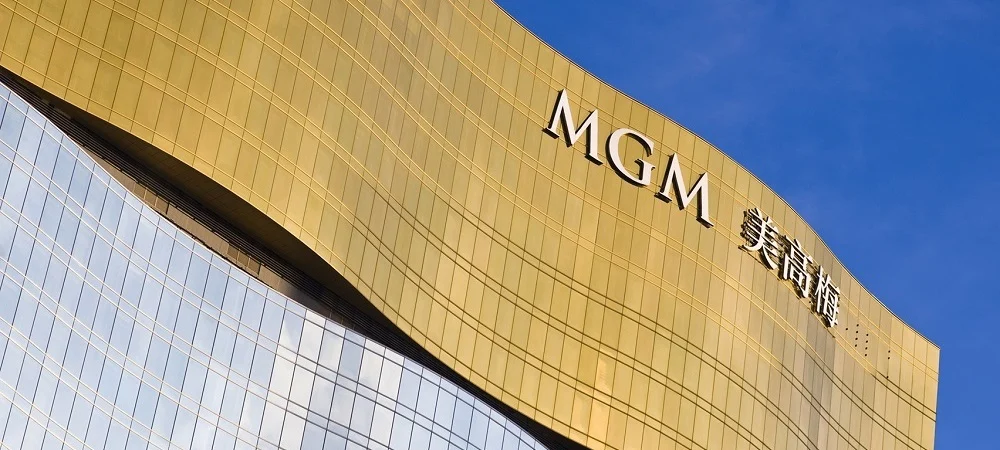
MGM Resorts Holdings released its second-quarter results on Wednesday, highlighting record group revenue and same-store regional revenue, with both figures drawing attention amid concerns regarding the health of the Las Vegas market and a pending takeover offer from Barry Diller's People Inc.
CEO Bill Hornbuckle addressed analysts, stating that an independent committee is still evaluating Diller's $48.30-per-share proposal submitted on June 1, shortly after Caesars Entertainment was acquired by Fertitta Entertainment. "I'm confident our board will pursue the course of action that’s in the best interest of the company and our shareholders," Hornbuckle remarked, opting not to elaborate further on the potential acquisition.
For the quarter, MGM's total revenue reached $4.5 billion, marking a 1% increase compared to the previous year. Adjusted EBITDA was $610 million, down about 6% year-over-year, while net income surged to $292 million from $49 million one year ago. At the end of the quarter, the company held $2.5 billion in cash against a long-term debt of $6 billion.
Las Vegas operations yielded $2.2 billion in revenue with adjusted EBITDA of $735 million, both reflecting a 3% rise year-over-year. However, analysts continued to raise concerns regarding MGM's performance in the lower-end gaming segments, prompting discussions on strategies to enhance low-end play. COO Ayesha Molino noted, "Overall, I think we continue to see really strong strength in the luxury segment. As we’ve noted, the lower end of the segment, particularly Luxor and Excalibur, those do remain challenged, but we’ve been deploying offers such as the all-inclusive and we’ve seen positive reaction to that."
To address market trends, MGM introduced all-inclusive two-night packages at Luxor and Excalibur for $330 earlier this year. Hornbuckle has consistently emphasized Las Vegas as a desirable "value" destination, a message supported by the recent push for all-inclusive promotions. Amid rising prices, travelers had expressed frustration, notably over a $26 bottle of water at Aria, leading to some adjustments in strategy. Hornbuckle confirmed that over 30,000 room nights had been booked as part of the promotion, which has stabilized occupancy rates.
In terms of casino revenue in Las Vegas, MGM reported a 17% year-over-year increase to $536 million, with slot and table hold rates documented at 9.6% and 29.6%, respectively. Compared to the Strip's averages of about 8% and 16%, MGM's performance appeared robust. Hornbuckle and CFO Jonathan Halkyard indicated consideration of room renovations at Aria and the Cosmopolitan, although no specific costs or timelines were revealed.
Regionally, the company reported a record $904 million in same-store revenue, with total net revenue dropping 4% year-over-year to $924 million, and segment-adjusted EBITDAR decreasing by 9% to $280 million. MGM had successfully concluded the sale of its Northfield Park racino in Ohio for $546 million in April. Hornbuckle mentioned that no immediate mergers and acquisitions are anticipated, but renovations at Borgata in Atlantic City and the Beau Rivage in Mississippi are set to begin by the year's end, as these locations made significant contributions to the recent regional success.
Attention also turned to the new Sphere venue under construction near Washington, D.C., adjacent to MGM National Harbor. Hornbuckle expressed enthusiasm for the potential tourism impact, although no specifics on the timeline for its opening were provided, following earlier indications of a 2030 completion.
In Macau, MGM China saw revenue remain steady at $1.1 billion year-on-year, while EBITDAR dropped by 15% to $257 million. Factors affecting this included the Fifa World Cup, which diverted high-rollers during June. Kenneth Feng, CEO of MGM China, indicated a focus on maximizing yield rather than merely increasing promotions.
Digital revenue at MGM Digital climbed 20% year-over-year to $196 million, however, the adjusted EBITDAR loss widened to $31 million from $26 million in the prior year’s quarter. This segment includes results from MGM's LeoVegas subsidiary and is distinct from its BetMGM joint venture with Entain.
BetMGM reported $711 million in Q2 revenue, a 3% increase, bolstered by an 8% rise in iGaming revenue to $483 million. Online sports betting revenue remained flat at $228 million, but adjusted EBITDA saw a 15% decline to $74 million, impacting contributions back to MGM, which fell 11% to $171 million. Hornbuckle dismissed concerns regarding whether BetMGM is fully optimized within its joint venture structure.
MGM's adjusted earnings per share stood at $0.59, slightly below analysts' estimates of $0.63. Despite this, analyst reactions were generally positive, with the stock closing at $45.66 on Thursday, reflecting a 22% increase over the past year. During the quarter, MGM repurchased 4 million shares, valued at around $164 million. As of June 30, about $1.4 billion remains available from a stock repurchase plan initiated in April 2025.
Analyst Chad Beynon of Macquarie retained an outperform rating and raised the target price to $54, highlighting MGM's strong Vegas presence and improving regional performance as key strengths. Barry Jonas from Truist maintained a buy rating, reiterating a $55 target price while praising the company's robust regional results despite ongoing challenges in Macau.

