
Bally's Corp has halted construction on the non-gaming components of its ambitious $1.7 billion Chicago casino project, significantly increasing pressure on the city following its recent budget that lifted a prohibition on video gambling terminals. Meanwhile, in Las Vegas, the situation for Bally's looks increasingly strained.
In April 2021, Bally's acquired the operations of the former Tropicana Las Vegas for $148 million, with the transaction finalized in September 2022. Following the purchase, Bally's and its landlord, Gaming and Leisure Properties (GLPI), reached an agreement to demolish the Tropicana in 2024 to accommodate the construction of a new MLB stadium for the Oakland Athletics, in return for the right to develop a new resort on the leftover land.
For almost a year after the demolition announcement, Bally's had been relatively quiet regarding its plans for the site. During this period, the company also explored various other ventures, including a proposed casino in New York City and the buyout of Australian gaming operator Star Entertainment.
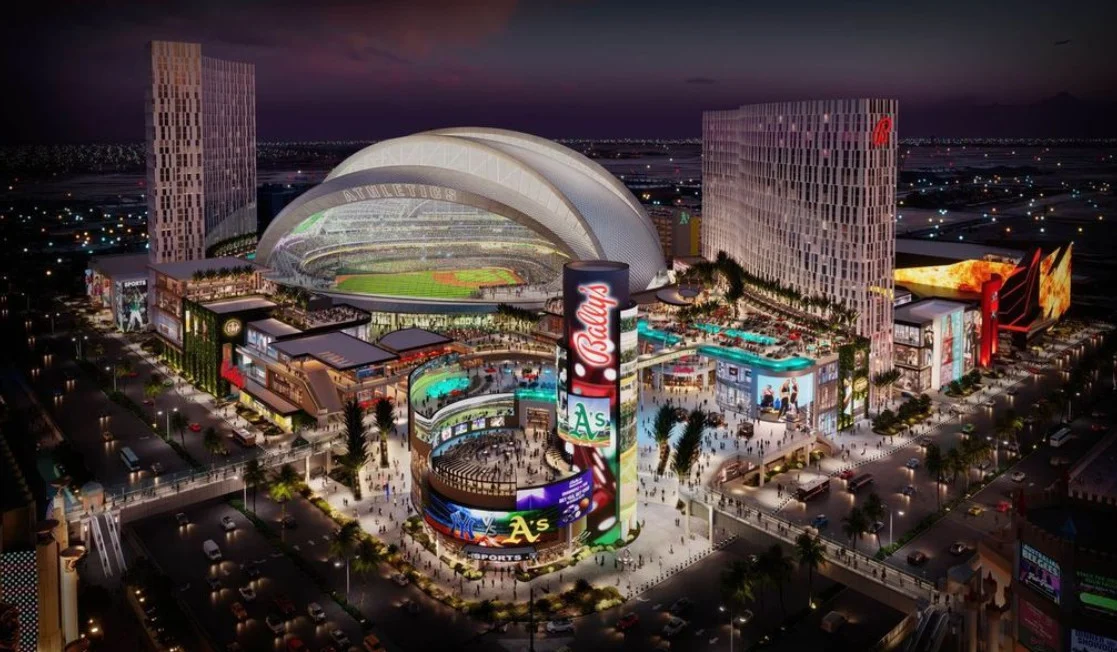
Things began to take shape in September when Bally's unveiled plans for a mixed-use complex featuring 3,000 hotel rooms split between two towers, an entertainment venue seating 2,500, and over 500,000 square feet dedicated to retail, dining, and entertainment options. A rendering of the proposed development illustrates it enveloping the A's stadium. Subsequent filings submitted to Clark County in December outlined a four-phase construction plan with a projected completion date in December 2030 and an estimated total cost of $1.19 billion.
With the A's stadium construction moving forward on schedule for its opening before the spring 2028 MLB season, questions arise regarding the progress and financial viability of Bally's proposed developments for the site.
Since the beginning of the year, Bally's has emphasized that the focus for the project will prioritize the retail-entertainment district (RED) elements rather than the casino and hotel aspects. Chairman Soo Kim stated at the ICE Barcelona conference in January that the company is "actually more focused on developing an RED," even "before we build our integrated resort and casino." This perspective was echoed by CFO Mira Mircheva and attorney Dan Reaser during a licensing hearing in June, where Reaser clarified that the 2028 deadline pertains solely to the stadium's completion and not Bally's projects.
Concerns are mounting that the A's could be opening their new stadium amid ongoing construction. The Athletics are reportedly preparing contingency plans to install their own infrastructure if Bally's fails to make adequate progress, with estimates suggesting that this could cost the team around $100 million, as reported by The Athletic in June.
Steve Hill, CEO of the Las Vegas Convention and Visitors Authority, expressed doubts about Bally's financial capacity to deliver the project, indicating he had directly questioned the company about presenting a financing plan by August. Bally's, however, declined to comment on this ultimatum, and the LVCVA did not respond to inquiries.
According to its first-quarter 10-Q filing with the SEC, Bally's reported total cash and equivalents of $559.3 million, contrasted with long-term net debt of $4.3 billion. The company has yet to publish its second-quarter results and filed a Form 12b-25 recently, indicating that the results will be delayed—marking the second consecutive quarter of late filings. Despite a 5% increase in shares to $13.70 on Wednesday, the stock has fallen approximately 18% year-to-date.
GLPI holds a significant stake in the Las Vegas project, having invested billions in Bally's ventures nationwide. Bally's has been leasing the Tropicana site from GLPI since 2022, with lease terms lasting 50 years and potential renewals extending up to 99 years. However, in its Q1 filing, Bally's stated that these renewal options are not currently deemed reasonably certain.
GLPI has committed up to $125 million for shared development that benefits both parties involved at the Las Vegas location. During GLPI's first-quarter earnings call on July 31, COO Brandon Moore said that Bally's is getting closer to a solid plan regarding essential infrastructure to support the stadium, including accessways and utility conduits. He acknowledged, however, that while they are open to further investments in critical infrastructure, they are not yet prepared to allocate more than the $125 million previously pledged and will continue discussions with Bally's.

