
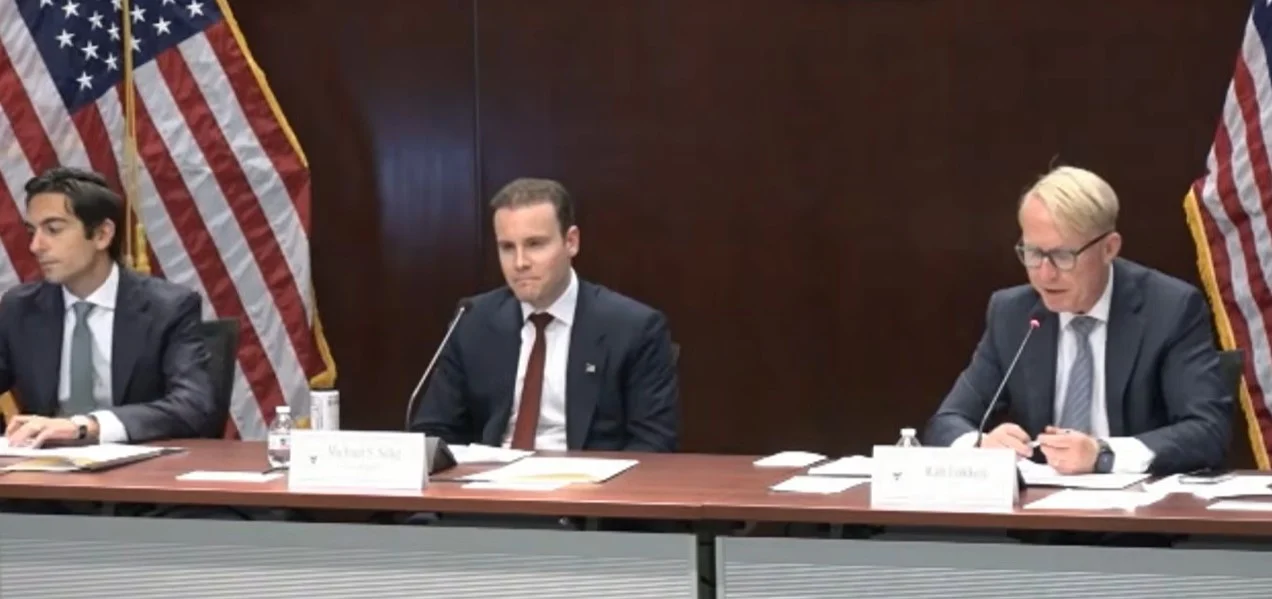
At a notable conference on Thursday, prominent figures in the derivatives market gathered for the inaugural meeting of the US Commodity Futures Trading Commission's (CFTC) advisory committee. As the agency continues to develop regulations for sports event contracts, executives such as Vlad Tenev of Robinhood and Tyler Winklevoss of Gemini were present, alongside sports betting leaders Jason Robins, Matt King, and Christian Genetski.
The meeting focused on topics related to crypto asset management and finance, but tensions escalated during a discussion on prediction markets. CME Group CEO Terrence Duffy sparked a heated exchange with CFTC Chairman Michael Selig when he expressed his concerns about contracts he considers susceptible to market manipulation. Duffy pointed to three specific contracts that, in his view, breach CFTC Core Principle 3, which mandates that only contracts not prone to manipulation can be listed on Designated Contract Markets (DCMs). These included a contract predicting the ouster of Nicolás Maduro from the presidency of Venezuela and a derivative linked to a former teleprompter operator for President Donald Trump.
Selig countered that the contracts in question were not listed within the US, but instead offshore. This lively debate highlighted the committee's final panel without a follow-up meeting scheduled, leaving critical questions about the potential outcomes of the discussions.
The teleprompter operator associated with Trump, Gabriel Perez, has reportedly come under investigation for allegedly trading on privileged information regarding the president's remarks, generating substantial earnings from these contracts. Kalshi, the exchange where the trades occurred, flagged the activities to the CFTC's internal surveillance team.
During the meeting, Selig mistakenly suggested that all implicated trades were conducted outside the US. While he acknowledged the offshore nature of the Maduro trade, Duffy noted his concerns about additional self-certified contracts that he believes could lead to manipulative practices. Although he refrained from naming specific sports trades, Duffy voiced that lowering industry standards could push participants away from regulated markets. "That is horrible for the industry; we are not a bunch of carnival barkers at a circus," he asserted.
Selig later mentioned potential routes for developing a prediction markets framework, referencing proposed changes to Rule 40.11 that would give the CFTC authority to regulate contracts related to war, terrorism, and assassination if deemed contrary to the public interest. He also suggested establishing guidelines for product governance and market design.
The discussion continued as Duffy pressed Kalshi about its ability to offer "compute contracts" while the CME's application for similar derivatives is still under review. This prompted a response from Kalshi co-founder Luana Lopes Lara, who inquired whether the CME had ever faced a manipulation case. Duffy countered that CME's regulatory staff far exceeds the size of Kalshi's entire team, to which Lara remarked that Duffy could benefit from understanding efficiency better.
In a moment of levity, DraftKings CEO Jason Robins attempted to mediate the escalating tensions by calling for collaborative discussions free from disputes. However, he and his fellow sportsbook executives refrained from delving into regulatory issues regarding market-making or federal preemption. Fanatics Betting + Gaming CEO Matt King emphasized the importance of a principles-based approach to consumer protections and responsible trading, while newly appointed FanDuel CEO Christian Genetski highlighted building consumer trust as a priority.
Looking ahead, Selig did not clarify if the committee would meet again in the year or provide any information on when the CFTC might finalize rules for sports-event contracts, especially with the football season approaching. He characterized prediction markets, artificial intelligence, and blockchain innovations as pivotal elements likely to influence financial markets for years to come, stating, "We’ve crossed the Rubicon and are standing at a new frontier of finance."

