
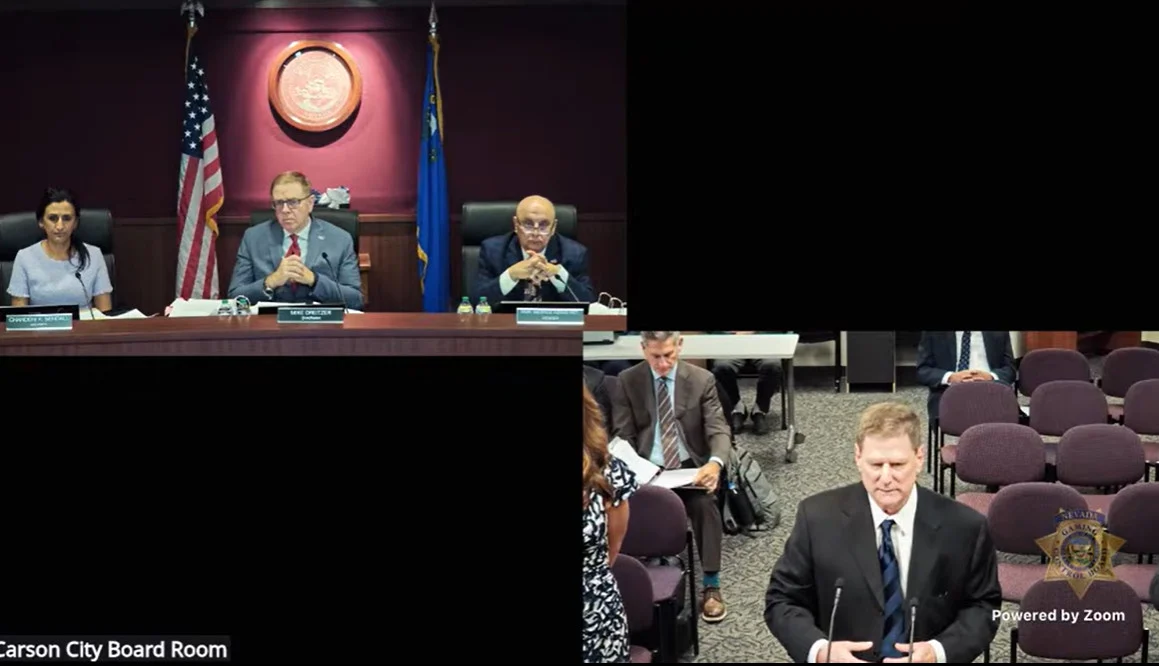
Fertitta Entertainment offered a detailed timeline for its acquisition of Caesars Entertainment during a recent meeting with Nevada regulators, following the announcement of the deal in May. Executives Richard Liem, the CFO, and Steven Scheinthal, general counsel, received preliminary licensing approval from the Nevada Gaming Control Board. Their approval was unanimous and they are scheduled to appear before the Nevada Gaming Commission for final consideration on July 23.
Liem and Scheinthal are long-time associates of billionaire Tilman Fertitta, presently serving as the U.S. ambassador to Italy and San Marino. Scheinthal began working with Fertitta in 1988, while Liem joined in 1999. The two emphasized that Fertitta is not involved in daily operations, with them and Fertitta's wife, Paige, forming the company board during his absence.
Both executives are not new to Nevada's gaming industry, having been licensed since 2005 after Fertitta acquired Golden Nugget Casinos. Their last appearance before the board occurred in 2023, when Golden Nugget took over the former Hard Rock Lake Tahoe.
While discussions touched upon aspects of the transaction, board members first focused on compliance issues. Last year, Caesars incurred a $7.8 million fine for anti-money laundering violations tied to illegal bookmaker Mathew Bowyer, now banned from all casinos in Nevada. Scheinthal asserted that Fertitta and Golden Nugget had never encountered integrity issues. "We understand the importance of compliance. Everybody knows what the repercussions are in connection with not following the rules and regulations," he stated.
Regarding the Caesars acquisition, Scheinthal outlined the necessary steps to close the deal, which he estimated would take a year or more. The all-cash transaction totals $17.6 billion, comprised of $5.7 billion in equity and $11.9 billion in assumed debt.
The immediate priorities involve antitrust filings and obtaining gaming license approvals across all of Caesars' jurisdictions. The Fertitta team plans to file a Hart-Scott-Rodino antitrust application to the Federal Trade Commission by July 13, followed by a 30-day waiting period. They've organized gaming license applications into two groups, expecting to complete the first group this week, with 45 days allocated for the second.
"We think that probably will take nine to 10 months from today in order to get that approval," Scheinthal noted. As a public company, Caesars must also file a proxy statement and gain shareholder approval. They held their annual meeting on June 9 and will release their second-quarter results on July 28 without an analyst call.
Another significant discussion point was funding. Scheinthal mentioned that Fertitta has a commitment from a coalition of banks for transaction financing but aims to secure better market terms. This approach carries risks given the current high-interest environment. The U.S. Federal Reserve maintained steady interest rates in June and expectations for future cuts diminish amid persistent inflation and economic impacts from the U.S.-Iran conflict. "Our hope is that in the next few months there will be a window of opportunity where the market will be hotter and [it’s] a more interest-rate-friendly environment where we can raise the money and then just put it in an escrow account," he explained.
A go-shop period for the Caesars deal lasts until July 11. Billionaire investor Carl Icahn, who previously facilitated Caesars' acquisition by Eldorado Resorts, is reportedly attempting to make a competing bid, proposing $33 per share, higher than the $31 share agreement Fertitta made with Caesars. Icahn is exploring interest in a $5 billion debt financing package and holds two of the ten board seats at Caesars.
Though intense, the Caesars board reportedly favors the Fertitta deal due to its firm financing structure. "When we have the money, we get HSR clearance, shareholder approval, and approval for all the various gaming jurisdictions, then we’ll be in a position to close the transaction," Scheinthal stated.
Board members also inquired about Fertitta's stake in Wynn Resorts, where he is the largest shareholder with a 12% interest. With Wynn's stock down over 19% this year and facing delays on a new UAE resort due to regional conflict, the board sought clarity on future sales of that stake. Scheinthal expressed surprise at the inquiry, asserting that there was no indication of regulatory issues regarding passive ownership. "We’re a passive investor in Wynn, and we like owning the Wynn stock, and it’s our desire to keep owning the Wynn stock," he confirmed.

