
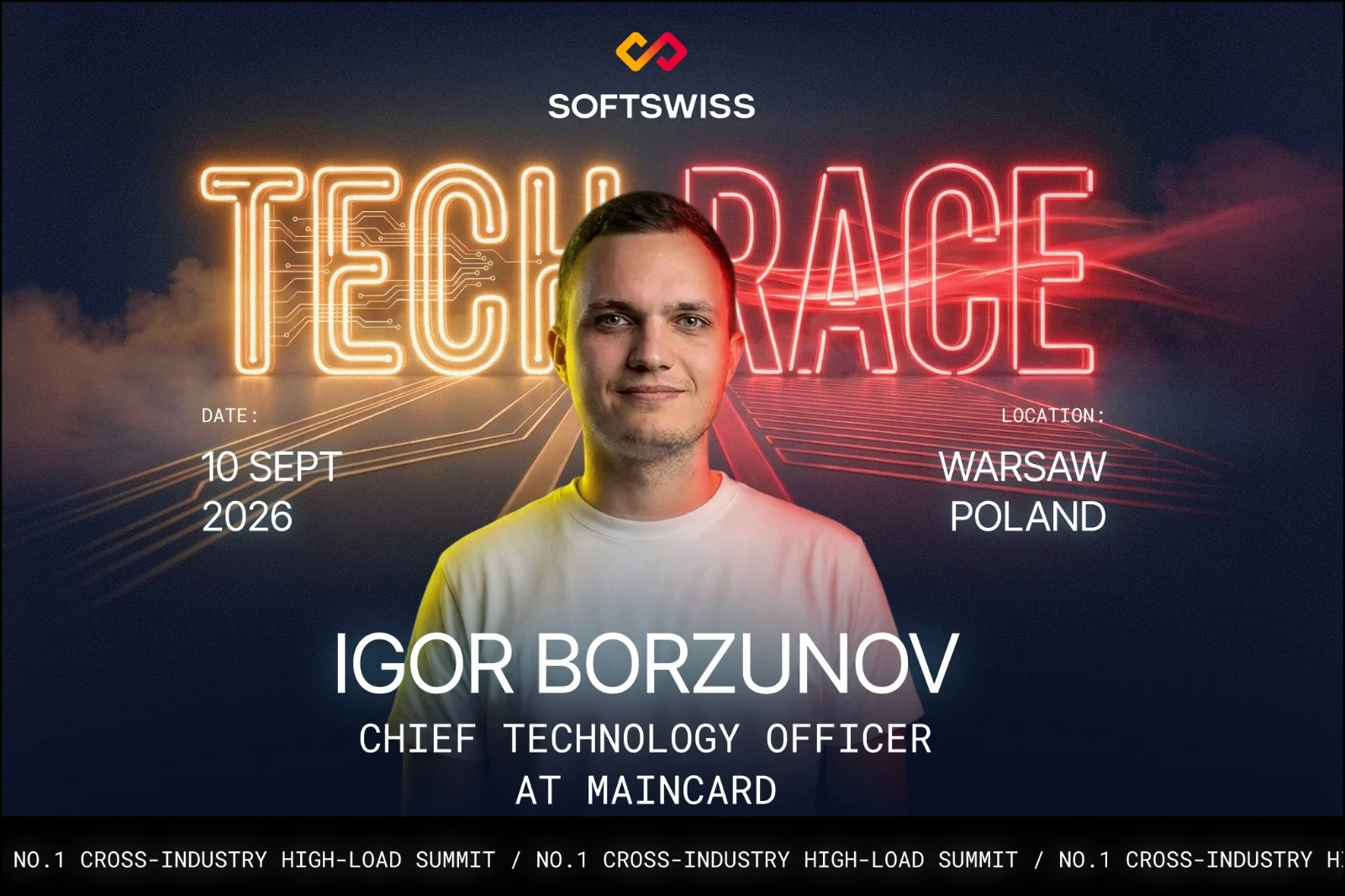
Igor Borzunov, the Chief Technology Officer at Maincard, has spent over a decade developing high-load enterprise systems. Maincard is a no-code platform that enables operators to launch branded iGaming sites rapidly, often in under half an hour.
At the Tech Race Summit in Warsaw on September 10, Igor is set to deliver a presentation titled "From 3am pages to 30 seconds: Building an autonomous AI ops agent." This session focuses on the complexities of allowing an AI agent to function within live production settings.
In an interview, Igor discussed the impact of AI in production, the true costs associated with scaling operations, and emphasized that AI agent autonomy should be viewed as a dial rather than a switch.
When asked if engineering leaders are currently overestimating or underestimating AI's capabilities, Igor replied, "Honestly, both at once. We overestimate what AI can do unsupervised. Every demo looks magical, but when you put it in front of real production, it confidently does the wrong thing. Our agent works well precisely because we spent most of our effort on the boring parts: guardrails, approval tiers, and knowing when to stop and ask a human.
"At the same time, we badly underestimate the speed of team change. A year ago, 'give an AI access to production' sounded reckless at best. Today, it triages our night incidents." He believes that engineers who learn to effectively build and oversee AI systems will gain a significant advantage over those who see AI merely as an advanced autocomplete tool.
Maincard currently supports over 40 casino brands from its unified platform. Igor raised a key takeaway for the iGaming industry: the challenge lies not in scaling the codebase, but rather in scaling operations. He explained, "The hard part isn’t scaling the code; it’s scaling the operations. Making one codebase serve dozens of brands is a solved engineering problem. But every new brand multiplies the operational surface. More payment routes, more provider integrations, more things that can quietly break at 3am. Your platform scales linearly, but your on-call pain scales worse than that."
He advised investing in operations tooling early on, stating, "We have over 40 brands running with an ops team of about 20 people, and that’s only possible because we treat operations as an engineering problem, not as a cost centre."
Igor pointed out that a 3am production incident does not inherently indicate poor engineering. "Most companies chase zero incidents and green dashboards. But when integrating many external providers, incidents are just a reality. If a provider changes a webhook format unexpectedly, no test suite can save you. Instead, it’s crucial to measure the time to diagnose problems."
In his view, the real challenge is managing blame surrounding incidents. "If every problem leads to finger-pointing, people will start hiding issues instead of fixing the system. The solution lies in better tooling, not in assigning blame."
He also reflected on the changing landscape of brand launches within iGaming. "Yes, launching a brand has become simpler, but that ease takes away the competitive edge. The market is saturated with brands that launch quickly but deteriorate over time due to insufficient ongoing support. Operating efficiently is much harder to replicate than just launching."
Maincard has achieved AI visibility in live production but with cautious limitations regarding its authority. Igor indicated that the primary hurdle was establishing trust, not the technical challenges associated with integrating systems.
"Trust was the biggest obstacle. The technical integration was quick, but we had to design an approval process carefully: reading data is unrestricted, but certain actions require multiple layers of consent. Trust was built gradually as engineers observed the agent diagnosing incidents accurately."
Looking ahead, Igor predicts that AI’s greatest impact on online casinos in the next three to five years will be its application beyond customer support, shifting to operational functions. "AI should operate within systems, handling tasks like monitoring payments and anomaly detection, thus alleviating the strain on human teams."
He regards fintech as a sector that iGaming should emulate, stating, "They deal with real money and heavy regulation, just like us. They've transformed reliability into a systematic engineering practice with error budgets and observability at the forefront, rather than merely expanding support teams."
At his session, Igor’s core message will be about the nuanced approach to AI autonomy in production environments. He hopes attendees will learn that autonomy is adjustable. "The common question often reduces to 'do you trust AI in production?', but that's the wrong framing. You give an AI tiered access, allowing it to earn its place, rather than making it an all-or-nothing situation. If attendees leave with the mindset of 'which tier do we start at?' instead of 'should we let AI into production?', then the session will have achieved its goal.

