
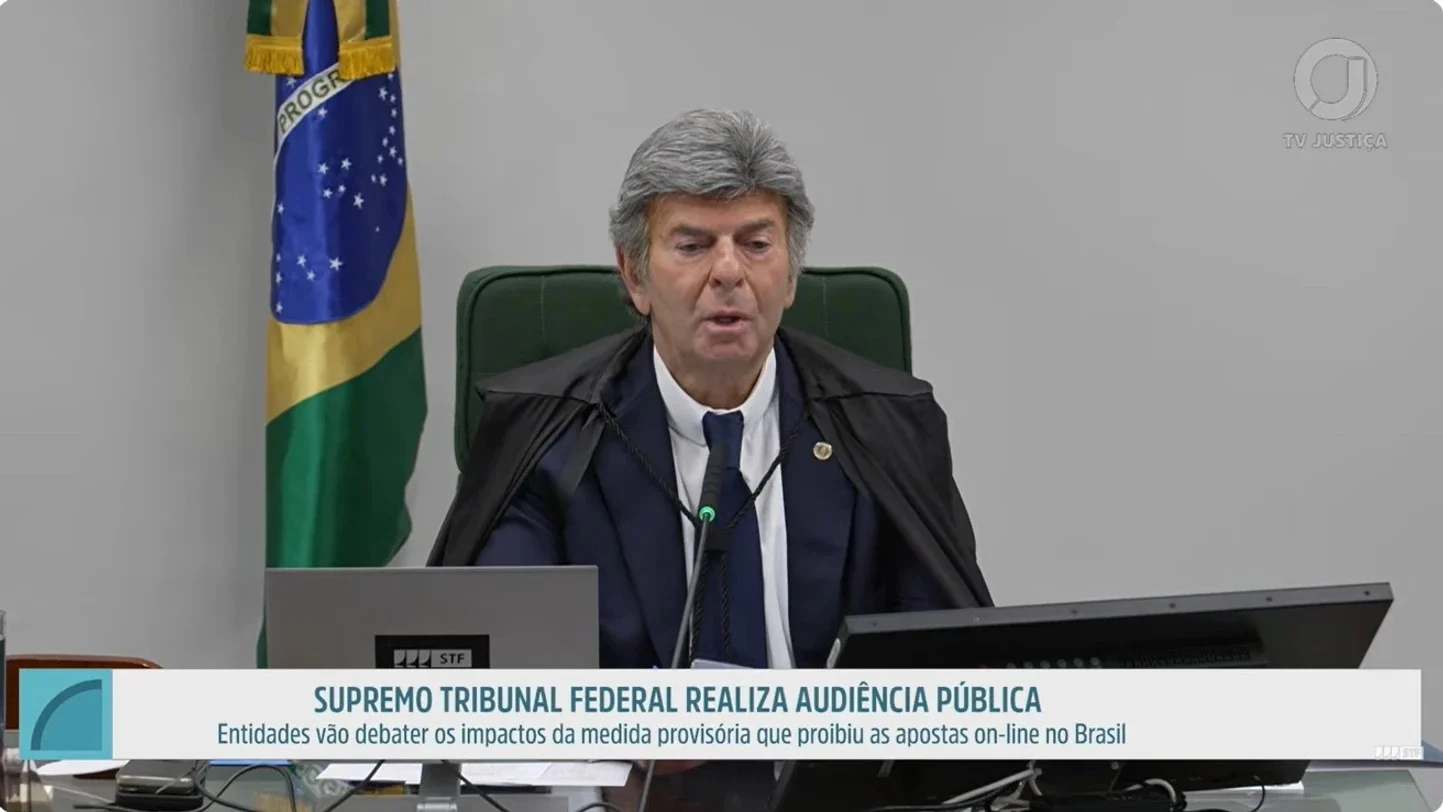
In a recent public hearing at Brazil's Supreme Federal Court (STF), industry representatives, including football clubs and sports organizations, voiced their concerns regarding the government's ban on betting, which they argue should be preserved as part of a regulated market.
The hearing, presided over by Minister Luiz Fux, convened on Tuesday with 34 entities participating to discuss Provisional Measure 1.394, which prohibits betting in Brazil. This measure is currently being legally contested under Direct Action of Unconstitutionality 8027, initiated by the National Association of Games and Lotteries (ANJL), which seeks to halt its enforcement.
Officials from the Justice, Health, and Finance ministries, along with the Attorney General's Office (AGU), defended the government’s ban as essential for safeguarding families against the adverse health, financial, and societal implications of gambling. Justice Minister Wellington César Lima e Silva characterized betting platforms as leading to “unspeakable dependency,” underscoring the urgency of the measure.
The AGU head, Jorge Messias, supported the government’s stance, stating that prior regulations failed to provide adequate protection. “Recognizing this effort does not oblige us to close our eyes to its limitations,” Messias stated, while acknowledging the contributions of licensed operators. He critiqued the prevailing framework as “materially unconstitutional due to insufficient protection of constitutionally protected assets.”
On the other hand, the betting industry and its advocates stressed the need for legal certainty and enhanced protective measures, asserting that the ban might push users toward unregulated markets. The Brazilian Institute for Responsible Gaming (IBJR) urged Minister Fux for an injunction to suspend the ban until Congress decides or the Supreme Court adjudicates the matter. A representative from IBJR, Celso Mori, emphasized that Brazil had moved towards regulated gambling through years of legislative efforts and challenged the abrupt shift back towards prohibition.
The Economic Regulation Laboratory from the State University of Rio de Janeiro (UERJ) provided a set of eight recommendations for potentially reopening the legal market if the ban is lifted. Their proposals include restricting funding for bets, limiting overall amounts wagered per taxpayer identification number, verifying user eligibility (including social benefit recipients), enhancing self-exclusion options, and ensuring the auditability of records in the Betting Management System (Sigap).
UERJ also suggested imposing advertising restrictions, mandating funding for gambling prevention via the public health system, and specifying a catalogue of authorized bets. Marcello Trindade Paulo from UERJ proposed a structured transition with set tasks and result verifications over the first 360 days if the ban is revoked.
Representation from sports clubs reflected similar sentiments, with Flamengo advocating for effective regulation rather than an outright repeal, while Corinthians proposed collaboration in addressing gambling addiction awareness. Meanwhile, the Brazilian Paralympic Committee called for age restrictions on betting and greater accountability from operators in identifying compulsive gambling behaviors.
Concerns were also raised about the handling of companies that had secured licenses under the former framework. Industry representatives argued that the state had encouraged investment prior to the sudden policy reversal and expressed objections about the imposed BRL30 million ($5.5 million) authorization fees and the hasty ban on betting advertising.
Gustavo Binenbojm of the Brazilian Association of Radio and Television (Abert) criticized the ban as a dramatic shift from established public policy. He questioned whether the state could effectively eliminate the regulated market through this provisional measure, which stands to undo policy developed collaboratively by both the Executive and Congress.
Minister Fux is expected to outline the subsequent steps regarding the evaluation of this measure, with no immediate decision on whether the ban will be lifted, maintained with additional regulations, or enacted through a transitional framework.

