
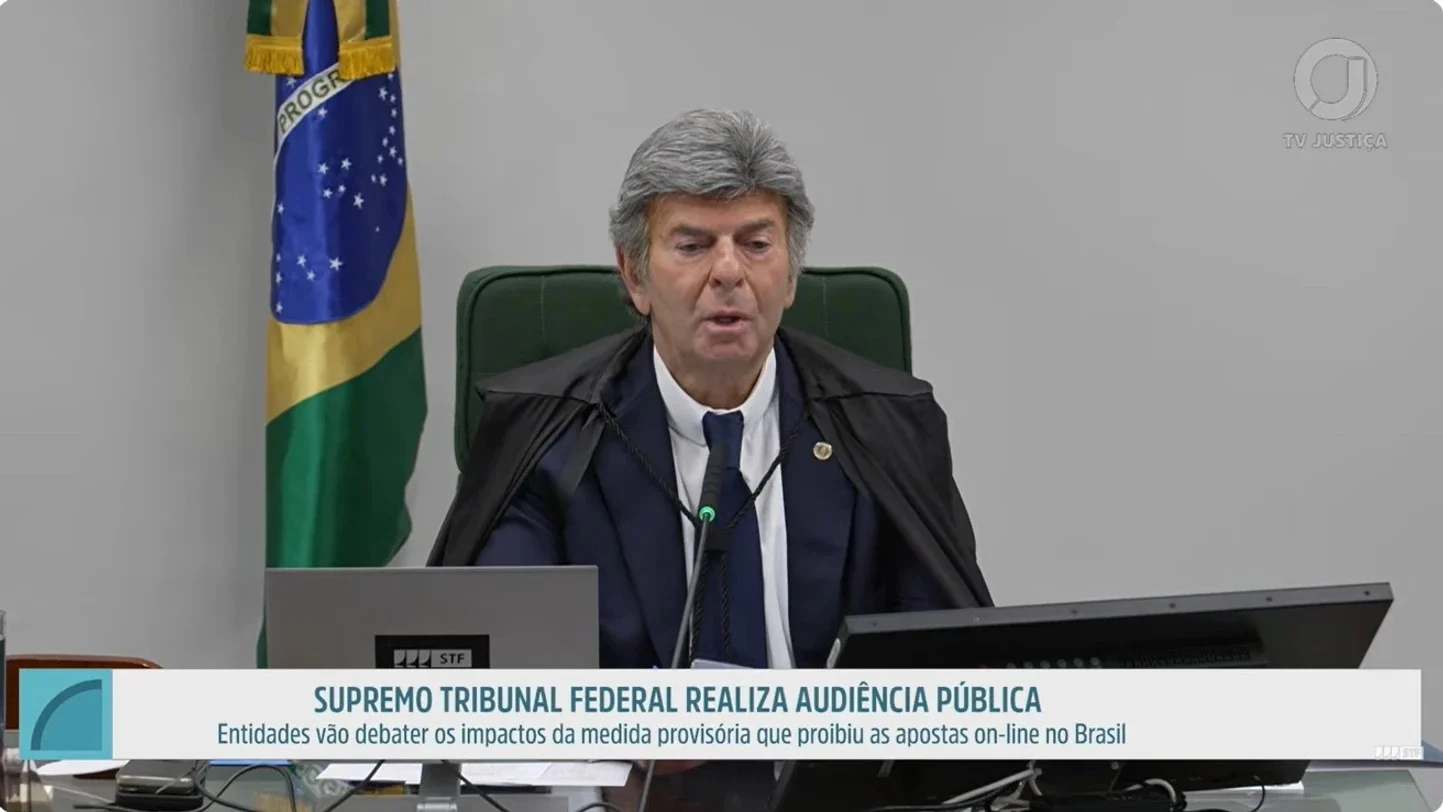
During a recent public hearing at Brazil's Supreme Federal Court (STF), industry representatives, sports organizations, and football clubs voiced their support for a regulated betting market, countering the government's recent decision to impose a ban. The hearing, led by Minister Luiz Fux, brought together 34 different organizations to discuss Provisional Measure 1.394, which outlaws betting activities in Brazil. This measure is currently being challenged by the National Association of Games and Lotteries (ANJL) in a case known as Direct Action of Unconstitutionality 8027, which seeks to suspend the measure's enforcement.
Officials from the Ministries of Justice, Health, and Finance, along with the Attorney General's Office (AGU), defended the ban as necessary for protecting families from the adverse health, financial, and social impacts associated with gambling. Justice Minister Wellington César Lima e Silva described betting platforms as creating an 'architecture of unspeakable dependency,' emphasizing the urgency of the government's actions.
Jorge Messias, head of the AGU, supported the ban by stating that the earlier regulatory framework had proven inadequate in protecting the public. He acknowledged the efforts of licensed operators but stressed the need for state review of policies based on their outcomes, noting the framework's material unconstitutionality due to insufficient safeguards for protected assets.
In contrast, representatives from the betting industry argued for the necessity of legal certainty and expressed concern that a prohibition might drive consumers toward unregulated channels. The Brazilian Institute for Responsible Gaming (IBJR) requested an injunction to temporarily pause the ban until Congress or the Supreme Court can make a substantive ruling on the case. The ANJL further urged for implementation of stricter regulations aimed at minimizing harm without resorting to an outright ban.
'By choosing to regulate gambling, the country through its Congress made a clear decision after years of legislative process,' stated IBJR representative Celso Mori. 'Suddenly changing direction to promote clandestine gambling is counterproductive.'
The Economic Regulation Laboratory at the State University of Rio de Janeiro (UERJ) suggested eight potential conditions for reinstating the legal betting market, should the ban be lifted. These proposals included preventing bet financing via credit, setting global betting limits for individuals, ensuring the eligibility of users receiving social benefits, and enhancing self-exclusion measures, among others.
Participants from various football clubs voiced their support for continued regulation. Flamengo, a prominent football club, emphasized the need for effective regulations instead of a full repeal of the ban. Meanwhile, Corinthians offered to participate in initiatives that combat problem gambling and illegal betting. The Brazilian Paralympic Committee echoed calls for stricter age limits on betting and enhanced responsibility among operators to detect and prevent compulsive gambling behaviors.
Moreover, the hearing highlighted concerns regarding how the government would handle companies that had previously acquired licenses under the earlier regulatory framework. Representatives from the industry criticized the abrupt policy shift after encouraging prior investments, questioning the treatment of BRL30 million ($5.5 million) authorization fees and the sudden cessation of betting advertisements.
Gustavo Binenbojm of the Brazilian Association of Radio and Television (Abert) described the government's decision as a reversal of established policy. He emphasized that the original regulation aimed to acknowledge sector risks without turning the market over to criminal enterprises. Binenbojm raised concerns about whether the state could feasibly revoke such a comprehensive policy through a singular provisional measure.
Minister Fux will decide the subsequent steps regarding the measure. The hearing ended without a resolution on whether the ban will be lifted, maintained with adjustments, or transitioned to a new framework.

