
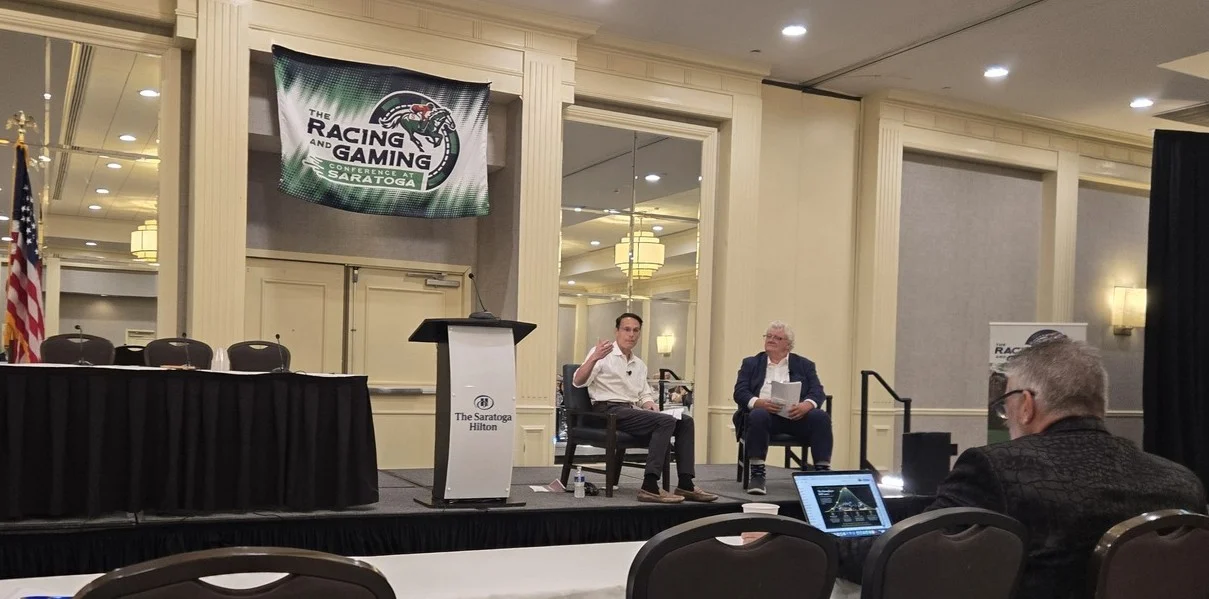
Steve Kornacki pulled an all-nighter on Primary Night this week, as a surprising result from the Wisconsin gubernatorial primary kept him on a livestream until after 1 a.m. Despite getting less than four hours of sleep, Kornacki managed to catch a flight to upstate New York, arriving just in time to deliver a 9 a.m. keynote address at The Racing and Gaming Conference in Saratoga.
The chief data analyst at NBC News, Kornacki addressed pivotal issues in horse racing, such as the concentration of ownership in major races, the worrying decline in foal populations, and the diminishing television ratings for the Triple Crown events. His insightful and engaging presentation aptly illustrated the challenges the industry faces.
A sharp decrease in television ratings and racing handle has emerged as a pressing concern. Kornacki highlighted a stark drop in annual U.S. handle, which fell from approximately $15 billion in 2003 to around $11.8 billion last year. Equally troubling is the decline in viewership for events outside the Triple Crown.
He cited the viewership for last year’s Breeders’ Cup World Championships, which offered a staggering $34 million purse across 14 Grade I races. Closing on November 1, 2022, the event showcased Forever Young’s victory in the $7 million Classic. Unlike the inaugural Breeders’ Cup in 1984, which attracted an estimated 4.3 million viewers, last year’s Day 2 audience dropped below 1 million.
According to Kornacki, the rising popularity of college football might be contributing to the falling viewership for horse racing. During the same period, at least eight college football games recorded higher ratings, including a matchup between Oregon State and Washington State, both of which ended the season with a combined 9-16 record.
Although Kornacki did not offer a concrete solution for improving Breeders’ Cup ratings, he suggested some informal ideas, including rescheduling the championships to avoid competition with college football games. Traditionally, the Army-Navy game is the only matchup on the second Saturday of December, following conference championships. Alternatively, moving the Breeders’ Cup to a midweek date, when both the NFL and college football are idle, was another possibility.
Conversely, the Triple Crown has largely avoided the same ratings decline. NBC reported record viewership for the Kentucky Derby in May, reaching a peak of 24.4 million viewers. However, Kornacki noted that only three Derby participants, none of which were among the top three finishers, competed in the Preakness, typically seen as a “low-wattage” event that still managed to attract 6 million viewers.
This month, Maryland Governor Wes Moore announced the Preakness will be rescheduled to occur eight days later in 2027. This change aims to draw more entries from the Kentucky Derby, providing a longer layoff. The newly established Thoroughbred Championship Series will include the Kentucky Derby and Belmont Stakes but will not feature the Preakness. Kornacki, along with NYRA executive Andrew Offerman, did not comment on the new series during the conference.
Kornacki also advocated for a broader wagering menu to attract more Millennials to horse racing venues. On August 1, trainer Todd Pletcher won five races on the Saratoga card, culminating with Renegade’s triumph in the Jim Dandy. Nevertheless, parimutuel tracks currently do not offer prop bets concerning trainer success on specific days. Kornacki compared these potential wagers to props on whether New England Patriots quarterback Drake Maye will exceed 300 passing yards in a game.
“Anything like prop bets, parlays—if you can create that, you can attract the same bettor,” Kornacki stated to iGB.
In another hot topic, New York Attorney General Letitia James’ lawsuit against Kalshi, announced last month, gained attention at the conference. On July 31, alongside Governor Kathy Hochul, James filed a $36 billion suit against Kalshi, alleging it carried out illegal gambling activities within the state. The state claims that Kalshi’s sports markets meet the legal definition of "gambling" in New York due to the uncertainty surrounding the outcomes of its event contracts.
The suit caught the attention of key figures, including Carrie Woerner, chair of the New York State Assembly Committee on Racing and Wagering, who expressed the need for states to assert their rights as regulators managing prediction markets. Several states are currently embroiled in litigation with the U.S. Commodity Futures Trading Commission regarding the regulation of this asset class. In a statement released on August 11, the CFTC mandated that Kalshi must continue operations in New York in compliance with the Commodity Exchange Act.
In June, New York State Senator Joseph Addabbo noted that he would explore options to regulate and tax prediction market operators, though it remains unclear if his stance has changed after the lawsuit's filing.
The day before, Brian O'Dwyer, Chair of the New York State Gaming Commission, praised James for the lawsuit against Kalshi, which is reportedly seeking a $44 billion valuation. Meanwhile, Polymarket, another notable player in the prediction market sector, is seeking outside funding that would value it around $20 billion. O'Dwyer also commended Hochul for her efforts to prevent underage betting, particularly since most prediction markets permit participation starting at age 18. He expressed a belief that the case involving sports event contracts is likely to be elevated to the Supreme Court, where he is optimistic the states will succeed.
O'Dwyer acknowledged that illegal sportsbooks had previously targeted underage bettors before PASPA, but he believes it inappropriate for teenagers in New York to shift to predictions.
“Replacing criminal actions with corporate greed isn’t the solution,” O'Dwyer remarked to the audience.
Additionally, the conference addressed a recent betting investigation launched by the Horseracing Integrity and Safety Authority. The investigation centers on a group of horses shipped from Fair Hill Training Facility in Maryland that achieved four wins at northeast tracks, including Saratoga, despite many of them having long layoffs before the recent races.
Trainer Angel Quiroz’s operations at Fair Hill were scrutinized in relation to this incident. He trained two of the winning horses, The Great Amira and Tepeyac, both of which won races at Monmouth Park in New Jersey. Quiroz had previously trained two additional winners, Classic Rock and M Bs Melanie Cares. Recent reports indicate that prominent UK bookmakers sustained significant losses on parlays and other bets involving these horses, with early estimates putting those losses between £600,000 and £800,000.
Pat Cummings, executive director of the National Thoroughbred Alliance, discussed the situation in a conference panel on Wednesday, noting the surprising attention received from UK bookmakers compared to comments from U.S. stakeholders. Quiroz downplayed the allegations, asserting that it was not unusual for racehorses to outperform expectations. The Great Amira, a 17/1 longshot, won by 9 1/2 lengths at Monmouth after previously finishing last in his two lifetime starts. Classic Rock also claimed victory at Saratoga with an 8/1 payout, winning by 8 3/4 lengths.
“Everyone is surprised. I don’t see what the big deal is. Shouldn’t I try to win?” Quiroz remarked in an interview with Thoroughbred Daily News.

