
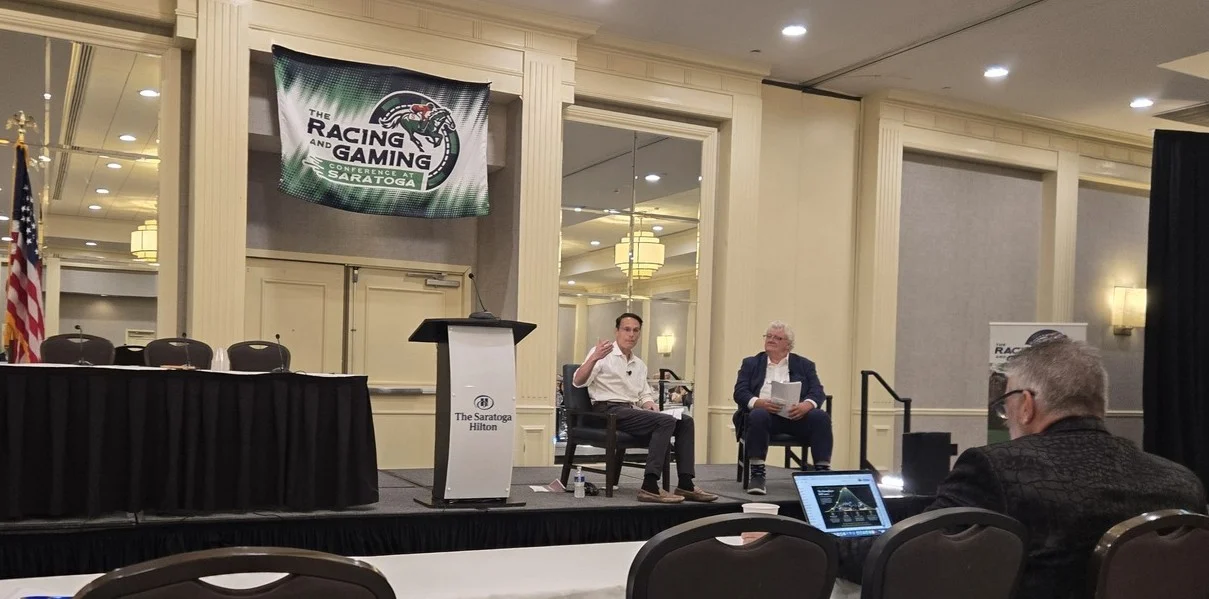
Steve Kornacki, NBC News' chief data analyst, pressed through a late night on Primary Night as a Wisconsin gubernatorial primary result unfolded, keeping him online past 1 a.m. After just four hours of sleep, he boarded a flight to upstate New York and arrived in time for a 9 a.m. keynote at The Racing and Gaming Conference in Saratoga. Kornacki delivered an engaging presentation on critical issues like ownership concentration in horse racing and the ongoing decline of foal populations, along with television ratings for the Triple Crown.
The sharp drop in TV viewership and racing handle is a particularly troubling subject. Kornacki highlighted that the annual handle in the U.S. has dwindled from roughly $15 billion in 2003 to about $11.8 billion last year. The viewership for events outside the Triple Crown has also suffered. He cited last year’s Breeders’ Cup World Championships, boasting a total purse of $34 million across 14 Grade I stakes, which concluded on November 1. While the inaugural Breeders’ Cup in 1984 attracted an estimated 4.3 million viewers, last year’s Day 2 viewership fell below 1 million.
Kornacki suggested that the growing popularity of college football could be contributing to this decline. Data showed that at least eight college football games outperformed horse racing ratings, including a matchup between Oregon State and Washington State, both of which finished the season with a combined 9-16 record.
Although Kornacki did not offer specific solutions to improve Breeders’ Cup ratings, informal suggestions included rescheduling the championships to a weekend with fewer college football games. Historically, only the Army-Navy game takes place on the second Saturday of December, following the conference title games. Alternatively, he mentioned that midweek dates could work, as the NFL and most college football leagues do not schedule games then.
Interestingly, the Triple Crown has largely escaped the trend of declining ratings. The Kentucky Derby achieved record ratings this May, with peak viewership reaching 24.4 million. Despite only three Derby entrants competing in the Preakness, the second leg of the Triple Crown, it managed to draw an audience of 6 million, according to Kornacki.
Maryland Governor Wes Moore announced earlier this month that The Preakness will move back eight days in 2027 to attract more Kentucky Derby entrants, providing a longer gap between races. The newly established Thoroughbred Championship Series, which includes the Kentucky Derby and Belmont Stakes, does not feature The Preakness. Kornacki and NYRA executive Andrew Offerman were not questioned about the series during the conference.
Kornacki expressed support for expanded wagering options to attract younger bettors. He noted Trainer Todd Pletcher's success on August 1, where he won five races during the Saratoga card, culminating in Renegade's victory in the Jim Dandy. However, he pointed out that parimutuel tracks do not currently offer prop bets on trainer wins for a specific day. Kornacki compared this to propositions on whether New England Patriots quarterback Drake Maye would exceed 300 passing yards in a game. He stated, “Anything like those prop bets, parlays – to me if you can create that, you can get the same bettor.”
The conference also addressed a significant legal case involving New York Attorney General Letitia James, who announced a $36 billion lawsuit against Kalshi on July 31. The suit accuses Kalshi of illegal gambling in New York, arguing that the outcomes of its event contracts are uncertain and thus qualify as gambling under state law.
Carrie Woerner, chair of the New York State Assembly Committee on Racing and Wagering, asserted that states need to uphold their regulatory rights over prediction markets. Multiple states are engaged in litigation with the U.S. Commodity Futures Trading Commission concerning federal preemption in regulating such markets. The CFTC ordered Kalshi to continue its operations in New York in alignment with the Commodity Exchange Act as of an August 11 statement.
Previously, New York State Senator Joseph Addabbo mentioned in June that he might consider ways to regulate and tax prediction market operators, but it's uncertain whether he has changed his stance since the lawsuit was introduced.
O’Dwyer, chair of the New York State Gaming Commission, praised James for her lawsuit against Kalshi while attending the conference. Kalshi is seeking a valuation of $44 billion, while another major prediction market, Polymarket, hopes to secure outside financing that would value it at approximately $20 billion. O'Dwyer commended Governor Hochul for her efforts to curb underage betting, noting that most prediction markets allow participation from individuals aged 18 and above. He indicated that the Supreme Court might hear the sports event contract case, expressing confidence that states would prevail.
In another topic of discussion, panelists addressed a betting investigation initiated by the Horseracing Integrity and Safety Authority (HISA). A group of horses from the Fair Hill Training Facility in Maryland secured four wins at northeastern tracks, including Saratoga, after lengthy layoff periods. Trainer Angel Quiroz is connected to the group, with two of his horses winning at Monmouth Park on Sunday. UK bookmakers reportedly faced huge losses on betting combinations involving these horses, with initial liability estimates ranging from £600,000 to £800,000. Another horse, Scootaloo, stumbled at the start and finished fourth in his race at Saratoga.
Pat Cummings, executive director of the National Thoroughbred Alliance, remarked, “It’s quite notable that we had to hear from UK bookmakers about this more than we have really heard from anyone on the US betting side.”
On Thursday, HIWU charged Quiroz with a substance violation linked to a positive test for Bonita Rough, a filly who tested positive for albuterol, a banned substance used for bronchoconstriction. Hiwu serves as HISA's enforcement arm. Bonita Rough’s lone racing career resulted in a seventh-place finish in June. Quiroz waived the opportunity for a B sample analysis. The results of the post-race drug tests for the five Fair Hill horses that raced have yet to be made public, typically taking about ten business days for release.
In remarks to Thoroughbred Daily News, Quiroz downplayed the Fair Hill investigation, noting that many horses had previously struggled to win races. He defended the performance of The Great Amira, a 17/1 longshot that clinched a Monmouth victory by 9 1/2 lengths, despite having finished last in two prior lifetime starts. Classic Rock also performed well, winning the fourth at Saratoga at 8/1, which was an improvement of 24 points over his last race. Quiroz questioned the fuss over their performance, stating, “Everybody is shocked. I don’t see what the big deal is. I’m supposed to run all the time and not try to win the race?”

