
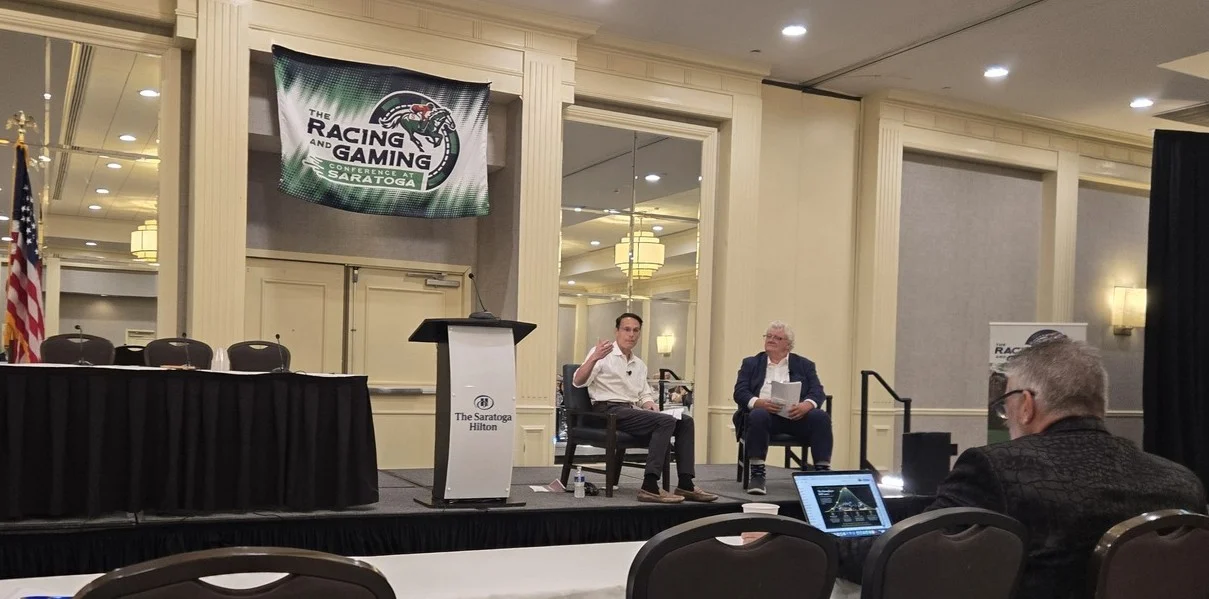
Steve Kornacki worked through the early hours of Primary Night this week, staying on a livestream beyond 1 a.m. due to an unexpected result in the Wisconsin gubernatorial primary. After just under four hours of sleep, he boarded a flight and made it to upstate New York for a 9 a.m. keynote address at The Racing and Gaming Conference in Saratoga. Kornacki, NBC News' chief data analyst, discussed critical issues like the concentration of ownership in major races, the ongoing decline in foal populations, and the falling television ratings for the Triple Crown. His engaging presentation was a notable display of resilience.
The significant drop in television viewership and racing handle remains a pressing concern. Kornacki highlighted that annual handle in the U.S. has plummeted from approximately $15 billion in 2003 to about $11.8 billion last year. Viewership for non-Triple Crown events has also noticeably regressed.
He cited last year’s Breeders’ Cup World Championships, which offered a collective purse of $34 million across 14 Grade I stakes. Held on November 1, the event concluded with Forever Young winning the $7 million Classic. The inaugural Breeders’ Cup in 1984 attracted an estimated 4.3 million viewers; however, average viewership dropped to below 1 million on Day 2 last year.
Kornacki suggested that the surge in college football’s popularity might contribute to the declining racing viewership. At least eight college football games outperformed the Breeders’ Cup in ratings, including a matchup between the Oregon State and Washington State teams, which had a combined record of 9-16.
While Kornacki refrained from proposing definitive solutions to enhance Breeders’ Cup ratings, he mentioned informal ideas such as scheduling the championships on a weekend with fewer college football games. Historically, the Army-Navy game is the only contest on the second Saturday of December, following the conference title games. An alternative could be to shift the Breeders’ Cup to a midweek event when both the NFL and most college football are off.
Contrastingly, the Triple Crown has largely escaped the ratings downturn. The Kentucky Derby, held in May, achieved record ratings with peak viewership of 24.4 million. Kornacki noted that three Derby entrants, none of whom finished in the Top 3, participated in the Preakness. Nonetheless, a lackluster Preakness drew an audience of 6 million.
Earlier this month, Maryland Governor Wes Moore announced a decision to move the Preakness back eight days in 2027 to attract more entrants from the Kentucky Derby, extending the layoff duration. The newly announced Thoroughbred Championship Series consists of six races for three-year-olds, including the Kentucky Derby and Belmont Stakes, but excludes the Preakness. Neither Kornacki nor NYRA executive Andrew Offerman commented on this series during the event.
Kornacki expressed support for expanding wagering menus to engage more Millennials at racetracks. On August 1, trainer Todd Pletcher won five races at Saratoga, culminating in Renegade’s victory in the Jim Dandy. However, parimutuel tracks currently do not provide prop bets on trainer victories on a given day. Kornacki compared such bets to props for NFL quarterback performance.
"Anything like that prop bets, parlays — to me if you can create that, you can get the same bettor," he stated.
The lawsuit by New York Attorney General Letitia James against Kalshi dominated discussions at the conference. On July 31, James and Governor Kathy Hochul announced a $36 billion lawsuit against Kalshi, claiming the company is engaging in illegal gambling within the state. According to the state, Kalshi's sports markets constitute gambling under New York law since the outcomes of its event contracts are uncertain.
Carrie Woerner, chair of the New York State Assembly Committee on Racing and Wagering, asserted that states need to assert their rights to regulate prediction markets. Many states are currently entangled in litigation with the U.S. Commodity Futures Trading Commission regarding federal preemption issues surrounding this asset class. In a statement issued August 11, the CFTC required Kalshi to comply with the Commodity Exchange Act while operating in New York.
Earlier, State Senator Joseph Addabbo had indicated a willingness to explore solutions for regulating and taxing prediction market operators, but it is unclear if he has changed his stance following the lawsuit.
On Tuesday, Woerner spoke on the day before New York State Gaming Commission Chair Brian O’Dwyer addressed the conference. O’Dwyer praised James for her lawsuit against Kalshi, which is seeking a $44 billion valuation. He noted that Polymarket, another leading prediction market, is seeking external financing that would value it around $20 billion. O’Dwyer commended Hochul for her actions against underage betting, considering many prediction markets permit participants aged 18 and older. He believes a Supreme Court hearing on sports event contracts is likely, where states may achieve victory.
O’Dwyer pointed out that illegal sportsbooks targeted underage bettors before PASPA, asserting that teens in New York should not resort to predictions as a substitute.
"The answer is not in replacing criminal thuggery with corporate avarice and greed," O'Dwyer stated.
Conference discussions also turned to a betting investigation conducted by the Horseracing Integrity and Safety Authority, initiated this week. Last Sunday, a group of horses from Fair Hill Training Facility in Maryland won four races at tracks across the northeast, including Saratoga. Many of these horses, who ran off long layoffs, had steep odds.
Trainer Angel Quiroz is linked to this activity, with two of his horses, The Great Amira and Tepeyac, winning races at Monmouth Park that day. Quiroz had previously trained two other winning horses from Fair Hill. UK bookmakers reported substantial losses on parlays and other bets involving these horses, with initial liabilities estimated between £600,000 and £800,000. A fifth horse, Scootaloo, stumbled at the start and finished fourth in its Saratoga race.
Pat Cummings, executive director of the National Thoroughbred Alliance, commented on the situation during a panel at the conference, expressing concern about hearing more from UK bookmakers than their U.S. counterparts.
Additionally, on Thursday, the Horseracing Integrity and Welfare Unit charged Quiroz with a violation related to a positive test for Bonita Rough, a 4-year-old filly, on July 10. Bonita Rough tested positive for albuterol, a banned substance indicated for treating bronchoconstriction. Quiroz chose not to have the opportunity for a B sample analysis. Results for post-race drug tests for the five Fair Hill horses that ran that Sunday are pending, typically taking around 10 business days to release.
In remarks to Thoroughbred Daily News on Tuesday, Quiroz downplayed the allegations regarding the Fair Hill horses, noting that they had previously struggled to win races. The Great Amira, a 17/1 longshot, won at Monmouth by 9 1/2 lengths, though it finished last in its two prior starts.
Classic Rock, winning at 8/1 at Saratoga, triumphed by 8 3/4 lengths, marking a 24-point improvement in its racing figures. "Everybody is shocked. I don’t see what the big deal is. I’m supposed to run all the time and not try to win the race?" Quiroz remarked.

