
Lawrence Sperry made aviation history in June 1914 when he flew over the Seine River near Paris with both hands off the controls while his mechanic climbed onto the wing. This demonstration used a gyroscopic stabilizer, showcasing one of the earliest forms of autopilot.
Today, autopilot technology has advanced to the point that it manages a large portion of commercial flight operations; however, most passengers still prefer a licensed pilot to navigate and oversee critical systems. In the world of sports betting, a similar evolution is on the horizon.
Imagine a sports bettor assigning a budget to an AI agent that follows a specific cricket model, supports an NFL tipster's picks, or monitors golfers throughout a tournament. This AI software could analyze selections and, when allowed by the platform, place bets within predetermined limits, enabling the bettor to go about their day with minimal effort.
This level of convenience could attract more participants to the betting market, expanding the reach and utility of specialized tools and betting insights for a broader audience. Platforms like Polymarket are already pioneering automated trading in prediction markets, signaling that sportsbooks may soon face pressure to provide similar functions within their own ecosystems.
Automated betting is not a novel concept; professional racing syndicates have long utilized computer-assisted wagering systems, integrating probability models with software to place significant bets into tote pools. Betfair also offers automated betting capabilities through its Exchange API.
AI agents promise to democratize access to these advanced capabilities. Users who may not have the technical skills to create a betting bot can outline a strategy in plain language, allowing software to execute their approach.
A traditional betting bot typically operates on a tipster's selections, placing bets according to specified price and stake limits. In contrast, an AI agent can interpret broader instructions, selecting the most relevant information and tools. For instance, in cricket betting, it could gather team news and weather forecasts while comparing prediction model outcomes to odds before placing a wager.
AI agents can implement familiar betting strategies like capitalizing on price momentum or seizing opportunities following sudden shifts. They may also engage in market-making by providing buy and sell prices, potentially earning from the spread. This is advantageous for exchanges, as market-making bots can enhance overall liquidity, facilitating trading for other users and generating additional fee-based revenue.
Consumer-focused products already exist; for example, the AI agent platform Olas launched Polystrat in February. This tool allows users to fund an agent and either choose or articulate a strategy, with the software analyzing markets and executing trades on Polymarket. Similarly, Forkast's ATLAS enables clients to propose and approve trades via Telegram.
With the promotional slogan "trade while you sleep" gained traction on platforms like X (formerly Twitter), certain providers highlight success stories with profitable trades to market their offerings. However, such trades might not provide reliable indicators of long-term profitability.
Polymarket maintains public trading records, allowing inquisitive bettors to examine which accounts achieve profitability, what they trade, and whether their methods are replicable. As these tools become more accessible, bettors can mimic strategies and test concepts that previously required advanced programming skills, and some may develop their own tools for resale.
A key benefit of using AI agents is the reliability of execution. A casual bettor may perceive a $25 bet at odds of $2.20 similarly to one at $2.50. However, with a winning probability of 43%, the $2.20 odds translate to an expected loss of 5.4 cents per dollar wagered, whereas the $2.50 odds suggest an expected profit of 7.5 cents before fees.
With probability estimates and prescribed staking rules, AI software can adjust stakes as prices fluctuate while avoiding bets below a minimum threshold. It can also enforce user-established betting limits, assisting customers in managing their finances. While this added convenience is valuable, automation alone cannot compensate for unprofitable strategies.
Ultimately, the customer retains control over their betting decisions. Granting an agent the autonomy to select wagers may require more confidence than merely providing instructions, prompting many customers to prefer approving trades individually before giving broader discretion to the agent.
One individual in our network utilizes a Telegram bot to pinpoint bets and calculate stakes in accordance with Australia's minimum bet regulations, which mandate bookmakers to accept specific qualifying bets up to a designated potential win. The bot quickly computes stakes, enabling timely actions before price adjustments, with the user still confirming each bet prior to placement.
Professional betting teams focus on optimizing execution, error management, and safeguarding their proprietary strategies, necessitating that any tool they adopt does not compromise their hard-won advantages.
With numerous AI agents potentially targeting the same markets, the resulting orders could adversely impact prices for subsequent bettors. Bill Benter highlighted a parallel issue in horse racing, where independently developed models might converge on the same horses, thereby diminishing payouts for all participants.
Imitating a successful account's selections is comparatively simpler than replicating its financial returns. Positions dispersed across multiple accounts may yield an incomplete understanding, while securing worse entry prices can erase any original advantage. An AI agent must still evaluate whether a bet is worthwhile at the accessible price.
As AI agents increasingly vie for similar opportunities, proprietary information, unique analyses, and specialized betting insights are expected to gain heightened value. Additionally, these agents may broaden the audience for tipsters by executing selections that customers might overlook, as long as they can obtain favorable prices that maintain their edge.
To adapt to the demand for more personalized and functional tools, wagering operators must decide between internal development and outsourcing capabilities.
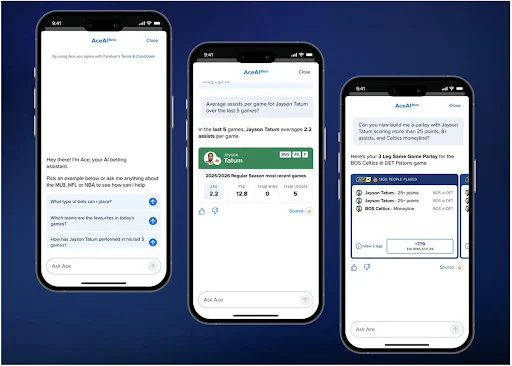
FanDuel's AceAI allows users to investigate markets and formulate bets through conversational interactions, while customers retain the responsibility of placing their own bets. This functionality showcases how large organizations can share resources across different brands within their portfolios.
Outsourcing development and maintenance to specialized suppliers can enable operators to manage costs effectively while accessing proprietary data and expertise that is challenging to replicate, creating a strong incentive to invest in external partnerships. Waterhouse VC recognizes a distinct opportunity in financially supporting suppliers that can produce superior products at a lower cost than operators could achieve independently.

