
In June 1914, Lawrence Sperry made aviation history by flying above the Seine near Paris with both hands off the controls while his mechanic climbed onto the airplane’s wing. He was showcasing one of the earliest forms of autopilot technology, which kept the aircraft steady.
Over a century later, autopilot systems continue to play a crucial role in commercial flights, yet passengers still prefer having a pilot on board. The flight crew charts the course, oversees the aircraft’s systems, and is ready to step in when needed.
Sports betting is following a similar trajectory with the emergence of AI agents. Bettors can now allocate a budget and set parameters for an AI to follow along with specific strategies, such as employing a cricket model or taking advice from NFL betting experts. This technology has the potential to research options and place bets according to predetermined limits, allowing users to focus on other activities.
This ease of use is expected to attract more individuals to sports wagering, making betting tools and insights accessible to a broader audience. Current prediction markets like Polymarket are already implementing automated trading, setting a precedent for sportsbooks to enhance user convenience within their platforms.
Automated betting has been a fixture in the industry for years, particularly among professional racing syndicates that utilize complex software for high-volume wagers based on probability models. Betfair facilitates automated betting through its Exchange API.
AI agents are poised to democratize these advanced capabilities. Users who may not possess the technical skills to create a betting bot can now simply describe their strategies in everyday language, and the software will execute it.
Traditional betting bots usually accept advice from tipster feeds and place wagers within set limits. In contrast, an AI agent takes broader directives, autonomously determining which data and tools to utilize. For instance, in cricket betting, the agent might research team lineups, assess weather reports, consult a specialized model, and compare predictions against available odds prior to making a bet.
These AI agents can adopt established strategies as well, such as betting based on price momentum or reacting after sharp price shifts. They can even create markets by offering buying and selling prices to earn profits from the spread. Markets should welcome these bots as they can enhance liquidity, making it easier for users to trade while also generating additional revenue through increased transactions.
Currently available consumer products such as Olas's Polystrat, launched in February, allow users to fund an AI agent and select or describe a strategy. The software then evaluates markets and conducts trades on Polymarket. Another example, Forkast's ATLAS, enables customers to request and approve trades via Telegram.
On social media platforms like X, the concept of “trade while you sleep” is gaining traction. Providers often highlight successful trades, with screenshots serving as marketing tools. Yet, a single profitable trade doesn’t guarantee ongoing success.
Polymarket provides a transparent view of trading records, enabling players to explore which accounts are financially successful, the types of trades they engage in, and whether their strategies can be replicated. As usability increases, bettors can mimic accounts, adapt tactics, and test strategies that once required significant resources.
A key advantage for bettors is enhanced consistency. A casual bettor may perceive a $25 wager at odds of $2.20 similarly to one at $2.50. However, a 43% win probability at $2.20 translates to an expected loss of 5.4 cents per dollar staked, while $2.50 indicates an expected profit of 7.5 cents, excluding fees. Software can use established probability assessments and staking guidelines to calculate appropriate wager sizes as prices fluctuate, ensuring adherence to spend limits and helping manage bankrolls. Despite the efficiency and time saved, automation alone cannot transform a flawed strategy into a winning one.
Customers still determine the course of their betting. Trusting an AI to select bets autonomously requires confidence that may not yet be fully realized, leading many to prefer reviewing each trade before granting the AI more control.
One contact in our network utilizes a Telegram bot specifically for Australian racing. This bot swiftly calculates stakes in accordance with mandated minimum bet conditions, allowing the user to act quickly before prices shift. However, he still confirms each wager before it is submitted.
Professional betting teams are likely to emphasize execution oversight, error correction, and the safeguarding of proprietary strategies. Any new tool must maintain the competitive edge they have developed over years of practice.
With numerous AI agents targeting the same opportunities, their collective actions could shift market prices against later bettors. Bill Benter described this challenge within horse racing where independently developed models often favor the same horses, leading to diminished payouts for all. Additionally, replicating a successful account’s selections does not guarantee the same return rates. Diversification across various accounts may obscure the complete picture, as a worse entry price could negate the initial advantage.
As more AI agents compete for the same positions, distinct data, insightful analysis, and specialized betting knowledge will likely increase in value. These agents could also broaden the audience for tipsters by pursuing selections that individual customers might overlook, provided they can still secure advantageous prices.
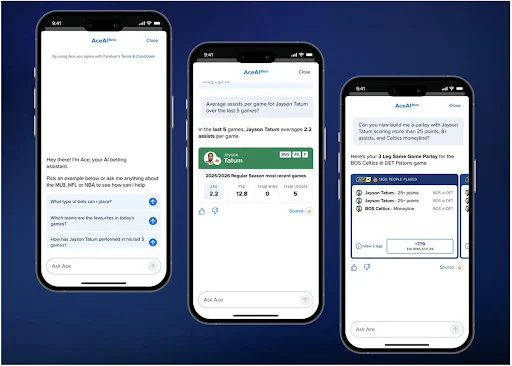
To meet the rising demand for personalized and effective tools, wagering operators must weigh their options between in-house development and external partnerships. FanDuel, for instance, introduced AceAI, a feature that empowers customers to research markets and place bets through conversational queries, while maintaining direct control over their betting actions. FanDuel has shared this infrastructure with fellow Flutter brand Sportsbet for a similar assistant.
Specialist suppliers can also distribute development and maintenance costs across multiple operators, enhancing affordability, particularly when combined with proprietary data or unique betting strategies that are difficult for competitors to replicate. Waterhouse VC recognizes the potential to invest in suppliers that can produce superior products at lower costs compared to what operators could achieve independently.

