
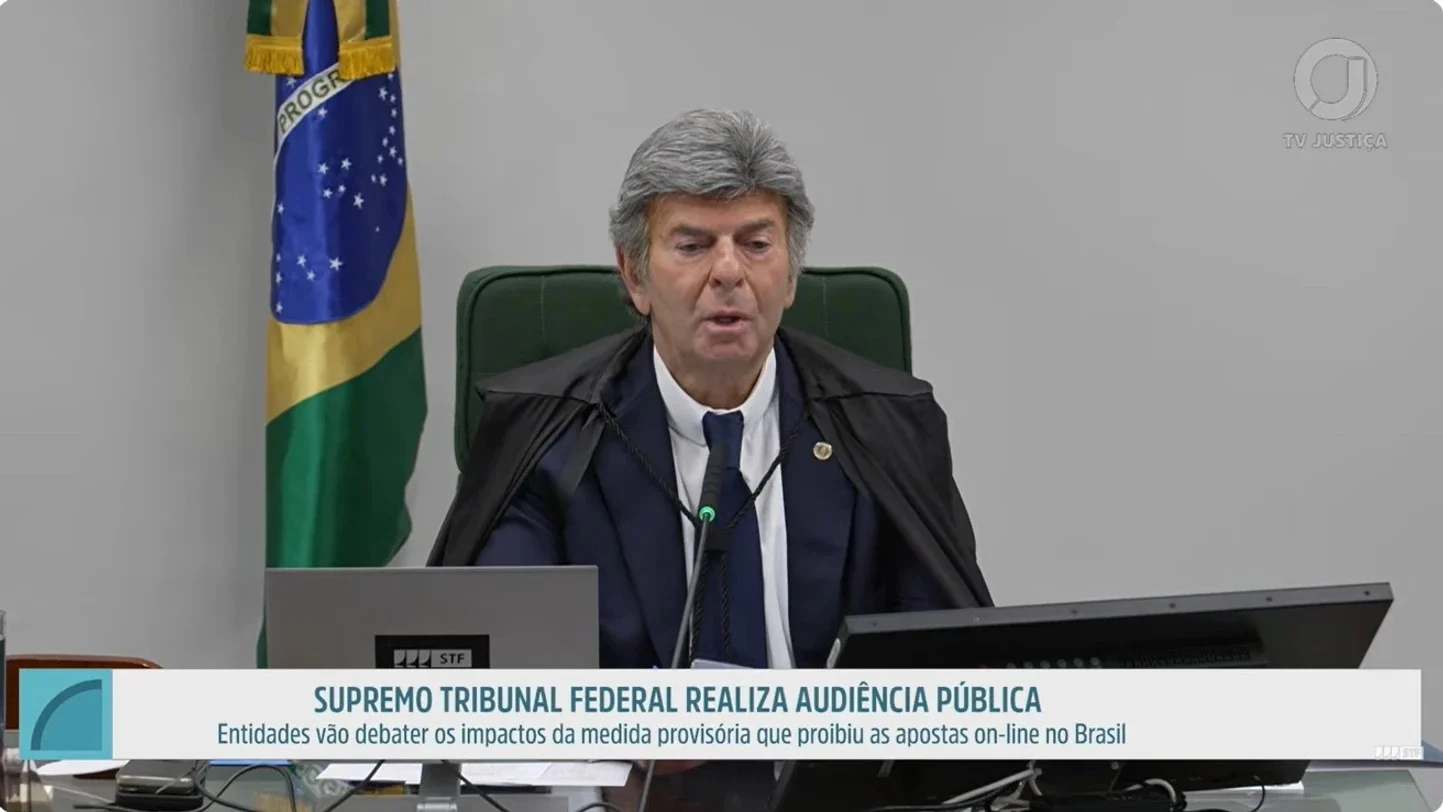
In a critical Supreme Federal Court (STF) hearing on Tuesday, Brazil's government defended its decision to ban betting amid calls from industry representatives, football clubs, and sports organizations to uphold a regulated market. Minister Luiz Fux opened the public session, which saw participation from 34 stakeholders discussing Provisional Measure 1.394, the enactment that prohibits betting in Brazil. This measure is being contested in Direct Action of Unconstitutionality 8027, put forth by the National Association of Games and Lotteries (ANJL), which aims to annul the provisional measure's effects.
Officials from the Ministries of Justice, Health, and Finance, along with the Attorney General’s Office (AGU), asserted that the prohibition is essential for safeguarding families from gambling's adverse health, financial, and social ramifications. Justice Minister Wellington César Lima e Silva characterized betting platforms as fostering “an architecture of unspeakable dependency,” emphasizing the measure’s importance and urgency.
Jorge Messias, head of the AGU, backed the government's stance, declaring that the previous regulatory structure had not provided adequate protections. He acknowledged the efforts of licensed operators but noted the need for a review of such policies in light of their results, indicating that the existing framework had become “materially unconstitutional” due to its failure to adequately protect constitutionally safeguarded interests.
In response, the betting industry argued for legal certainty and stronger protective measures, warning that prohibition might drive consumers toward unregulated markets. The Brazilian Institute for Responsible Gaming (IBJR) urged Fux for an injunction to suspend the ban until Congress or the Supreme Court could make a definitive ruling. Celso Mori, representing the IBJR, emphasized that Brazil had chosen to regulate gambling after extensive legislative processes, lamenting a sudden shift towards total prohibition.
The Economic Regulation Laboratory at the State University of Rio de Janeiro (UERJ) introduced eight conditions that could accompany a reopening of the betting market if the ban is lifted. These recommendations include preventing bets from being financed by credit-funded transactions, implementing a cap on betting limits for individual tax identification numbers, verifying user eligibility, enhancing self-exclusion measures, and ensuring the Betting Management System (Sigap) is transparent and auditable.
UERJ also proposed regulatory measures such as advertising restrictions, mandatory funding for gambling prevention and treatment services through Brazil's public health system, and a clear catalogue of approved bets. UERJ representative Marcello Trindade Paulo suggested a phased transition plan, including milestones at 180 and 360 days, to manage the reopening if the ban is rescinded.
Additional appeals came from sports clubs advocating for a regulated approach. The prominent Brazilian football team Flamengo urged for effective regulation instead of a complete withdrawal of the ban, while Corinthians proposed that football organizations engage in campaigns to combat gambling addiction and challenge illegal platforms. Meanwhile, the Brazilian Paralympic Committee stressed the importance of age restrictions and operator accountability in recognizing and mitigating compulsive behavior.
The discussion also highlighted concerns regarding the treatment of companies that had previously acquired licenses. Industry representatives indicated that the state had fostered prior investments before abruptly revising its policy. They questioned aspects related to a BRL30 million ($5.5 million) authorization fee and the immediate cessation of betting advertisements.
Gustavo Binenbojm from the Brazilian Association of Radio and Television (Abert) criticized the ban as a significant retreat from an established public policy, describing the original decision to regulate as a pragmatic approach that balanced sector risks without surrendering the market to illegality and organized crime. He questioned whether the state had the authority to overturn such a policy abruptly through a provisional measure.
Minister Fux will determine the proceedings regarding the measure; no decision regarding a suspension or modification of the ban was reached during the hearing.

