
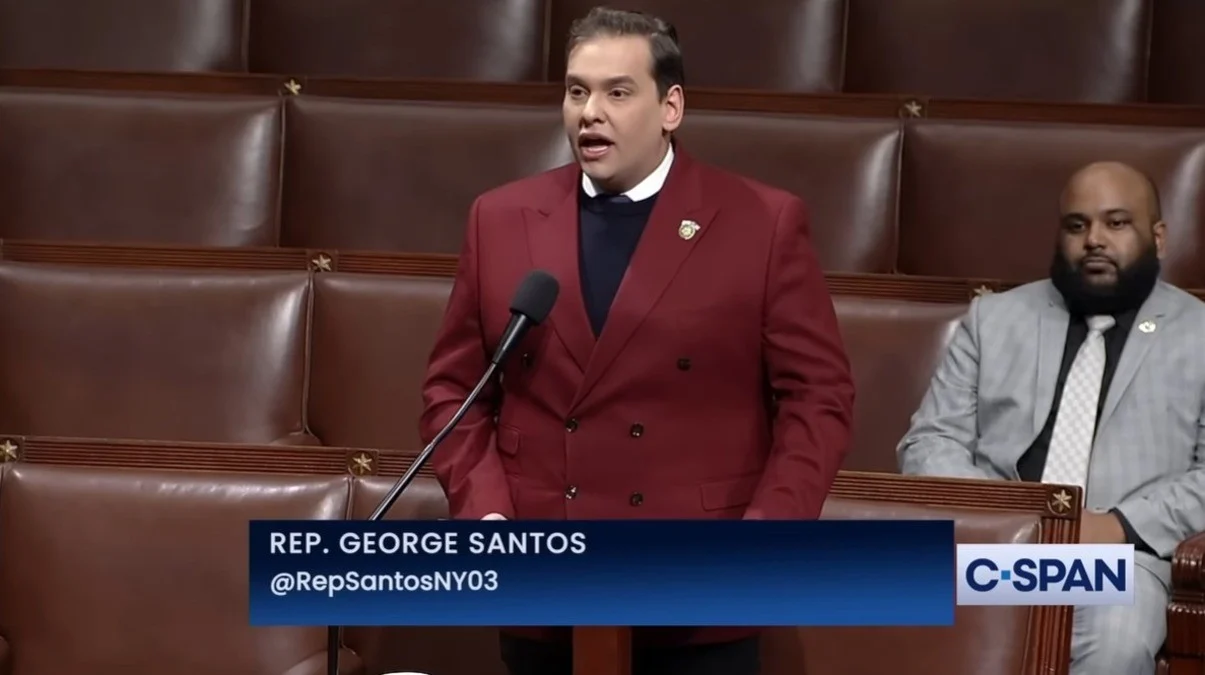
In the latest development surrounding insider trading in prediction markets, Polymarket has severed its relationship with George Santos amid a Department of Justice investigation. The former congressman from New York reportedly placed a wager regarding his attendance at the State of the Union address on February 24. Santos had expressed his intent to be present at the address, stating on X, 'I’m going to be there for the State of Union in the gallery, guys,' just one day before the event.
While millions were traded on Kalshi, a competing prediction market, about individuals attending the event, Santos later disclosed that he could not attend due to flight issues. Reports indicate that he made wagers on Kalshi about his attendance. After identifying his trades, Kalshi froze Santos’ account and notified federal authorities. Notably, Santos had made a wager on himself not attending the address, as indicated by a timestamp on X during President Donald Trump's speech. When asked if he had an account on Kalshi, Santos replied, 'I’m not saying yes, I’m not saying no.'
A federal judge sentenced Santos to 87 months in prison last April after he was found guilty of felony wire fraud and check fraud charges. He was granted clemency by Trump after serving several months in 2025, leading to his immediate release. Shortly thereafter, Santos began working as an influencer for Polymarket.
In other news, Illinois has become the second state to implement a tax on prediction market operators, following Kentucky. This move places a new financial burden on companies offering sports-event contracts. The Illinois General Assembly passed SB 3019, which imposes taxes on prediction markets as part of a broader budget plan projected to yield around $65 million for the state in fiscal year 2027.
While the exact tax rates for prediction markets remain unspecified, the American Gaming Association has estimated that states have collectively lost over $1 billion in tax revenue due to the rise of sports event contracts. Advocates for prediction markets argue that the new taxes resemble double taxation, as profits from trading are already subjected to capital gains taxes. More than two dozen states are considering legislation against prediction markets.
In a unique promotional effort, patrons at an Upper East Side bar cheered for the New York Knicks during Game 1 of the NBA Finals. As the Knicks approached a victory against the San Antonio Spurs, owners of The Jeffrey promised to cover part of the customers' tabs. Owner Andy Freedman credited a $5,000 wager placed on Kalshi for the successful promotion. If the Knicks won, each customer could enjoy up to $100 on food and drinks, though this did not include sales tax or tips. The wager had a 37% probability of winning, leading to a payout of roughly $12,940 afterward. Kalshi described this strategy as a method to transform a 'risky promotion' into a 'fully insured one,' but the bar has not revealed specific expenses related to the promotion. Kalshi’s Nicolas Hull remarked on the significance of such platforms, stating, 'Small businesses are exposed to real-world risk…traditional insurance is not built for this kind of operational exposure.' As of Friday afternoon, Kalshi indicated that the Knicks had a 53% chance of winning the NBA title.

