
In June 1914, Lawrence Sperry performed a remarkable feat over the Seine River in Paris, flying with both hands off the controls while his mechanic climbed onto the wing of the aircraft. This was one of the first demonstrations of an autopilot system, which utilized a gyroscopic stabiliser to maintain level flight.
Fast forward over a century, autopilot technology now plays a crucial role in modern commercial aviation, though few would board a plane without a human pilot onboard. The flight crew is responsible for planning the journey, monitoring onboard systems, and taking control whenever necessary.
A similar evolution is underway in the betting industry. Picture a sports bettor instructing an AI agent with a predetermined budget and specific directives—perhaps to follow a cricket model or back selections from an NFL tipster while monitoring golfers throughout a tournament. This AI could research potential bets and, depending on the platform's rules, place wagers within set parameters, allowing customers to focus on their daily lives.
This convenience is expected to attract a greater number of participants into sports betting, making advanced tools and expertise more accessible to a broader audience. Emerging prediction markets like Polymarket have already embraced automated trading, providing a preliminary space for such innovations. Consequently, sportsbooks may feel compelled to introduce similar features on their platforms.
The concept of automated betting is not new; professional racing syndicates have long employed computer-assisted wagering that merges probability models with software capable of placing large bets into tote pools. Platforms like Betfair also enable automated betting through their Exchange API.
AI agents promise to democratize access to these advanced capabilities. Even casual bettors who lack programming skills could articulate a betting strategy in simple terms for the software to execute.
Standard betting bots typically accept selections from a tipster’s feed, submitting wagers within predetermined price and stake constraints. In contrast, AI agents operate on broader instructions, autonomously determining the most relevant information and tools. In a cricket context, this could involve gathering team updates, checking weather forecasts, evaluating specialist model predictions, and comparing these to available odds before making a wager.
These agents can adopt established strategies as well, such as betting based on price momentum or making calculated reversals after significant price movements. They can act as market makers by quoting buying and selling prices to profit from the spread. Exchanges have an incentive to support such activities, as these market-making bots can enhance liquidity and increase profitability through additional fee-generating trades.
Several consumer-friendly products are already available. In February, AI agent platform Olas introduced Polystrat, enabling users to fund an agent and specify or describe a strategy while the software assesses markets and executes trades on Polymarket. Similarly, Forkast’s ATLAS allows customers to request and authorize trades via Telegram.
The concept of "trade while you sleep" is being promoted on social media platforms like X. Providers and marketers often highlight profitable trades, using compelling visuals to sell subscriptions. However, a profitable trade does not necessarily indicate sustainable profitability.
Polymarket’s publicly accessible trading records allow intrigued bettors to examine the success of various accounts, the trades they execute, and whether their strategies could be replicated. As these tools become increasingly user-friendly, bettors can mimic successful accounts, adapt strategies, and experiment with ideas that previously required developer knowledge. Some may even create their tools and find a market for them.
Consistent execution is an immediate advantage for bettors using AI agents. A casual bettor, for instance, may not differentiate between a $25 bet at odds of $2.20 and one at $2.50. In reality, the former represents an expected loss of 5.4 cents per dollar based on a 43% chance of winning, while the latter suggests an expected profit of 7.5 cents, prior to fees. With a clear probability estimate and established staking rules, software can dynamically adjust stakes as market prices evolve and can choose to decline bets falling below set limits, thus assisting with bankroll management.
This consistency and time-saving aspect may justify its cost, but it's essential to note that automation alone cannot transform a flawed betting strategy into a winning one. Customers must still define their betting parameters. Handing over bet selection to AI demands a higher level of confidence compared to providing explicit instructions, and many may prefer to approve individual trades before relinquishing more autonomy.
One individual in our network employs a Telegram bot that identifies bets and calculates stakes in accordance with Australian racing's minimum bet regulations, which require bookmakers to accept qualifying wagers up to a specified potential payout. The bot provides rapid calculations, enabling decisive action before market prices shift, but the user still confirms each bet before placement.
Professional betting teams will closely scrutinize their execution, error management, and strategy protection. Any tool adopted must safeguard the competitive advantages cultivated over years of experience.
As numerous AI agents converge on the same betting opportunities, increased orders can lead to price fluctuations that impact latecomers. Bill Benter highlighted a similar challenge in horse racing, noting that independently developed models could converge on common selections, diminishing payouts for all who wager on those horses.
Although mirroring a successful betting account's picks is straightforward, reproducing its returns can be elusive. Bets spread across multiple accounts may obscure the complete picture, and less favorable entry points can undermine original advantages. Agents must still evaluate whether a wager holds value at the price available to their customer.
The competitive landscape presents an opportunity for those with proprietary data, unique analysis, and specialized betting acumen, which will become increasingly valuable as more agents vie for the same betting spots. Furthermore, agents could enhance the visibility of tipsters by pursuing selections that their users might otherwise overlook, provided that they can secure prices that maintain the original advantage.
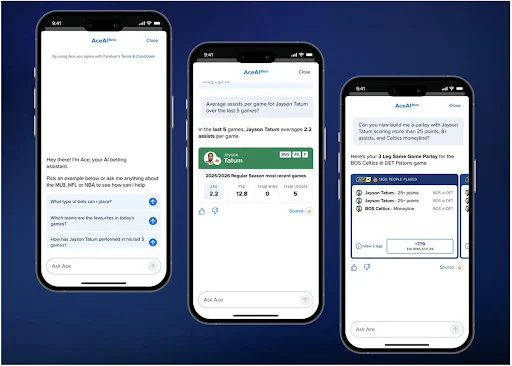
With customers demanding more tailored, effective tools, wagering operators are faced with a key decision: what features to develop in-house and what to acquire externally. FanDuel rolled out AceAI, allowing customers to explore markets and create bets through dialogue, although bettors ultimately retain control over their wagering decisions. This technology was also shared with Sportsbet, another brand under Flutter, maximizing efficiency across their portfolio.
Specialized vendors may distribute development and maintenance costs among various operators, and when paired with proprietary data or hard-to-replicate betting expertise, this may provide a compelling rationale for operators to make purchases.

