
In June 1914, Lawrence Sperry demonstrated one of the earliest autopilots by flying over the Seine River near Paris while his mechanic stood on the aircraft wing, aided by a gyroscopic stabilizer that kept the plane level. Over a century later, autopilot technology plays a significant role in modern aviation, although most passengers would still hesitate to board a flight that lacks a pilot. The flight crew is essential for setting the course, monitoring systems, and taking control during critical moments.
The world of sports betting is evolving in a similar manner. Bettors may soon have the ability to engage an AI agent to manage their betting activities, setting a budget and giving instructions tailored to a specific sport, such as cricket, or using selections from NFL tipsters while keeping tabs on golfers during tournaments. This AI could autonomously research bets and, according to the platform's parameters, place wagers within pre-established limits, allowing bettors to focus on other aspects of their day.
This enhanced convenience is anticipated to attract a larger audience to sports betting, making advanced wagering tools and betting insights more accessible. Automated trading is already present in prediction markets like Polymarket, pointing to an emerging trend that sportsbooks may need to adopt to maintain competitiveness.
Automated betting is not new; various professional racing syndicates employ computer-assisted wagering that merges probability models with extensive betting on tote pools. Similarly, Betfair allows automated betting via its Exchange API.
AI agents promise to democratize access to such technology. Those who might not have the expertise to create their own betting bots can simply articulate their strategies, allowing the software to execute them.
A traditional betting bot might follow tipster selections, placing bets based on predetermined price and stake limits. In contrast, an AI agent can interpret broader instructions and make intelligent decisions on which resources to utilize. For a cricket match, for example, the AI could gather team updates, monitor weather forecasts, consult specialized models, and compare predictions against available odds before deciding to place a bet.
AI agents can also execute well-known strategies, such as betting on price movements or identifying reversals following significant shifts. Market-making bots can enhance liquidity, facilitating easier trading for other customers while also increasing revenue from additional fee-paying transactions.
Several consumer products utilizing AI agents are already operational. For instance, Olas launched Polystrat in February, enabling users to fund an agent and either choose or describe their strategies while the AI evaluates markets and makes trades on Polymarket. Forkast’s ATLAS platform also permits customers to request and approve trades via Telegram.
Promotions claiming to enable trading while you sleep are already appearing on social media, particularly on X. Although providers often showcase profitable trades to attract subscriptions, one profitable trade does not guarantee consistent returns. Public trading records, like those on Polymarket, allow inquisitive bettors to analyze which accounts are performing well, what they trade, and whether their methods can be replicated. As tools become increasingly user-friendly, bettors can adapt strategies, test new ideas, and potentially build their own tools that could attract interest from others willing to pay.
For bettors, one immediate advantage of using AI agents is consistent trade execution. A recreational bettor might view a $25 wager at $2.20 similarly to one at $2.50. Yet, the expected outcome varies significantly, with differing implications for potential loss or profit based on probability estimates. Software can continuously calculate stake adjustments as prices shift while managing spending limits to help users control their bankrolls. While automation can enhance execution and save time, it cannot turn a bad strategy into a successful one.
Ultimately, the customer maintains control over their betting decisions. Allowing an AI to choose bets requires a greater level of trust than simply having it follow explicit instructions, leading many customers to prefer approving each individual trade before granting broader discretion to the agent.
One contact within our network utilizes a Telegram bot to quickly identify bets and calculate stakes under Australian racing rules, which mandate that bookmakers accept qualifying bets of a specific potential win. The bot rapidly computes stakes, allowing him to act swiftly before prices change, while still requiring his approval for each bet.
Professional betting teams will closely scrutinize execution methods, error management, and safeguarding their strategies. Any tools integrated into their workflow must protect the advantages they have developed over the years.
However, if multiple AI agents pursue similar betting opportunities, the resulting rush could affect market prices for subsequent customers. Bill Benter highlighted this issue in horse racing, noting that independently developed models could all favor the same outcomes, diminishing payouts.
While it may be easier to mirror a successful account’s selections, replicating its returns is significantly more complicated. Distributing positions among multiple accounts could obscure a complete picture, and less favorable entry prices can undermine the original advantage. An AI agent must discern whether a bet remains valuable based on the price a customer can access.
As competition among AI agents intensifies, we foresee proprietary data, unique analyses, and specialized betting expertise becoming increasingly important. Agents might also broaden exposure for tipsters by acting on selections that clients may miss, as long as they can still secure advantageous prices.
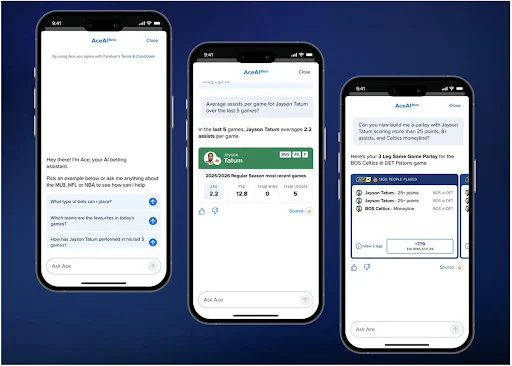
As customer expectations heighten regarding effective, personalized tools, betting operators face decisions about their development strategies—whether to build in-house or collaborate with suppliers. FanDuel’s AceAI, for example, enables customers to explore markets and construct bets through conversational interfaces while still requiring users to submit their own bets.
FanDuel developed AceAI in-house and shared its code and infrastructure with Sportsbet, another brand under Flutter, which has created a similar assistant. Larger entities can distribute development costs across various brands, optimizing their investments.
Specialized suppliers can also mitigate development and maintenance expenses across multiple operators, and when combined with unique data or betting expertise that is hard to replicate, they present a strong case for operators to consider outsourcing.

