
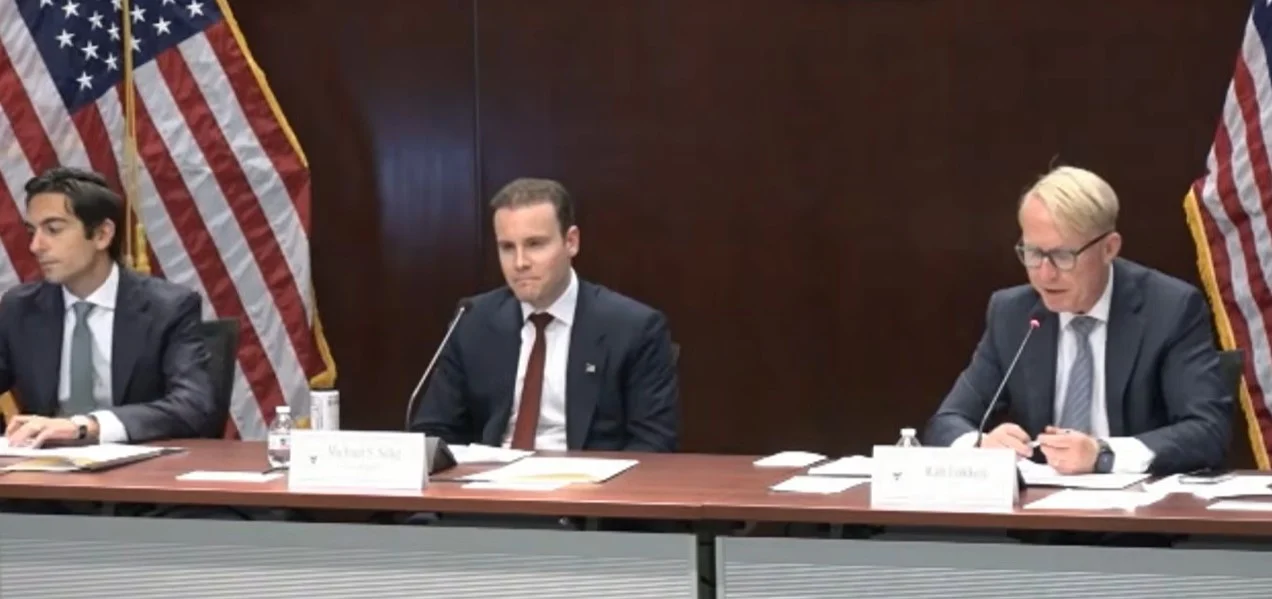
Executives from the derivatives sector gathered in Washington, DC, on Thursday for a highly anticipated conference, where the atmosphere turned tense as clashes arose during discussions about regulations for sports event contracts. The U.S. Commodity Futures Trading Commission (CFTC) hosted an advisory committee's inaugural meeting, bringing together significant figures like Robinhood CEO Vlad Tenev and Gemini co-founder Tyler Winklevoss, along with prominent sports betting leaders such as Jason Robins, Matt King, and Christian Genetski.
While the early parts of the conference covered less thrilling topics related to crypto asset management and agentic finance, the discussion shifted dramatically during a panel on prediction markets. CME Group CEO Terrence Duffy's comments on potential market manipulation sparked a heated exchange with CFTC Chairman Michael Selig.
Duffy expressed concern over several questionable contracts he claims could damage market integrity, including one tied to the removal of Venezuelan President Nicolas Maduro, a derivative linked to Gabriel Perez, a former teleprompter operator for President Donald Trump, and various sports-related contracts. He stressed that these contracts violate CFTC Core Principle 3, which ensures that Designated Contract Markets (DCMs) only list products that are resistant to manipulation.
In response, Selig, who became the CFTC's 16th chairman in December, pointed out that these contracts are not listed in the U.S. but are instead available on offshore platforms. This exchange underscored the intense debate surrounding regulatory approaches during the meeting, with unresolved questions looming over the potential impact on rulemaking.
An incident involving Perez, who reportedly profited from trades on insider information regarding Trump’s remarks, was particularly scrutinized online. Trade alerts from Kalshi, the platform where these trades occurred, prompted an internal investigation by the CFTC. Selig incorrectly stated that these transactions were made outside the U.S., although he correctly noted that the Maduro contract was indeed listed offshore.
Duffy raised additional concerns about self-certified contracts that he deems vulnerable to manipulation but refrained from naming specific sports-related trades. He asserted that reducing standards could drive participants away from regulated markets, stating, "That is horrible for the industry, we are not a bunch of carnival barkers at a circus. We are running the most envious markets in the world."
Selig outlined potential pathways for developing a framework for prediction markets, mentioning proposed amendments to Rule 40.11 that could allow the CFTC to assess whether contracts related to sensitive topics like war and assassination align with the public interest. He also hinted at possible governance and market design expectations.
The program saw further friction when Duffy questioned why Kalshi can offer so-called "compute contracts," which are binary options on products like Nvidia’s AI graphical processing units, while the CME's application for similar derivatives remains under review. Lara, co-founder of Kalshi, retorted, challenging Duffy about any known manipulation cases involving the CME, to which Duffy quipped about the size of his regulatory team compared to Kalshi's workforce.
DraftKings CEO Jason Robins took on the role of mediator, requesting attendees to focus on encouraging constructive dialogue rather than conflicts. However, he and other sportsbook leaders did not dive into pressing issues related to market-making regulations or federal preemption. King emphasized the importance of a principles-based consumer protection approach, while Genetski voiced FanDuel's commitment to building consumer confidence in predictions.
Selig did not clarify if the committee would meet again this year or address the timeline for final rules on sports-event contracts, especially as the football season approaches. He highlighted the potential of prediction markets, artificial intelligence, and blockchain technology to redefine financial markets in the coming decades, stating, "We’ve crossed the Rubicon and are standing at a new frontier of finance."

