
Triple zero roulette first appeared at the Venetian in Las Vegas in the fall of 2016. Casual casino players might not even notice it.
Casinos often use a logo instead of zeroes to further hide it from view. But its inclusion makes a huge difference, according to a recent experiment from Math and Computer Science Professor Christopher Ingrassia of Kingsborough Community College in New York.
“I chose roulette, not because I particularly love the game, but I really chose roulette because it’s a very simple game,” Ingrassia explained in a call this week. “Once your bet is on the table, there’s no further decision to be made. So, for any kind of mathematical analysis or for computer simulation, it’s a very simple game to look at. Another thing with roulette is that, no matter which type of bet you make, even though the payouts are all different, the house edge is consistent throughout.”
It may be consistent across all bets, but the addition of the triple zero has significantly increased the house edge.
The house edge for European (single-zero) roulette is around 2.7%; for American double-zero roulette, it’s about 5.4%. For triple zero, that increases to 7.69%.
In most casinos, European roulette tables are becoming rarer, and the minimum stake is significantly higher at around $100.
Ingrassia was interested in whether it is worth it for casual bettors to seek out these tables and bet more money at better odds, or to stick to low stakes on the triple-zero roulette game.
Better Odds Will Make You Better Off
He compared a roulette player staking $10 per spin on the triple-zero table with a player staking $100 per spin on the single-zero table. He ran the experiment with starting bankrolls ranging from $500 to $3,000 and conducted 10,000 trials for each.
There were three scenarios to end the experiment: if the gambler hit a desired profit level (20 to 100% of the bankroll), losing all the bankroll, or exceeding 600 spins.
“I think a roulette dealer will probably spin the ball about one time per minute,” Ingrassia reasons. “It takes them time to settle the bets and so forth. So, one spin per minute, that’s 10 hours of play. I think that’s about the limit for a regular visitor to Las Vegas.”
The findings were stark and attracted considerable interest when he presented them at the International Conference on Gambling & Risk Taking last month in Las Vegas.
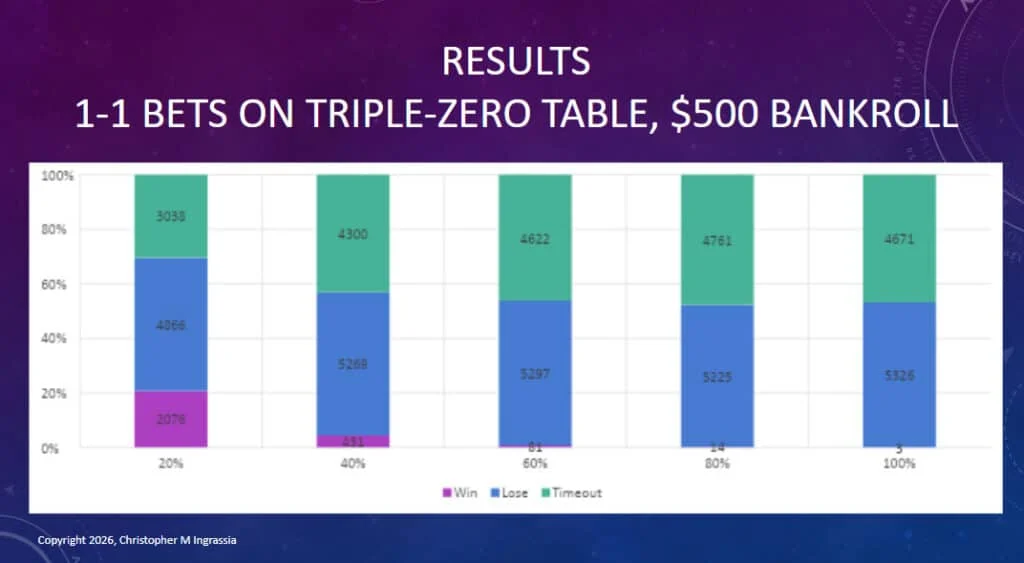
A gambler could walk away with a $100 profit from a starting bankroll of $500 over 80% of the time when playing the high-stakes game. On the triple-zero table, chances of success drop to around 20%.
As shown in the graph below, bettors would lose all their money most of the time before meeting their target. If a player targets $100 from their $500 bankroll, they would lose all their money roughly 50% of the time. In the green bar shown, the player would still have some money left after 600 spins, but would usually be down.
Aim for Modest Profits, Then Walk Away
The graph above also shows that aiming for higher profits or playing longer will reduce your chances of success. Even targeting $200 instead of $100 results in a sharp decrease in success rate, from 20% to less than 5%.
If you want to double your money, the chances of doing so on the triple-zero game are basically nonexistent. Across 10,000 trials, there were only three occasions where the simulator doubled $500 when staking $10 per spin on the triple-zero game.
In the single-zero game, you could double $500 about 40% of the time. For larger bankrolls, you will find it harder to convert that into larger profits. If you start with $3,000, the probability of generating a 20% profit ($600) falls from 80% to about 65%.
The graph below shows how often a player can hit a desired profit level with different starting bankrolls. These are all from even-money outside bets, such as red or black. Ingrassia noted that the results were pretty much identical when placing other kinds of bets, as the house edge remains consistent across all wagers.

Ingrassia plans to run further experiments to test how often you can make smaller profits with a bigger bankroll. A player starting with $3,000 would be expected to make a $100 profit far more often than a gambler starting out with $500.
“But if you’re making the dealer change out $3,000, you’re probably not going to want to walk away from the table after a $100 profit. You’re probably going to shoot to make a little bit more than that,” Ingrassia says.
Although, as his experiment shows, shooting for a high percentage of your bankroll will greatly reduce your chances of winning.
He stresses that the experiment was not designed to call out casinos. “I’m actually trying to help them, if anything,” he clarifies. “I’m trying to help them attract more bettors. I really do believe that if the casinos gave back a little more to the players, the players would churn more over time. I think it would be a win-win situation for everyone. But I don’t know if many of the executives feel the same way.”
Discipline & Value Bets are Key
The house always wins, especially when it increases its edge by introducing features like the triple zero. The equivalent in sports betting is single-game parlays. A sportsbook’s edge on single bets may be around 4.5%; on parlays, it could be as much as 30%.
Avoiding these kinds of high-risk, bad-odds bets is essential if you want to generate any winnings from gambling, Professors Robert Scott and Mikhail Sher told me recently.
Those sentiments were echoed by Trevis Waters, the CEO of PlayerProps.ai, who teaches novice bettors on how to avoid some of the biggest pitfalls in betting.
Ingrassia’s experiment further emphasizes the need for gamblers to remain disciplined and seek out better odds bets. The more edge you give to the house, the more the mantra rings true.

