
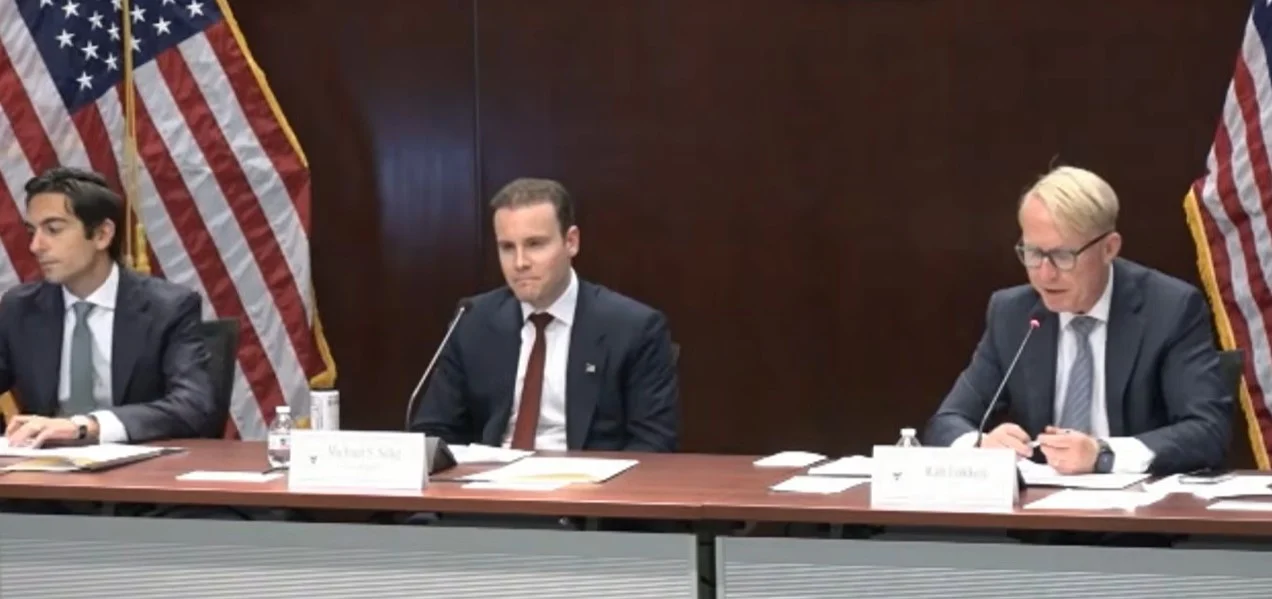
High-profile executives from the derivatives market gathered at the CFTC's Washington, DC headquarters on Thursday for a highly anticipated conference, where tensions flared amid discussions on sports event contracts regulation. The US Commodity Futures Trading Commission (CFTC) held its inaugural meeting of the Innovation Advisory Committee, featuring notable attendees such as Robinhood CEO Vlad Tenev, Gemini co-founder Tyler Winklevoss, and several sports betting leaders including Jason Robins, Matt King, and Christian Genetski.
The initial hours covered technical aspects of cryptocurrency asset management and agency finance. However, during a panel on prediction markets, discussions quickly escalated. CME Group CEO Terrence Duffy initiated a heated debate with CFTC Chairman Michael Selig regarding concerns over market manipulation in certain contracts. Duffy, expressing alarm over contracts he deemed "susceptible to manipulation," particularly cited three cases that might violate CFTC Core Principle 3: a contract related to the ouster of Venezuelan President Nicolas Maduro, one from a former teleprompter operator for President Donald Trump, and various sports-related contracts. This principle mandates that Designated Contract Markets (DCMs) must list only contracts that are not prone to manipulative trading practices.
Selig replied, clarifying that these contracts were "not listed" in the U.S., but offshore instead. This exchange underscored the meeting's final panel, as remaining key questions linger on whether the conference will yield any significant progress in the rule-making process.
The teleprompter incident involving Trump generated considerable attention on social media. Industry figures pointed out that the controversial trade took place on Kalshi, where Gabriel Perez, Trump's former teleprompter operator, is reportedly under investigation for allegedly trading on insider information. He is suspected of making over $100,000 from these contracts. Kalshi's internal team had flagged the trades to inform the CFTC of these potential irregularities. Kalshi co-founder Luana Lopes Lara attended the meeting in place of Tarek Mansour, her CEO and former MIT classmate.
Selig later mistakenly stated that the trades occurred outside of the U.S., though he did correctly note that the Maduro-related trade was conducted on an offshore platform. Additionally, Gannon Van Dyke, a U.S. special forces soldier, faces charges for allegedly trading on classified information related to a mission concerning Maduro.
Duffy continued to voice his concerns over other self-certified contracts, asserting that the industry should not lower standards that could drive participants away from regulated markets. He firmly stated, "That is horrible for the industry, we are not a bunch of carnival barkers at a circus. We are running the most envious markets in the world."
Meanwhile, Selig proposed several avenues to develop a roadmap for prediction markets, referencing proposed amendments to Rule 40.11 regarding contracts related to war, terrorism, and assassination that may be against public interest. He also pointed out potential guidelines for product governance, market design, and incentive programs.
Duffy later confronted Lara about why Kalshi was permitted to offer "compute contracts" while the CME's application for similar derivatives remains under consideration. Compute contracts allow users to predict the future price of AI-related components, such as Nvidia microchips. This prompted Lara to ask Duffy if CME had ever investigated a case of manipulation, to which Duffy humorously replied that CME's regulatory staff is larger than Kalshi's entire team. Lara quipped back, "maybe you should learn a bit about efficiency then."
DraftKings CEO Jason Robins attempted to mediate by urging participants against "infighting" that might hinder “constructive dialogue.” However, neither he nor other sportsbook representatives addressed critical regulatory topics, including market-making regulations or federal preemption issues. King, CEO of Fanatics Betting + Gaming, stressed the importance of a principles-based approach to consumer protection and responsible trading, while Genetski, who recently became the CEO at FanDuel, highlighted the company’s focus on building consumer trust in prediction markets.
Selig did not confirm if the committee would reconvene this year or if the CFTC plans to set final rules for sports event contracts before the football season begins. He characterized prediction markets, AI, and blockchain technology as innovative areas poised to shape future financial markets. "We’ve crossed the Rubicon and are standing at a new frontier of finance," Selig stated.

