
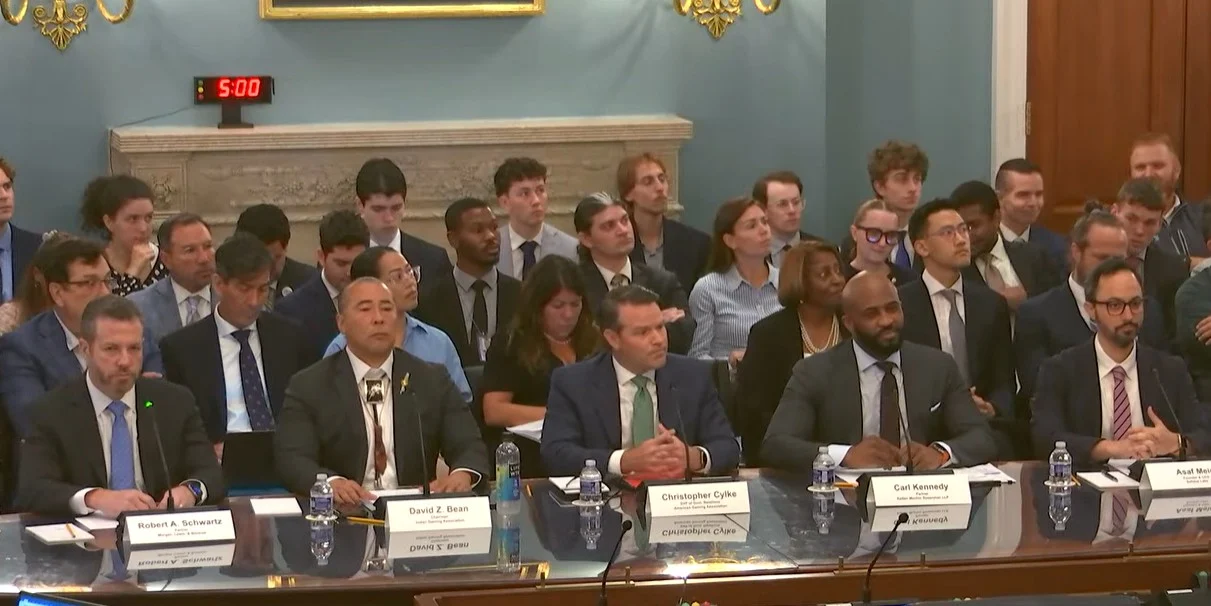
In May, shortly before the Memorial Day weekend, the US Senate conducted its first hearing on sports betting in over a year. Titled "No Sure Bets: Protecting Sports Integrity in America," the session aimed to address ongoing sports betting scandals but soon shifted towards a heated discussion regarding prediction markets.
This week, the House of Representatives took its turn to address the complex issues surrounding this emerging category of assets. On Tuesday morning, a House subcommittee convened for an important hearing focused on market integrity in relation to sports derivative contracts. This marked the first examination of the topic since Congressional members introduced numerous proposed bills aimed at implementing regulations within the multibillion-dollar industry.
The interest in sports event contracts is substantial, as shown by the recent 2026 FIFA World Cup, where trading volumes reportedly exceeded $50 billion. This high level of engagement highlights a significant contention over the regulation of sports event derivatives, which advocates for states' rights argue are illegal.
Two prominent gaming industry trade associations, the American Gaming Association and the Indian Gaming Association, contend that states and tribal nations might be losing millions in revenue due to the rise of prediction markets. Representatives from both groups provided testimonies during the hearing, along with two attorneys who shared their market perspectives. Asaf Meir, CEO of Solidus Labs, also testified, focusing on market surveillance capabilities to detect and prevent insider trading.
Alabama Representative Shomari Figures described the hearing as the "most balanced" he has ever attended in terms of the representation of witnesses, noting the intellectual debate it sparked.
The debate intensified this year as prediction markets became mainstream following their rise in 2025. The US Commodity Futures Trading Commission (CFTC), the federal authority governing derivatives, is actively validating the legality of sports event contracts amidst challenges posed by state governments.
Proponents of prediction markets argue that the mechanics of these contracts resemble traditional commodities futures, thus placing them under the CFTC's jurisdiction. Since taking office late last year, CFTC Chair Michael Selig has maintained that the agency is tasked with regulating sports event contracts.
Tuesday's hearing was organized by the House Agriculture Subcommittee on Commodity Markets, Digital Assets, and Rural Development in the Longworth Office on Capitol Hill. The broader House Agricultural Committee, chaired by Representative GT Thompson, a Republican from Pennsylvania, is overseeing these discussions.
Last month, the CFTC released a detailed set of proposed rules concerning sports event contracts, referencing a public interest test over 500 times. The agency will determine whether certain derivatives related to sports are contrary to public interest before finalizing these rules.
Thompson expressed encouragement over the draft’s thoroughness, stating, "This is an important rulemaking, and I am encouraged by the thought and work which went into the draft. It provides clear standards for the public interest and workable definitions for the key terms which have lingered undefined for so long."
David Bean, chair of the IGA, criticized the CFTC's staffing, pointing out that it has diminished under Selig's leadership and that distinctions between sports event contracts and typical sports bets remain unclear. He believes that sports event contracts are not fundamentally different from conventional wagers like over/unders and props.
The regulatory landscape remains contentious, with a federal framework for prediction markets appearing distant. Though Congress could potentially legislate on the matter while allowing state taxation on events contracts, state regulators are hesitant to relinquish control. Carl Kennedy, a derivatives attorney, advocated for a dual-regulation approach, suggesting that certain assets can be governed by multiple agencies without conflict.
Kennedy cited the example of gold, explaining that purchases can occur under state law while trading futures falls under CFTC jurisdiction. He contended that those who prefer state-licensed sportsbooks should still have the option to trade federally regulated event contracts.
Bean is pushing for immediate progress with HR 7840, the "Event Contract Enforcement Act," proposed by Representatives Blake Moore and Salud Carbajal. This legislation aims to amend the Commodity Exchange Act to prohibit federally registered exchanges from trading sports event contracts. However, the current political environment in Washington complicates passing new legislation, with GovTrack reporting that under 3% of standalone bills introduced in 2025 became law.
Kennedy, who also co-chairs the financial markets and regulation practice at Katten Muchin Rosenman LLP, does not support a blanket ban. He calls instead for tailored regulations that permit the CFTC to utilize its statutory authority.
Designated Contract Markets, such as Kalshi, follow the core principles mandated by the Commodity Exchange Act (CEA) for oversight. Kennedy pointed out that DCMs must adhere to 23 principles to achieve and maintain CFTC designation. He advocates for a system in which the CFTC ensures adherence to core principles, safeguarding customer protection and market integrity.
Most industry experts believe the matter of sports event contracts will likely lead to a Supreme Court case. Kennedy testified alongside Robert Schwartz, a former CFTC general counsel. Schwartz remarked on the unpredictability of the Supreme Court's involvement.
There are indications that New Jersey will soon request a review from the Supreme Court regarding the Third Circuit's ruling in favor of Kalshi, although another case might reach the Court first.
Schwartz noted the bipartisan nature of the issue, suggesting that its appeal across party lines could facilitate legislative action. South Dakota Representative Dusty Johnson, chair of the House subcommittee, confirmed that this week's hearing is just the beginning.
Johnson stated, "I do not believe that the committee, that Congress, should be silent. We have an obligation to drive toward finding out what is the common ground."

