
In June 1914, Lawrence Sperry executed an impressive stunt over the Seine River near Paris, flying with both hands off the controls and his mechanic perched on the wing. He was demonstrating one of the earliest forms of autopilot for airplanes, using a gyroscopic stabilizer to maintain level flight.
Fast forward over a century, autopilot technology has advanced significantly, now managing a large portion of commercial flights. Most travelers still prefer a pilot onboard, as the crew is essential in determining flight paths, monitoring systems, and taking control when necessary.
In a parallel evolution, sports betting is gravitating towards its own version of autopilot. Imagine a sports bettor delegating a budget and guidelines to an AI agent tasked with following a cricket model, supporting selections from an NFL tipster, and tracking golfers throughout a tournament. Such software could conduct research, assess selections, and, if permitted by the platform, place bets within specified limits, thus allowing bettors to focus on other matters.
This emerging convenience is poised to attract more users to sports betting and could make specialized tools and betting knowledge more accessible to a broader audience. Early adopters like Polymarket have already embraced automated trading, setting a precedent that sportsbooks may feel pressured to replicate.
Automated betting is not new; professional racing syndicates have long utilized computer-assisted wagering that integrates probability models into large-scale betting. Notable platforms like Betfair support such automation through their Exchange API.
AI agents have the potential to democratize these advanced capabilities. Customers lacking technical skills could articulate a betting strategy in plain language, and the software would execute it. Typically, betting bots act on specific selections from tipsters, adhering to predefined price and stake limits. However, AI agents could interpret broader instructions, selecting relevant information and tools at their discretion. For example, when betting on cricket, the agent could compile team news, analyze weather conditions, utilize specialist models, and compare predictions against available odds before executing a wager.
These AI agents can also implement well-known strategies, like betting on price fluctuations or reversals following price shifts, acting as market-makers by providing buy and sell prices to earn the spread. This activity is beneficial to exchanges, enhancing liquidity, allowing for easier trading among users, and increasing the volume of revenue-generating transactions.
Consumer-facing AI betting products are already operational. Olas launched its Polystrat platform in February, enabling users to fund agents and define or describe their strategies, allowing the agent to evaluate markets and execute trades on Polymarket. Similarly, Forkast's ATLAS allows users to request and approve trades via Telegram.
The appeal of “trade while you sleep” is gaining traction on platforms like X, where service providers promote effective trades, enticing users with screenshots that demonstrate profitable results. This showcasing of successful trades often serves as advertising for the technology, but the fleeting nature of profits is not guaranteed for the long term.
Polymarket openly displays trading records, enabling users to examine which accounts yield profits, what they engage with, and whether they can replicate those successful methods. As these tools become more user-friendly, bettors may emulate the strategies of successful accounts or test their own ideas without requiring technical expertise.
Automation offers immediate benefits, such as consistent execution. A casual bettor may treat a $25 wager at $2.20 similarly to one at $2.50, despite the significant difference in expected outcomes based on probability. If a wager has a 43% chance of winning, a $2.20 bet suggests a potential loss of 5.4 cents per dollar placed, while a $2.50 bet indicates an anticipated profit of 7.5 cents before deducting fees. With set probability estimates and staking protocols, software can dynamically adjust stakes as prices fluctuate and refuse bets that fall below a predetermined price. Furthermore, it can adhere to specific limits of spending and staking, enabling users to manage their bankroll effectively.
While this consistency and time-saving can make the service appealing, automation can’t make a flawed strategy profitable. The bettor still controls the overall strategy, as letting an AI agent autonomously choose bets requires a level of confidence that may deter some. Users often prefer to approve individual trades before granting more autonomy.
One user from our network employs a Telegram bot to identify potential bets and calculate stakes based on Australia’s minimum bet regulations, which compel bookmakers to accept bets for a specified potential win. The bot allows quick calculations to place bets before prices shift, yet the user still approves each wager manually.
Professional betting teams will require rigorous verification of execution, error management, and protection of sensitive strategies. Any tool they integrate must maintain their competitive edge, which has taken years to establish.
However, widespread adoption of AI agents could create challenges if numerous agents compete for identical bets, thus driving prices away from later customers. Bill Benter previously highlighted a similar issue in horse racing, where similarly coded models could concentrate bets on the same horses, reducing payouts for those betting on them.
While copying a successful account's selections is simplified, replicating its overall returns is complex. Users with diversified investments across multiple accounts may miss key insights, and obtaining less favorable entry prices can negate the initial advantage. Agents must assess whether a wager presents value based on the price available to their customers.
As competition among AI agents increases, proprietary data, unique analyses, and specialized betting knowledge may see a rise in worth. AI tools could broaden the audience for tipsters by acting on selections that might otherwise slip under the radar of bettors, assuming they can still secure advantageous prices.
Given the rising demand for efficient and customizable tools, sports wagering operators face the decision of what to develop versus what to outsource.
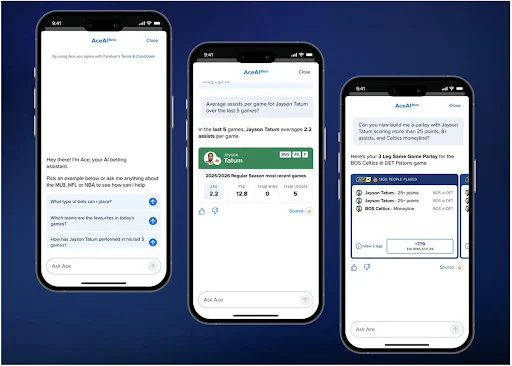
FanDuel has created its AceAI, allowing users to explore markets and craft bets through conversational prompts, keeping the responsibility of placing bets with the customers themselves. This technology was later shared with the Flutter-owned Sportsbet brand to produce a similar assistant. Larger organizations can distribute investment costs across their various brands.
Specialized suppliers have the ability to spread development and maintenance expenses among multiple operators. When combined with proprietary data or exclusive betting knowledge, which is difficult to replicate, this can provide operators with a compelling incentive to purchase rather than build their own solutions. Waterhouse VC sees a strong opportunity in backing suppliers that can deliver superior products at a lower cost than operators could generate internally.

