
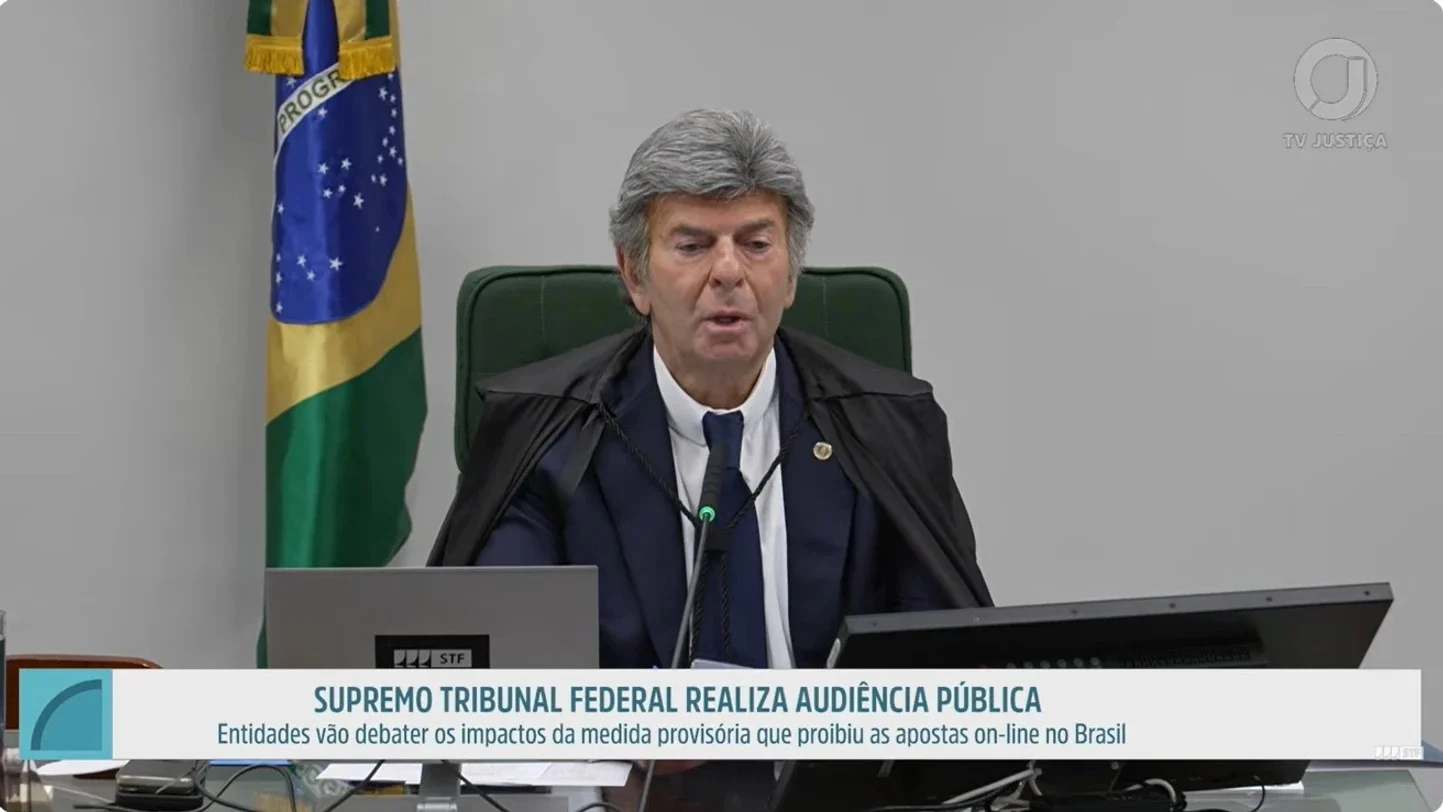
During a public hearing at Brazil's Supreme Federal Court (STF), the government defended its prohibition on betting, while various stakeholders, including industry representatives and sports organizations, advocated for the maintenance of a regulated betting market.
The hearing, chaired by Minister Luiz Fux, took place on Tuesday and involved 34 different entities discussing Provisional Measure 1.394, which has effectively banned betting activities in Brazil. This measure is currently being contested in Direct Action of Unconstitutionality 8027, initiated by the National Association of Games and Lotteries (ANJL), which seeks to suspend the provisional measure's effects.
Representatives from the Ministries of Justice, Health, and Finance, accompanied by the Attorney General’s Office (AGU), asserted that the ban was crucial for protecting families from the potential health, financial, and social repercussions associated with gambling. Justice Minister Wellington César Lima e Silva described betting platforms as an "architecture of unspeakable dependency," emphasizing the urgency of the measure.
AGU head Jorge Messias supported the government's stance, arguing that the previous regulatory framework had failed to safeguard citizens adequately. He stated, "Recognising this effort does not oblige us to close our eyes to its limitations" and acknowledged the contributions of licensed operators. Messias asserted that the prior framework had become "materially unconstitutional due to insufficient protection of constitutionally protected assets."
Conversely, industry representatives argued for the necessity of legal certainty and more effective protective measures, warning that a complete ban would drive consumers toward unregulated operators. The Brazilian Institute for Responsible Gaming (IBJR) requested Fux to issue an injunction to halt the measure until Congress decides or the Supreme Court addresses the issue. The ANJL echoed this call for stricter regulations aimed at harm reduction, rather than an outright prohibition.
Celso Mori, an IBJR representative, criticized the government’s abrupt policy shift after years of legislative development towards regulated gambling, expressing concern over returning to illicit gambling practices.
The Economic Regulation Laboratory at the State University of Rio de Janeiro (UERJ) proposed eight conditions to facilitate a reopening of the legal market if the ban is overturned, such as blocking bet financing via credit and setting a global betting limit per taxpayer identification number. They emphasized the need for user eligibility checks, enhanced self-exclusion tools, and auditing capabilities in the Betting Management System (Sigap).
UERJ also suggested advertising limitations, mandatory funding for gambling prevention and treatment through Brazil’s public health system, and a defined catalogue of authorized bets. UERJ representative Marcello Trindade Paulo indicated that a transitional process should include milestones for monitoring outcomes if the Provisional Measure remains in effect, proposing a phased approach with specific deadlines.
Additionally, prominent football club Flamengo called for improved regulation rather than a total repeal, while Corinthians proposed partnerships with football clubs to tackle gambling addiction and illegal betting platforms. The Brazilian Paralympic Committee promoted age restrictions and emphasized operators' responsibilities to identify and manage compulsive gambling behavior.
The hearing also raised concerns regarding the government's handling of companies that had previously obtained licenses under the prior regulatory regime. Stakeholders contended that the state encouraged investments only to pivot sharply on the policy, raising questions about the BRL30 million (approximately $5.5 million) authorization fees and an immediate ban on betting advertisements.
Gustavo Binenbojm, representing the Brazilian Association of Radio and Television (Abert), described the decision to ban betting as a significant departure from established public policy that initially aimed to recognize sector risks without relegating the market to illegality and organized crime. He posed the dilemma of whether the state could effectively nullify a well-developed policy through a provisional measure.
Minister Fux will decide the next steps regarding the measure's analysis. The hearing did not yield a decision on whether the ban would be suspended, maintained with added safeguards, or managed through a transitional framework.

