
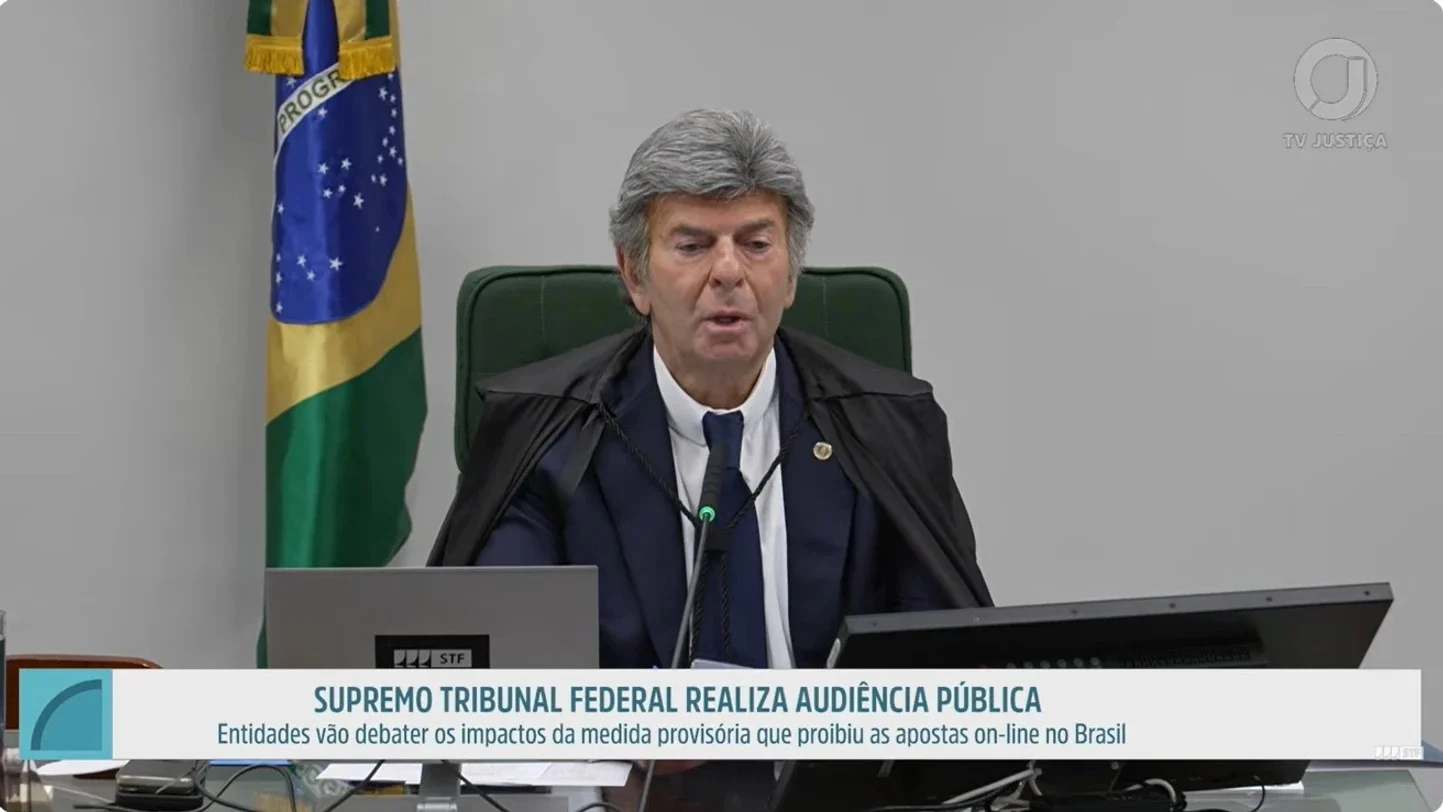
Brazil's government defended its ban on betting during a public hearing at the Supreme Federal Court (STF), where industry stakeholders, football clubs, and sports organizations argued for the preservation of a regulated market. Minister Luiz Fux opened the session, which included 34 entities discussing Provisional Measure 1.394, aimed at prohibiting betting in the country. The National Association of Games and Lotteries (ANJL) has challenged this measure in a Direct Action of Unconstitutionality (ADIn) 8027, seeking to suspend its effects.
Speaking at the hearing, representatives from the Ministries of Justice, Health, and Finance, along with the Attorney General’s Office (AGU), claimed that the ban was essential to shield families from gambling's health, financial, and social repercussions. Justice Minister Wellington César Lima e Silva characterized betting platforms as fostering “an architecture of unspeakable dependency,” asserting that the ban was both “relevant and urgent.”
Jorge Messias, head of the AGU, supported the government’s stance, arguing that the previous regulatory framework had inadequately protected citizens. He noted, “Recognizing this effort does not oblige us to close our eyes to its limitations,” emphasizing that the state must review policies based on their outcomes. Messias described the existing framework as “materially unconstitutional” due to its failure to safeguard constitutionally protected assets.
In response, the betting industry highlighted the necessity for legal clarity, stronger protections, and the dangers of driving consumers towards unregulated operators. The Brazilian Institute for Responsible Gaming (IBJR) requested that Fux issue an injunction to halt the measure's enforcement until a decision is made by Congress or the Supreme Court. The ANJL also advocated for harm mitigation measures rather than an outright ban.
Celso Mori, representing the IBJR, stated, “The country, through its Congress, opted for regulated gambling, but it didn’t happen overnight. It was after years of legislative processes. Now, suddenly, you change that orientation. Now you want clandestine and irregular gambling.”
The Economic Regulation Laboratory at the State University of Rio de Janeiro (UERJ) proposed eight conditions for reopening the legal betting market, should the ban be overturned. These include measures to prevent financing of bets through credit-funded transactions, establishing global betting limits per taxpayer ID across operators, verifying user eligibility, enhancing self-exclusion tools, and ensuring auditable records in the Betting Management System (Sigap).
UERJ also suggested advertising restrictions, mandatory funding for gambling prevention through the public health system, and a defined list of authorized bets. Marcello Trindade Paulo from UERJ emphasized the need for a transitional schedule with milestones set at 180 and 360 days to monitor compliance with these conditions if the ban is lifted.
During the hearing, football clubs, like top-tier team Flamengo, expressed their desire for better regulation rather than total repeal, while Corinthians proposed their involvement in initiatives against gambling addiction. The Brazilian Paralympic Committee reinforced calls for age restrictions on betting and enhanced operator responsibilities to combat compulsive gambling.
The hearing also addressed the government’s handling of licensed companies under the previous framework. Industry representatives argued that the state had previously encouraged investment, only to quickly shift policy. Concerns were raised over BRL30 million ($5.5 million) authorization fees and the sudden deadline for phasing out betting advertisements.
Gustavo Binenbojm, from the Brazilian Association of Radio and Television (Abert), stated that the ban represented a regression from an established public policy. He remarked that the original framework acknowledged the sector's risks without pushing the market into illegality and organized crime, raising questions about the state’s ability to enforce such a sweeping ban through a provisional measure.
Minister Fux will decide the next steps concerning the measure, but the hearing concluded without a ruling on whether the ban would be suspended, retained with additional safeguards, or implemented through a transitional process.

