
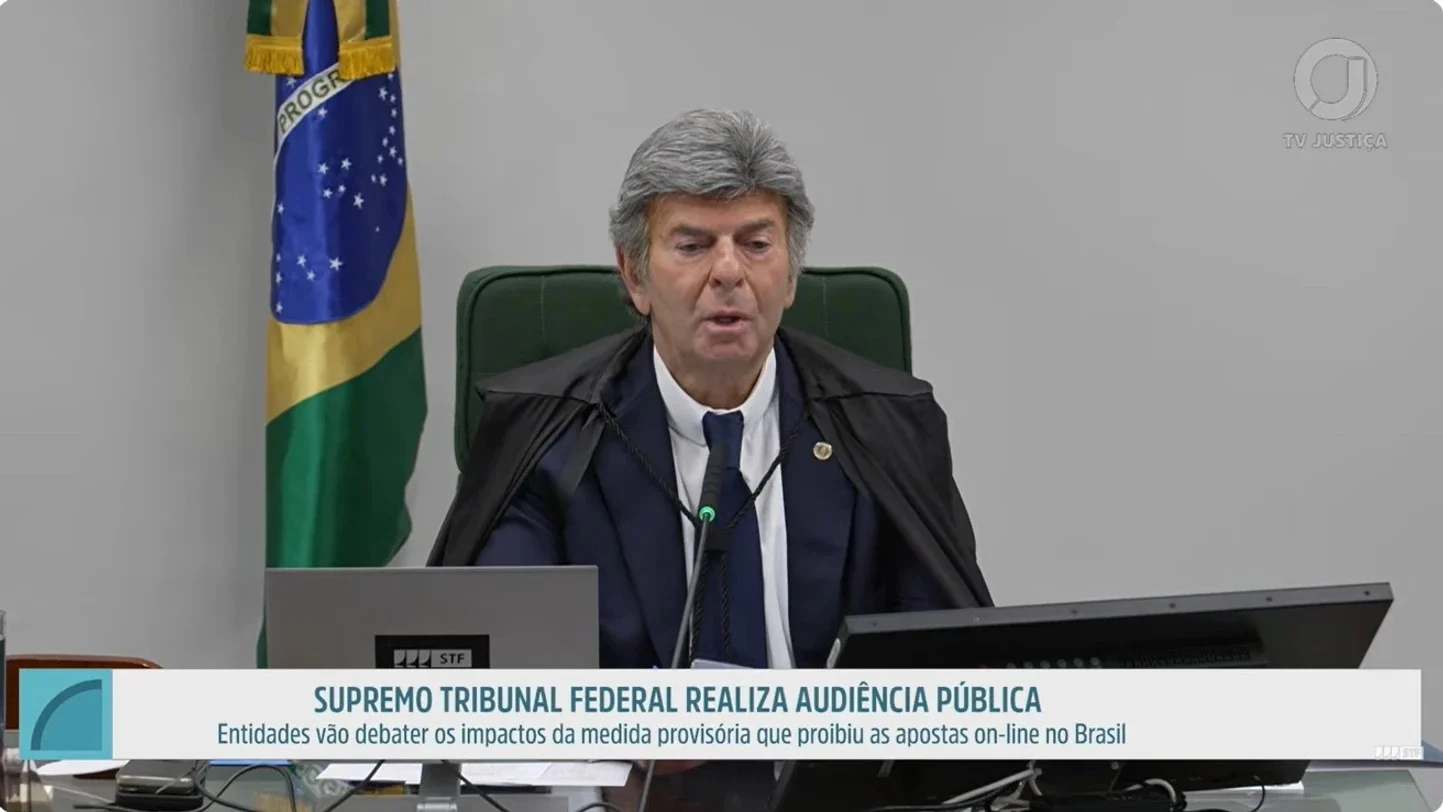
Brazil's government has firmly defended its decision to impose a ban on betting, while industry representatives, football clubs, and sports organizations have called on the Supreme Federal Court (STF) to maintain the regulated betting market during a public hearing focused on this significant measure.
The hearing, initiated by Minister Luiz Fux, assembled 34 stakeholders on Tuesday to address Provisional Measure 1.394, which prohibits betting activities in Brazil. This measure faces a challenge in the Supreme Court via Direct Action of Unconstitutionality (ADIn) 8027, filed by the National Association of Games and Lotteries (ANJL), which seeks to suspend the measure's effects.
In the hearing, representatives from the Ministries of Justice, Health, and Finance, in addition to the Attorney General's Office (AGU), asserted that the ban is essential to safeguard families from the various health, social, and economic repercussions associated with gambling.
Justice Minister Wellington César Lima e Silva described online betting platforms as fostering an “architecture of unspeakable dependency,” emphasizing the urgency and relevance of the ban.
Jorge Messias, head of the AGU, defended the government's stance by stating that the prior regulatory framework failed to offer adequate protections. He acknowledged the importance of licensed operators but stressed, “Recognising this effort does not oblige us to close our eyes to its limitations.” Messias described the previous regulatory framework as becoming “materially unconstitutional due to insufficient protection of constitutionally protected assets.”
Conversely, the betting industry responded by emphasizing the necessity for legal clarity, improved safeguards, and warning that outright prohibition might drive consumers towards unregulated operators. The Brazilian Institute for Responsible Gaming (IBJR) requested an injunction from Fux to temporarily suspend the measure until Congress makes a decision or the Supreme Court addresses the merits of the case. Additionally, the ANJL proposed stricter regulations aimed at minimizing harm instead of a total ban.
Celso Mori, an IBJR representative, remarked, “The country, through its Congress, opted for regulated gambling. But it didn’t happen overnight. It was after years of legislative processes. Now, suddenly, you change that orientation. Now you want clandestine and irregular gambling.”
The Economic Regulation Laboratory at the State University of Rio de Janeiro (UERJ) suggested eight conditions that should accompany any potential reopening of the legal market if the ban is lifted. Their recommendations included prohibiting bets financed through credit-funded Pix transactions, establishing a common betting limit for each taxpayer identification number across all operators, validating user eligibility—including those receiving social benefits—enhancing self-exclusion mechanisms, and ensuring the auditability of records maintained in the Betting Management System (Sigap).
Moreover, UERJ’s proposals included advertising restrictions, mandatory funding for gambling prevention and treatment initiatives via Brazil's public health system, and a defined list of approved bets. UERJ representative Marcello Trindade Paulo indicated that if the Provisional Measure remains in place, they recommend a transition strategy with specified tasks and results verification over a phased schedule of 180 and 360 days.
Several sporting clubs voiced their support for a regulated environment rather than a total repeal. Flamengo, one of Brazil’s prominent football clubs, argued for more effective regulations, while Corinthians expressed willingness to partner in campaigns focused on gambling addiction and curtailing illegal platforms. The Brazilian Paralympic Committee also emphasized the need for age restrictions on betting, as well as increased operator accountability in identifying and preventing compulsive gambling behavior.
The hearing did bring to light concerns regarding how the government would handle existing companies that had received licenses under the former framework. Industry and club representatives alleged that the state had previously encouraged investment only to abruptly alter its policy. They questioned aspects such as the BRL30 million ($5.5 million) authorization fees and the sudden deadline for ceasing betting advertisements.
Gustavo Binenbojm, representing the Brazilian Association of Radio and Television (Abert), critiqued the decision as a reversal of a previously established public policy. He stated, “It was a pragmatic choice that recognized the sector's risks without handing the market over to illegality and organized crime,” referring to the original decision to regulate betting. He posed the critical question of whether the state could “suppress it in one fell swoop through a provisional measure,” effectively undoing a policy shaped by both the Executive and Congress.
Minister Fux will determine the future course of the hearing. No immediate conclusion was reached regarding whether the ban will be suspended, maintained with additional safeguards, or subjected to a transitional implementation process.

