
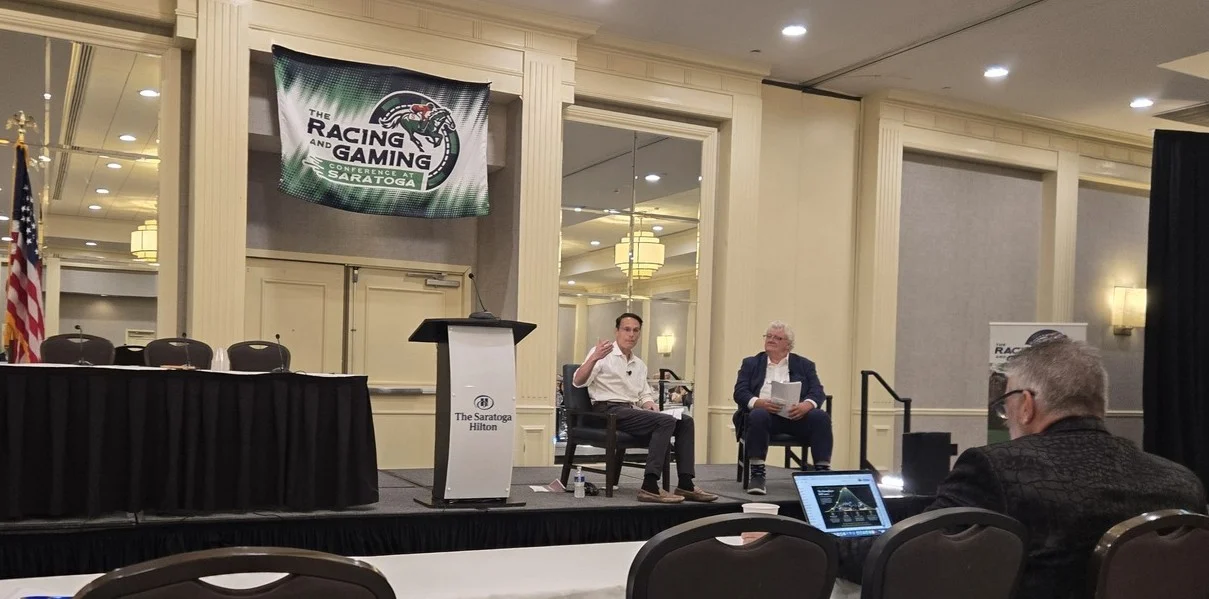
Steve Kornacki, NBC News' chief data analyst, endured a grueling night during Primary Night, staying up past 1 a.m. to cover an unexpected result in the Wisconsin governor primary. After getting less than four hours of sleep, he quickly boarded a flight and arrived in upstate New York just in time for a 9 a.m. keynote at The Racing and Gaming Conference in Saratoga. Kornacki delivered an engaging talk on critical issues such as ownership concentration in major racing events, the decline in foal populations, and dwindling television ratings for Triple Crown races.
The significant drop in television viewership and racing handle has become a pressing concern. Kornacki indicated that the annual handle in the U.S. has fallen from approximately $15 billion in 2003 to around $11.8 billion last year. Worryingly, Kornacki highlighted the decline in viewership for events outside the Triple Crown races. For instance, last year's Breeders' Cup World Championships, which featured a total purse of $34 million across 14 Grade I stakes races, drew an average of less than 1 million viewers on its second day, a drastic fall from the 4.3 million viewers for its inaugural event in 1984.
Kornacki suggested that the rising popularity of college football might be contributing to the decline in racing viewership. He pointed out that at least eight college football games outperformed racing broadcasts in terms of ratings, including a matchup between Oregon State and Washington State, which had a combined record of just 9-16 at the end of the season.
Although Kornacki did not present a solution for improving Breeders' Cup ratings, there were informal discussions about rescheduling the championships to avoid conflicts with college football games. One suggestion was to hold the Breeders' Cup on the second Saturday of December, which typically sees only the Army-Navy game being played, while another option included a midweek racing schedule when both the NFL and most college football teams are inactive.
The Triple Crown races have largely remained unaffected by the decline in ratings. The Kentucky Derby, held in May, achieved record viewership, with peak numbers reaching 24.4 million. Interestingly, only three of the Derby participants, none of whom placed in the top three, competed in the Preakness. Kornacki pointed out that even though the Preakness attracted a modest audience of 6 million, it was still relatively low in comparison.
Maryland Governor Wes Moore announced that The Preakness will move back eight days in 2027 to potentially increase participation from Kentucky Derby entrants. This adjustment comes alongside the introduction of the Thoroughbred Championship Series, a six-race series for three-year-olds featuring the Kentucky Derby and Belmont Stakes, but excluding The Preakness. Neither Kornacki nor Andrew Offerman from the New York Racing Association commented on this series during the conference.
Kornacki advocated for expanded wagering options as a way to engage a younger audience. He drew a comparison to traditional betting, noting how trainer wins in a single day, similar to prop bets in football, could entice more Millennials to the racetrack. On 1 August, trainer Todd Pletcher demonstrated his prowess by winning five races, including Renegade’s victory in the Jim Dandy, yet current parimutuel tracks do not offer prop betting on such trainer wins.
At the conference, the landmark lawsuit filed by New York Attorney General Letitia James against Kalshi captured significant attention. Announced on 31 July, the suit claims that Kalshi is engaging in illegal gambling through its sports markets, as the outcomes of its event contracts are uncertain under New York law.
During the event, Carrie Woerner, chair of the New York State Assembly Committee on Racing and Wagering, emphasized the necessity for states to regulate prediction markets. This comes as several states engage in litigation with the U.S. Commodity Futures Trading Commission regarding regulatory authority over this asset class. As of an 11 August statement, the CFTC has instructed Kalshi to maintain its operations in New York in compliance with the Commodity Exchange Act.
Earlier comments from New York State Senator Joseph Addabbo suggested a willingness to explore regulatory frameworks for prediction market operators, though it remains uncertain what direction this might take post-lawsuit.
On the morning of the conference, New York State Gaming Commission Chair, Brian O’Dwyer, praised AG James’ decision to target Kalshi, which currently seeks a valuation of $44 billion. He mentioned Polymarket, another key player in prediction markets, is pursuing funding that aims to value the company at around $20 billion.
O'Dwyer also commended Governor Hochul for her crackdown on underage gambling, as many prediction markets permit individuals aged 18 and over to participate. He expressed a belief that the Supreme Court will ultimately favor states in the ongoing cases concerning sports event contracts.
Panelists also addressed a current investigation by the Horseracing Integrity and Safety Authority (HISA) concerning suspicious betting activities linked to the Fair Hill Training Facility in Maryland. Several horses from the facility recently won four races across northeastern tracks, after long layoffs and at unexpected odds, raising questions among investigators.
Trainer Angel Quiroz has been identified in this inquiry. Quiroz trained multiple horses that emerged victorious, impacting UK bookmakers with initial liabilities estimated between £600,000 and £800,000. A fifth horse under his care placed fourth in Saratoga, but none reached the winner's circle in previous races.
Moreover, the HIAU announced that Quiroz was charged with a substance violation following a positive test for albuterol in one of his horses, Bonita Rough, back in July. Quiroz chose not to have a B sample analyzed related to this case. The final results of post-race drug tests for the Fair Hill horses are still pending, with typically a turnaround of around 10 business days for results.
In a statement made earlier, Quiroz dismissed concerns regarding the performance of his horses, highlighting their history of underperforming. He noted that Classic Rock, who won at Saratoga, showed a significant improvement compared to previous races. "Everybody is shocked. I don’t see what the big deal is," he remarked regarding the scrutiny surrounding their performances.

