
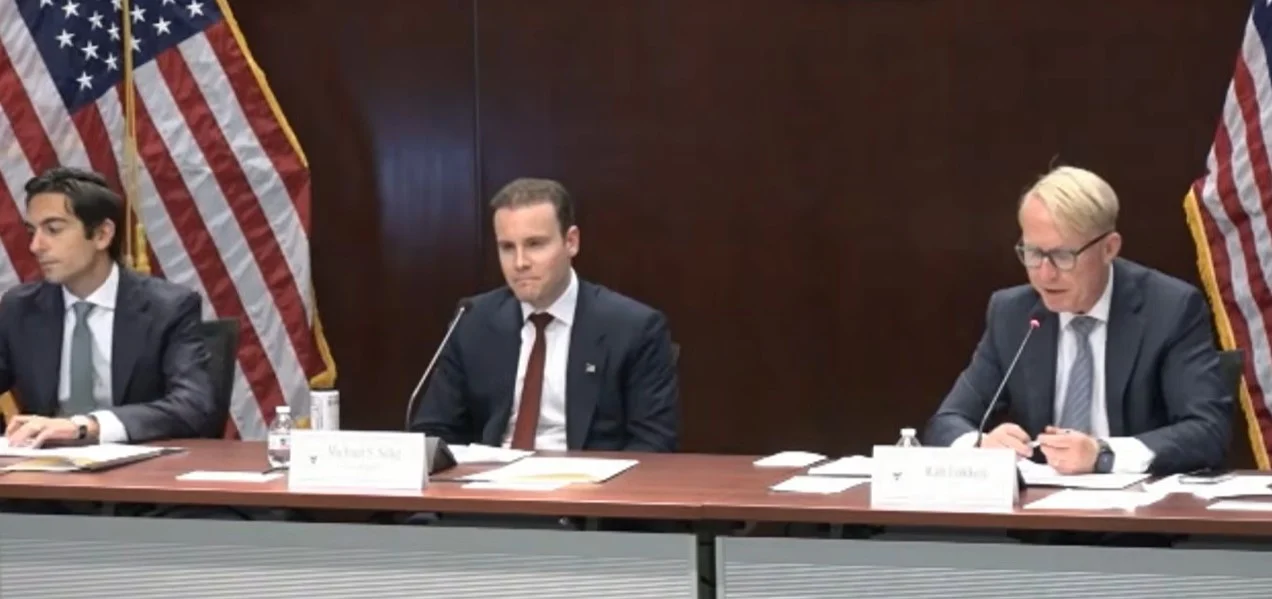
At a high-profile conference on Thursday, key figures in the derivatives market gathered at the US Commodity Futures Trading Commission's (CFTC) headquarters in Washington, DC. The event marked the advisory committee's inaugural conference, drawing attention to ongoing regulatory efforts concerning sports event contracts. Prominent attendees included Vlad Tenev, CEO of Robinhood, Tyler Winklevoss, co-founder of Gemini, and sports betting executives Jason Robins, Matt King, and Christian Genetski.
Initially, the discussions tackled relatively dry subjects like crypto asset management and agentic finance. However, tensions escalated shortly after a panel on prediction markets began. CME Group CEO Terrence Duffy's remarks on potential market manipulation sparked a heated debate with CFTC Chairman Michael Selig.
Duffy expressed concern over certain contracts he sees as vulnerable to manipulation, jeopardizing market integrity. He singled out a contract related to the ousting of Venezuelan President Nicolas Maduro, a derivative linked to Gabriel Perez, a former teleprompter operator for Donald Trump, and various sports-related contracts. According to Duffy, these contracts violate CFTC Core Principle 3, which requires that Designated Contract Markets (DCMs) only list contracts free from manipulation risks.
In response, Selig pointed out that these products were “not listed” in the US and were instead based offshore. This exchange marked a defining moment during the meeting, leaving many wondering whether it would result in meaningful regulatory advancements.
The incident involving Perez's trades drew attention online, with industry executives noting the contracts were placed on Kalshi. Perez is reportedly under investigation for allegedly profiting from inside information regarding Trump’s remarks, having earned over $100,000 from these trades. Kalshi's internal surveillance team alerted the CFTC about potential irregularities associated with these transactions.
Selig’s comments, however, may have contained inaccuracies, as he suggested that these trades occurred outside of the US. Nonetheless, he correctly noted that the Maduro contract was indeed on an offshore platform. Gannon Van Dyke, a US special forces soldier, is also facing charges for purportedly using classified information related to a Maduro raid for trading on Polymarket.
Duffy additionally criticized other self-certified contracts he believes could be easily manipulated, avoiding naming specific sports-related trades. He emphasized the importance of maintaining high standards within regulated markets, arguing against practices that would drive participants away. “That is horrible for the industry; we are not a bunch of carnival barkers at a circus,” he stated. “We are running the most envious markets in the world.”
In his remarks, Selig discussed potential paths for developing a framework for prediction markets, mentioning proposed amendments to Rule 40.11, which allow the CFTC to decide on the public interest implications of contracts involving war, terrorism, and assassination. He also hinted at establishing expectations for market design, product governance, and incentive programs.
Another point of contention arose between Duffy and Kalshi co-founder Luana Lopes Lara, who was present at the meeting due to CEO Tarek Mansour’s absence. Duffy questioned why the CFTC permitted Kalshi to offer “compute contracts,” while CME's application for similar derivatives remains under review. These contracts allow trading based on the future prices of AI graphical processing units.
Lara pressed Duffy on whether the CME had ever encountered a manipulation case, to which Duffy quipped about the CME’s regulatory team's size compared to Kalshi's workforce. Without missing a beat, Lara retorted, “maybe you should learn a bit about efficiency then.”
Jason Robins, CEO of DraftKings, attempted to mediate the discussion, urging attendees to avoid “any infighting” to foster constructive dialogue. Despite the spirited exchanges, sportsbook executives did not engage deeply with issues concerning regulatory market-making or federal preemption. King, the CEO of Fanatics Betting + Gaming, emphasized the need for a principles-based approach to consumer protection and responsible trading, while Genetski, CEO of FanDuel, briefly mentioned the importance of building consumer trust related to predictions.
Selig did not confirm whether the committee would meet again this year and did not address the timing of potential final rules on sports-event contracts ahead of the football season. He described prediction markets, AI, and blockchain as sectors poised to transform financial markets in the years to come. “We’ve crossed the Rubicon and are standing at a new frontier of finance,” Selig said.

