
Bally's Corp has halted the construction of non-gaming components for its $1.7 billion Chicago casino, a move that significantly impacts negotiation dynamics with the city following a recent budget change that lifted a ban on video gambling terminals. Meanwhile, Bally's appears to be facing its own challenges in Las Vegas.
In April 2021, Bally's acquired the operations of the former Tropicana Las Vegas for $148 million, with the deal finalized in September 2022. The company, in collaboration with landlord Gaming and Leisure Properties (GLPI), is expected to demolish the existing property in 2024 to facilitate the construction of a new MLB stadium for the Athletics. In return, Bally's will have the opportunity to develop a new resort on the remaining land.
Despite the demolition plans, Bally's remained silent on its intentions for the site for nearly a year. During this period, the company explored other initiatives, including a casino project in New York City and a potential buyout of Australian operator Star Entertainment.
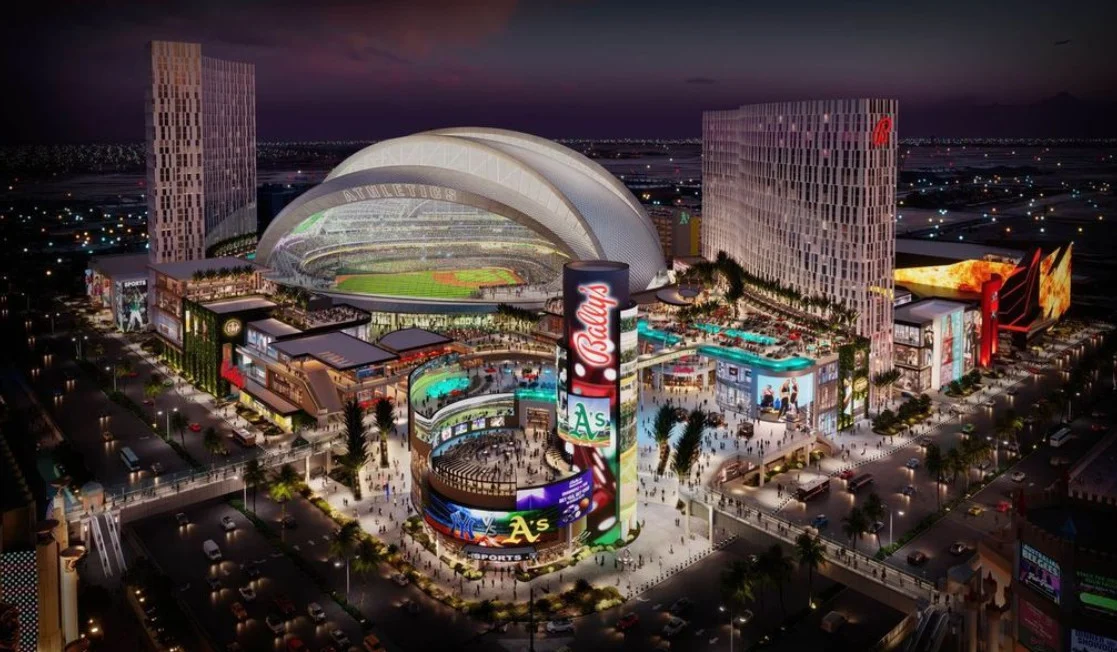
Last September, Bally's unveiled plans for a mixed-use development featuring 3,000 hotel rooms across two towers, a 2,500-seat entertainment venue, and over 500,000 square feet of retail and dining space. The project's one rendering reveals its layout surrounding the A's stadium. Subsequent submissions to Clark County in December outlined a four-phase buildout set to conclude by December 2030, with an estimated cost of $1.19 billion.
As the A's stadium is on track for a spring 2028 opening, questions arise about the future of Bally's site and whether the company can secure the necessary financing to complete it.
This year, Bally's shifted its focus toward the retail-entertainment district (RED) aspects of the development rather than the casino and hotel. During the ICE Barcelona conference in January, Chairman Soo Kim indicated that his company prioritizes developing the RED before the integrated resort and casino. CFO Mira Mircheva and attorney Dan Reaser reinforced this message in June, stating that the 2028 deadline pertains specifically to the stadium and not to Bally's developments.
Reaser clarified, "The April 2028 timeline is for the retail district, parking garage, utilities, and plaza, but not the towers that come at a later date."
Concerns are mounting in Las Vegas about the A's new stadium opening amid construction delays. A June report from The Athletic indicated that the team is preparing backup plans for its infrastructure if Bally's fails to deliver on time, potentially costing the team an additional $100 million.
Steve Hill, CEO of the Las Vegas Convention and Visitors Authority, commented on Bally's financial situation, expressing skepticism about the company's ability to finance the project. Hill stated he had urged Bally's to present a financing plan by August.
In response to inquiries about that deadline, Bally's opted not to make a comment, and the LVCVA did not provide further insights.
In its first-quarter 10-Q filing to the SEC, Bally's reported that it had total cash and equivalents of $559.3 million alongside long-term net debt of $4.3 billion. The company has yet to disclose its second-quarter results and filed a Form 12b-25, indicating a delay in reporting. Despite a recent rise in share prices by 5% to $13.70, Bally's shares have declined roughly 18% this year.
Another important player in the Las Vegas project is GLPI, a gaming-focused REIT that has invested significantly in Bally's nationwide projects, including Chicago. Bally's lease of the Tropicana site from GLPI commenced in 2022 and was adjusted following the casino's demolition. The lease spans 50 years with options to extend up to 99 years; however, Bally's has indicated that these renewal options are not currently deemed likely to be executed.
GLPI has committed up to $125 million for shared developments at the Las Vegas site, deemed mutually beneficial. During a recent earnings call, GLPI's COO, Brandon Moore, noted that Bally's is approaching a more definitive plan for essential infrastructure supporting the stadium. This includes providing access roads and utility conduits. Moore mentioned that while further investments could be considered in the future, the current cap remains at $125 million as they continue to collaborate with Bally's.

