
In May, shortly before Memorial Day weekend, the US Senate convened its first hearing on sports betting in over a year. Titled "No Sure Bets: Protecting Sports Integrity in America," the session aimed to address a series of sports betting scandals. However, discussions quickly shifted to the contentious issue of prediction markets.
This week, the House of Representatives took a proactive step by holding a hearing focused on market integrity involving sports derivative contracts. This marked the first hearing on the topic since over a dozen proposed bills were introduced in Congress, all aiming to implement regulatory frameworks for the burgeoning, multibillion-dollar industry.
The upcoming 2026 FIFA World Cup highlights a growing public interest in sports event contracts, with some estimating that trading volume during this occasion could exceed $50 billion. Yet, these high trading volumes have intensified the ongoing debate about the regulation of sports event derivatives, a matter some states' rights advocates argue is illegal.
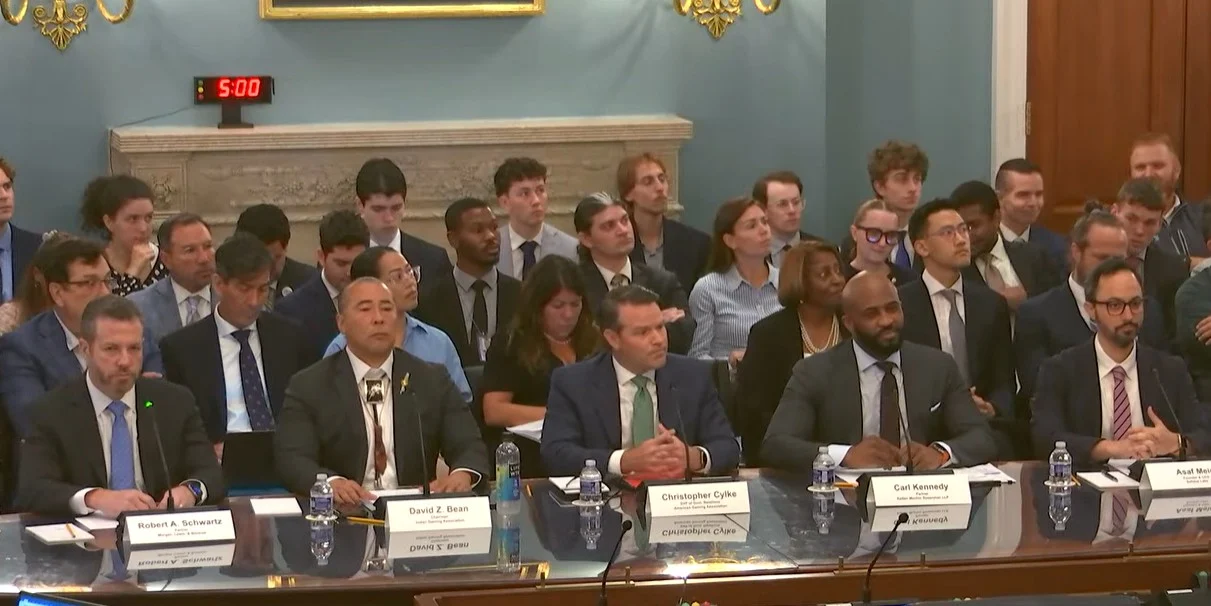
The American Gaming Association and the Indian Gaming Association, two significant trade groups, have expressed concerns that states and tribal nations are missing out on millions in potential revenue due to the rise of prediction markets. Both organizations provided testimony during the hearing, alongside two attorneys who shared market insight. Asaf Meir, CEO of Solidus Labs, also testified about market surveillance methods that could help identify and prevent insider trading.
Alabama Representative Shomari Figures remarked that the hearing featured the most balanced representation of witnesses he has ever seen, fostering intense intellectual debate on the subject.
"This year, the dispute over sports event contracts has intensified since prediction markets gained traction in 2025. The US Commodity Futures Trading Commission (CFTC) has taken the lead in defending the legality of these contracts against challenges from state governments across the country.
Proponents of prediction markets compare sports event contracts to grain and corn futures, arguing that they fall under the CFTC's regulatory authority. Since his appointment last year, CFTC Chair Michael Selig has consistently asserted that the agency holds jurisdiction over such event contracts.
The House Agriculture’s Subcommittee on Commodity Markets, Digital Assets, and Rural Development hosted Tuesday's hearing in Washington, D.C. This subcommittee is overseen by Representative GT Thompson, a nine-term Republican from Pennsylvania.
Last month, the CFTC released a set of proposed rules regarding sports event contracts, referencing a public interest test over 500 times. Before these rules are finalized, the agency must determine if certain derivatives related to sports are contrary to public interest.
Thompson expressed support for the proposed rules, noting that they provide clear public interest standards and define previously ambiguous key terms.
Currently composed of five commissioners, the CFTC has Selig as its only Senate-confirmed member. David Bean, chair of the IGA, criticized the CFTC as being severely understaffed, noting it has shifted from overseeing crops to props. According to the IGA, sports event contracts and traditional sports wagers like over/unders, parlays, and props are fundamentally similar.
Given the contentious environment, finding regulatory common ground seems difficult. Congress has the potential to create a federal framework for prediction markets while allowing states to retain control over taxing revenues from event contracts. Nonetheless, state regulators are hesitant to concede authority to the federal government. Carl Kennedy, a derivatives attorney experienced with the CFTC, argued that multiple agencies can regulate certain assets.
Kennedy illustrated this with an example about trading gold, which can be purchased from a local dealer under state law, while its futures transactions occur on CFTC-registered exchanges, with oversight from the SEC for gold ETFs. He contended that a similar approach could apply to prediction markets, maintaining that individuals can opt for either state-regulated sportsbooks or CFTC-regulated event contracts.
Bean is advocating for HR 7840, the "Event Contract Enforcement Act" introduced by Representatives Blake Moore and Salud Carbajal, which seeks to amend the Commodity Exchange Act to prohibit federally registered exchanges from offering sports event contracts. However, the current political climate makes passing legislation challenging. In 2025, fewer than 3% of standalone bills were enacted into law, per GovTrack.
Kennedy opposes a broad ban, favoring a tailored approach that allows the CFTC to exercise its congressional authority. He pointed to Designated Contract Markets like Kalshi, which must adhere to core principles of the Commodity Exchange Act (CEA) to maintain CFTC designation.
Many in the industry believe the issue of sports event contracts will ultimately reach the Supreme Court. Kennedy and Robert Schwartz, a former CFTC general counsel, discussed the uncertain timeline for such a case. Schwartz noted that New Jersey plans to petition the Supreme Court for a review of the Third Circuit’s ruling favoring Kalshi, though another pivotal case might be filed first.
Regarding market integrity, Schwartz highlighted that the discussion doesn't neatly divide along political lines. As bipartisan interest grows, he emphasized, it could pave the way for legislative action.
Dusty Johnson, the chair of the House subcommittee, reassured attendees that the recent hearing on prediction markets is just the beginning. "Congress should not remain silent," he stated. "We must work toward identifying common ground."

