
In June 1914, Lawrence Sperry made a remarkable flight over the Seine near Paris, demonstrating one of the earliest autopilots while his mechanic stood on the wing with Sperry’s hands lifted from the controls. Fast forward more than a century, and while automation has transformed commercial air travel, passengers continue to rely on the expertise of pilots to set flight paths, monitor systems, and take command when necessary.
The landscape of betting is evolving in a similar way, with the introduction of AI agents poised to enhance the experience for sports bettors. These agents allow bettors to allocate a budget and provide specific directives to follow various betting models. For instance, they could back selections from a specialized NFL tipster, track players during a golf tournament, or adhere to a cricket model. The AI software could conduct research, place bets within predefined parameters, and allow users to engage with their day while the technology handles the intricacies of the betting process.
This new convenience could attract more customers into the betting scene, making specialized betting tools and knowledge more accessible to a broader range of sports fans. Automated trading is already reality on platforms like Polymarket, which serves as a precursor for what sportsbooks may soon need to provide to remain competitive.
Automated betting systems are not new. Professional racing syndicates have long used computer-assisted wagering, combining sophisticated probability models with software that places large bets into tote pools. Additionally, Betfair allows for automated betting via its Exchange API.
AI agents have the potential to democratize access to advanced betting strategies. Users without programming acumen could articulate their strategies in straightforward language and have the software implement those plans.
Traditional betting bots typically operate by pulling selections from tipster feeds and placing bets within set limits. In contrast, AI agents can interpret broader instructions, deciding which information to source and which tools to utilize. For example, when betting on cricket, the agent might compile team information and weather forecasts, consult expert models, and analyze odds before executing a wager.
These agents can also adopt established betting strategies, identifying momentum shifts in prices or predicting a reversal after a significant movement. Market-making bots can enhance liquidity, facilitating trades and increasing revenue for exchanges.
Consumer products utilizing these AI agents are already available. In February, Olas launched Polystrat, a platform where users can fund an agent and define a strategy that the software uses to evaluate and trade in markets on Polymarket. Another emerging tool, Forkast’s ATLAS, enables users to request trades via Telegram.
The promise of “trade while you sleep” has begun circulating on platforms like X. Providers often showcase successful trades through screenshots to attract attention and subscribers, but even profitable trades do not guarantee long-term success. Polymarket provides public trading records that allow bettors to assess the performance of various accounts, scrutinizing trading strategies and profitability.
As these tools simplify usage, bettors may begin to replicate winning strategies and test new concepts that previously required programming expertise. Some users may even develop their tools and attract clients, monetizing their insights.
For bettors, the consistent execution of strategies provides an immediate advantage. For instance, a casual bettor might treat a $25 wager at odds of $2.20 similarly to a $25 bet at $2.50. However, the statistical implication of those different odds could translate to losses or profits. AI can compute optimal staking and betting levels as prices fluctuate, also enforcing agreed-upon spending limits to assist customers in managing their bankrolls.
While this automation can save time and ensure consistency in execution, it does not inherently convert poor strategies into profits. Ultimately, customers retain control over their betting flights—requiring confidence in the agent’s decisions, and many may prefer to approve trades individually before granting broader autonomy.
One user in our network employs a Telegram bot to identify bets and calculate stakes based on Australian racing’s minimum bet regulations, which mandate bookmakers to accept bets up to a stipulated potential win. The bot enables him to act swiftly on fluctuating prices while still giving him the final confirmation on each bet.
Professional betting teams will be diligent in evaluating execution, error management, and the safeguarding of their strategies. Any tool they integrate must protect their hard-earned competitive advantage.
As more AI agents operate in the betting arena, widespread adoption of similar betting strategies could push prices against later customers. Bill Benter has highlighted similar challenges in horse racing, where models independently developed might lead to decreased payouts by favoring the same horses.
While replicating a winning tipster's selections may seem straightforward, mimicking their returns is a different challenge. Investors spreading across multiple accounts might not attain a complete view, and securing a less favorable entry price could nullify any original advantage. An AI agent must effectively evaluate whether a bet holds value versus the price available to the customer.
In a climate where AI agents vie for comparable betting opportunities, proprietary data, unique analyses, and specialized betting knowledge are likely to become increasingly valuable. These agents could also broaden the audience of tipsters by acting on selections clients may overlook, as long as they can secure prices that maintain their advantages.
Wagering operators face a critical decision on future advancements—what to innovate in-house and what to source externally.
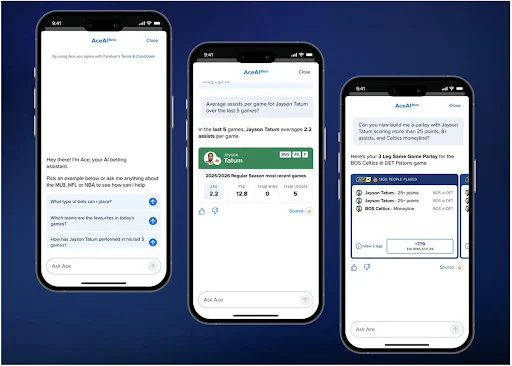
FanDuel's AceAI, which enables customers to research markets and create bets through conversation, illustrates efforts to integrate AI. Users still retain the responsibility of placing their own bets. FanDuel developed AceAI internally, then shared its framework with Sportsbet, enhancing their own capabilities while minimizing costs.
Investing in specialty suppliers can mitigate development costs across various operators. By combining proprietary data with challenging-to-replicate betting insights, these operators can find compelling reasons to procure further solutions. For firms like Waterhouse VC, the goal is to support suppliers who can produce superior products at lower costs than operators could generate independently.

