
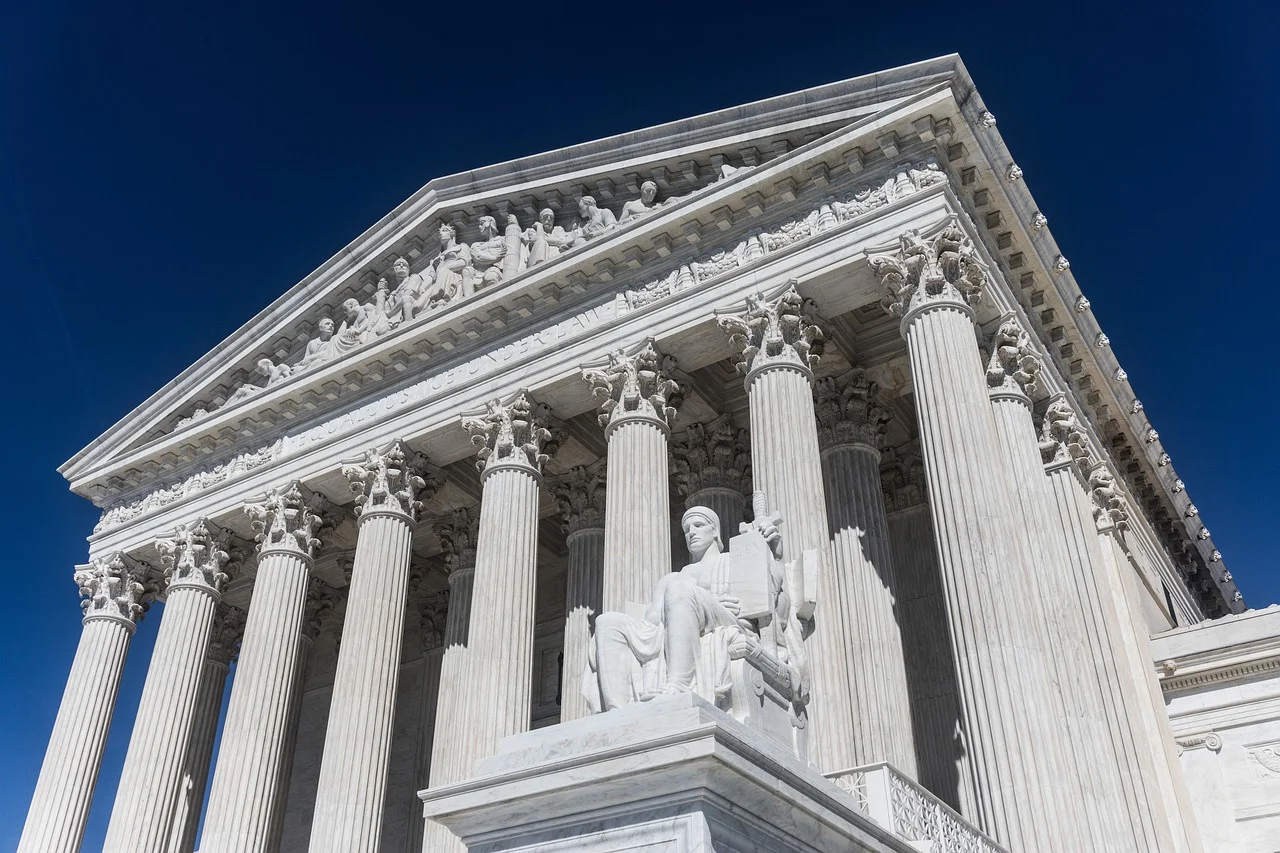
In recent weeks, the U.S. Supreme Court has been presented with numerous briefs urging it to address a key case that could significantly impact the future of sports event contracts. This legal battle could affect up to $1 trillion in notional value, representing a critical moment for the sports wagering and derivatives industries. On Wednesday, the NFL made a notable move by submitting an amicus brief to the Court, co-authored by former U.S. Attorney General William Barr.
The NFL's 32-page brief advocates for the Court to review Flaherty v. KalshiEx, LLC, emphasizing the need to maintain the integrity of professional sports while ensuring protections for market participants. The league pointed out that clarity in sports prediction markets is essential not only for the integrity of the games but also for consumer safety across the industry. As the U.S. Commodity Futures Trading Commission (CFTC) pushes for exclusive regulatory authority over derivatives, the NFL has been engaging in talks with prediction market operators in recent months.
According to the brief, the NFL contends that the CFTC and various market players have not adequately responded to the league’s requests for enhanced safeguards on sports event contracts.
The NFL identified several event contracts it considers problematic. These include wagers on outcomes such as whether a kicker will miss a field goal or which penalty will occur next in a game, as well as non-game-specific transactions like phrases mentioned during broadcasts. "It is at best unclear whether the Commission has the appropriate regulatory framework, oversight capacity and enforcement resources to ensure that prediction markets do not jeopardize game integrity,” the NFL stated.
Two major players in the prediction market sector, Kalshi and Polymarket, have also expressed their commitment to market integrity. Polymarket reaffirmed its alignment with the NFL’s goals, highlighting its ongoing enhancements to market surveillance tools. Likewise, Kalshi noted its attempts to work collaboratively with the NFL to foster market integrity, asserting that it actively monitors sports-related markets and hopes the NFL will engage constructively.
At an exhibition game in Macau, NBA Commissioner Adam Silver highlighted concerns around prediction markets' integrity and the necessity of data analysis to identify unusual trading behavior. Contrary to the NFL’s preference for state regulation, Silver advocates for a unified federal standard.
Market integrity was a focal point at the Predict 2026 conference in Midtown Manhattan, aimed at the emerging asset class of prediction markets. Sean Patrick Maloney, president of the Coalition for Prediction Markets, dedicated considerable discussion to fighting insider trading. Maloney, who previously served as a New York Congressman, had testified before a Senate hearing concerning these issues. His presence at the conference followed a significant insider trading case involving Gannon Van Dyke, a U.S. Army special forces soldier accused of profitably trading on classified information about Venezuela.
If convicted of his charges, which include misusing sensitive national security information, Van Dyke faces a potential prison sentence of over 20 years. When asked if a harsh penalty should be applied if he leaked classified information, Maloney firmly agreed, stating, "You’re talking about misusing sensitive national security information; you can throw away the key."
Jack Murphy, a senior counsel at Akin Gump Strauss, pointed out that Van Dyke’s case is among several closely monitored for insider trading in the predictions sector. He referenced other high-profile cases, including one involving a Google engineer and former Congressman George Santos.
In a separate development, the Seminole Tribe of Florida has begun to assert its authority, filing a significant lawsuit against DraftKings. This 72-page complaint, submitted in Broward County, Florida, alleges that DraftKings is engaging in illegal sports betting, violating the tribe's gaming compact. The complaint criticizes DraftKings' "Super App," a platform that combines various gaming functions, for circumventing regulatory oversight and consumer protections.
DraftKings responded by asserting that its sports event contracts comply with federal regulations under the Commodity Exchange Act and expressed respect for the Seminoles while maintaining confidence in its legal standing regarding prediction markets.
In an interesting twist, Kalshi announced partnerships with four tribes, including three in California – Kletsel Dehe Wintun Nation, Alturas Indian Rancheria, and Greenville Rancheria – alongside Alabama-Quassarte Tribal Town from Oklahoma.

