
Since President Donald Trump began his second term in January, the Federal Reserve has been embroiled in controversy, particularly as Trump pressures Chair Jerome Powell to rapidly lower interest rates amidst a backdrop of economic uncertainty. While the Fed does not regulate prediction markets—this responsibility falls to the US Commodity Futures Trading Commission—there are signals that some economists within the Fed are utilizing event contracts as a tool for economic research focused on indicators like interest rates and inflation. A recent Federal Reserve study revealed that 'Kalshi markets provide a high-frequency, continuously updated, distributionally rich benchmark' valuable for researchers and policymakers.
Powell's term as chair is set to conclude in mid-May, but a deadlock in Washington over his successor's confirmation has emerged, with no date yet scheduled for a hearing for Trump's nominee, Kevin Warsh. Senator Thom Tillis (R-NC), a member of the Senate Banking Committee, has threatened to delay the process, while Powell aims to remain in his position until Warsh is approved. This uncertainty could complicate the Fed's stance on prediction markets ahead of the November mid-term elections.
The 40-page study titled 'Kalshi and the Rise of Macro Markets' is co-authored by Anthony Diercks, a principal economist at the Federal Reserve, alongside Jared Dean Katz, a PhD student in financial economics at Northwestern who previously served as a research assistant at the Fed, and Jonathan Wright, a research associate at Johns Hopkins University.
The authors have highlighted prediction market data as an innovative tool to understand macroeconomic policy. They chose to focus exclusively on Kalshi data, asserting it 'represents the most mature and comprehensive prediction market for economic forecasting.' Kalshi has become a significant player in this field, especially after successfully winning a legal battle with the CFTC to offer political contracts during the 2024 elections. However, the company has faced numerous lawsuits in both state and federal courts and recently received criminal charges from Arizona.
Central to the study is the assertion that Kalshi data surpasses traditional forecasting methods like polls and futures markets. According to the researchers, Kalshi markets deliver insights on metrics like unemployment and GDP that were previously difficult to analyze. They noted, 'Using newly available contracts across a broad set of macroeconomic indicators, we have shown that Kalshi-implied distributions are well-behaved, responsive to news and comparable in forecasting accuracy to established benchmarks.' They emphasized that Kalshi provides unique insights into variables like GDP growth and core inflation, for which other market-based distributions do not exist.
In at least one case, Kalshi’s prediction on the Fed’s interest rate cut was more accurate than traditional measures that estimated probabilities of a 25 or 50 basis point cut. Kalshi indicated a greater likelihood of the latter, which ultimately proved correct.
Despite being the focus of backlash primarily over sports contracts, the economists only briefly referenced these contracts in their research. Critics argue that sports betting disguises illegal gambling as financial trade. However, the broader economic implications of prediction markets related to Fed decisions are harder to dispute, especially for large corporations and institutional investors. The study noted, 'Prediction markets offer high-frequency, continuously updating forecasts that can complement central bank decision-making.'
There are concerns that the expansion of prediction markets hinges on the considerable sums predominantly wagered on sports, without which they might dwindle into niche financial products. As of December, Kalshi was valued at $11 billion, exceeding that of many established gaming companies. Reports indicate that both Kalshi and Polymarket are pursuing new funding rounds, seeking valuations above $20 billion. Recent data shows that over 80% of Kalshi’s trading volume comes from sports contracts, with a notable example showing over $24 million wagered on a NCAA tournament game compared to just $2.7 million on the next Fed decision.
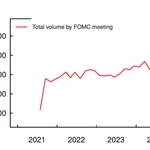
If Kalshi were to eliminate its sports offerings, trading volume could decline steeply, affecting liquidity and the viability of economic research. The report highlights that prediction markets are not uniquely affected by these challenges, noting that traditional options also experience sparse trading in extreme cases. Recent trends indicate that trading volume for Kalshi’s Fed contracts has increased over the last five years, suggesting that as the markets mature, their potential for enhancing real-time policy analysis will only grow.
This week, the Fed opted to keep rates steady at 3.5%-3.75%, with Powell citing uncertainty arising from escalating Middle East conflicts. As discussions about rate cuts continue, Kalshi’s odds of the Fed maintaining rates in April hover above 90%. The Fed made three consecutive rate cuts at the end of 2025 but has since held rates steady every month this year. The next Federal Open Market Committee meeting is scheduled for April 28-29.
Compounding these developments, Powell is facing scrutiny over a subpoena from Trump’s Justice Department regarding renovation expenses at the Fed. Powell has described these subpoenas as attempts to pressure him into conformity with Trump’s policies. A recent DC federal court dismissed the subpoenas, with Judge James Boasberg indicating that they were likely intended to coerce Powell into advocating for lower interest rates or resigning.
The investigation has stalled Warsh’s nomination process, prompting Senate Banking Committee members to hold back on moving forward until the matter resolves. This raises questions about Powell’s future as chair, including whether he would remain if his term ends without a successor. After a meeting with Warsh, Senator Tillis remarked on Warsh’s 'impeccable credentials' but did not commit to advancing his nomination. As of Thursday, Kalshi indicates that Powell has a 43.6% chance of vacating his role as Fed governor by June 1, a drop from 75% earlier this month. Powell stated he plans to continue as chair pro tem if necessary and has no intention of resigning during the ongoing investigation, aiming for transparency and resolution before making decisions on his future.

