
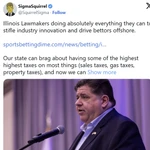
As the Illinois legislative session came to a close over the weekend, a Democratic faction pushed through a last-minute increase in sports betting taxes. This came as lawmakers faced a significant budget shortfall, ultimately passing a state budget of $55.2 billion just moments before the deadline. The proposal, which includes tax hikes on tobacco and out-of-state business income, will particularly impact the country’s largest sportsbooks.
For major industry players, this proposal echoed last spring’s imposition of a progressive tax increase on sports wagering revenues. Illinois Governor JB Pritzker expressed his intention to sign the new bill despite considerable pushback from stakeholders in the state’s sports betting sector. This latest tax hike raises important questions about whether leading sportsbooks will shift these costs onto consumers.
Wall Street analysts suggest one potential response could be the adoption of prediction markets, allowing companies to offer derivatives on sports event contracts without the tax burden.
The state has already drawn criticism for its tax policy enacted last year, which introduced a minimum tax rate of 20% on adjusted gross revenues (AGR), up from a previous flat rate of 15%. This system also includes a sliding scale that escalates the tax rate for high-revenue operators, capping at 40% for those with annual AGR exceeding $200 million. Following last year’s tax changes, DraftKings considered a surcharge on customer wagers but abandoned the idea after FanDuel announced it would not implement a similar fee.
Under the new tax structure, Illinois operators will incur a tax of $0.25 on wagers up to the first $20 million in fiscal year handle, increasing to $0.50 for each wager above that threshold. While this increase might affect mid-tier operators minimally, DraftKings and FanDuel are expected to bear the most significant impacts once again.
Analysts at JMP Securities estimated that had this tax been assessed over the last 12 months, FanDuel would face a gross tax burden of $86 million and DraftKings $79 million, considering they control at least 75% of the Illinois market.
The new tax raises Illinois’s tax burden closer to New York's, where operators pay 51% on sports wagering gross gaming revenues, the highest in the nation. New Hampshire joins New York in holding this record, with DraftKings as its only operator.
The projected combined negative tax impact for DraftKings and FanDuel is estimated at $165 million, whereas the other eight operators in Illinois might collectively see a tax burden of around $20 million. JMP's analysis shows that this could represent 5.4% of DraftKings' projected EBITDA for fiscal year 2026, while none of the smaller operators would incur more than 0.5%.
Barry Jonas from Truist Securities outlined three potential strategies for DraftKings and FanDuel: imposing minimum bet floors—a move likely to be poorly received by bettors; revisiting the surcharge idea; or embracing prediction markets.
Jonas suggested that a Kalshi-style prediction market could provide a means for operators to avoid this tax burden temporarily. Both companies have addressed the topic during recent earnings calls, with DraftKings CEO Jason Robins stating vigilance on upcoming developments. Flutter, the parent company of FanDuel, mentioned its efforts to explore this opportunity by assembling a team from Betfair’s exchange.
The abrupt addition of the tax to Illinois’ budget has drawn a backlash on social media. Supporters of legal sports betting cautioned that such tax increases may hinder innovation and inadvertently steer customers towards illegal offshore markets. FanDuel even enlisted the help of former NFL star Rob Gronkowski to advocate against the proposal.
This tax marks the first instance since the PASPA decision where a state has imposed a flat fee on sportsbook operators based on number of wagers. Brendan Bussmann of B Global Advisors commented that this represents a significant setback for the gaming industry, impacting innovation and the service economy adversely.
While the Pritzker administration celebrated a balanced budget for the seventh consecutive year, Republican lawmakers criticized the last-minute nature of the tax increase. Republican Rep. John Cabello remarked that the lack of transparency during the process was concerning, as the tax proposal was introduced just one day before finalizing the budget.
Cabello stated, "We’re rushing this process like we always do: ‘Let’s hide this stuff. Let’s hide it so that the public doesn’t see it until it’s too late.'"
Neither DraftKings nor FanDuel provided comments regarding the new tax. Both referenced statements from the Sports Betting Alliance, which advocates for companies like DraftKings, FanDuel, BetMGM, and Fanatics Sportsbook.
The Sports Betting Alliance criticized Illinois’ decision, arguing that it undermines responsible gaming initiatives and could lead to larger wagers or a shift towards unregulated operators. They described the new tax as discriminatory and harmful to stability in the regulated sports betting landscape in Illinois, emphasizing that consumers will ultimately absorb the costs, pushing them towards unsafe betting environments.

