
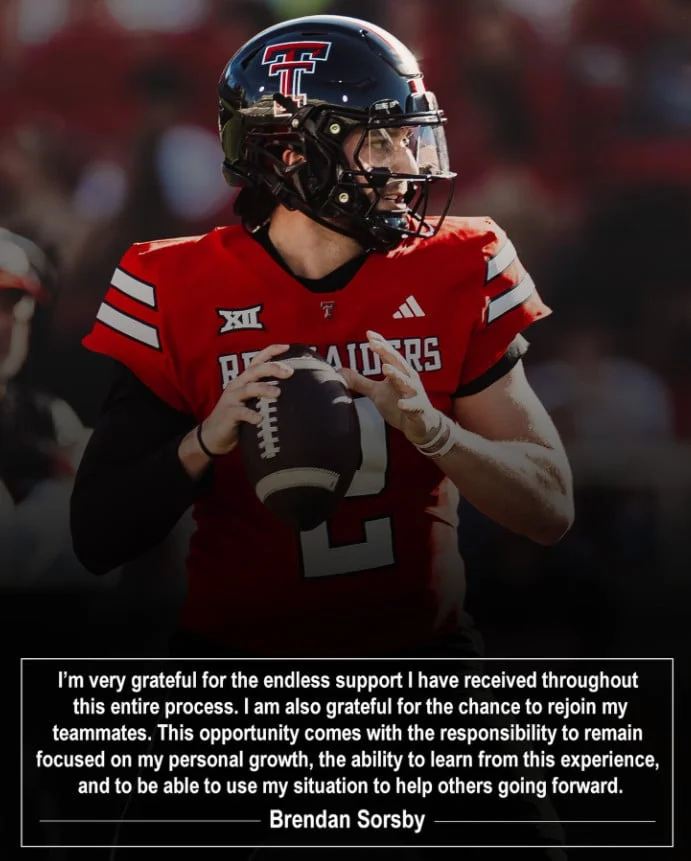
A judge in Texas has cleared the path for Brendan Sorsby to continue playing football for Texas Tech. The ruling overturns the NCAA’s decision to ban the player for violating the organization’s gambling rules, including placing wagers on his own team while playing for Indiana.
Judge Ken Curry issued a temporary injunction on Monday, ruling that Sorsby’s ban would cause him irreparable harm. Sorsby would not benefit from Texas Tech’s elite coaching to improve his football skills. He would also be unable to make an informed decision regarding whether to enter the 2026 NFL Supplemental Draft, according to the ruling.
It is an unprecedented decision to allow a player who admitted to gambling on matches involving his own team to essentially escape punishment.
Reaction to the Ruling
Sorsby took to Instagram to celebrate the decision, stating he was grateful for all the support he had received and the opportunity to learn from the experience.
Texas Tech had appealed against the NCAA decision to make Sorsby ineligible, writing a letter of support on his behalf.
Kirby Hocutt, Director of Athletics at Texas Tech, issued a statement in support of the decision. Hocutt reiterated the college’s stance, noting, “We do not believe that the circumstances of Brendan’s case warranted permanent ineligibility.”
The NCAA spoke out against the ruling, saying it sets a dangerous precedent. In a post on X, the organization said, “The NCAA is committed to supporting student-athlete mental health but must continue to aggressively defend against actions that defraud college athletics and threaten competitive integrity, such as betting on one’s own sport.”
Other Big Ten schools are reportedly considering refusing to play Texas Tech if Sorsby is allowed to play.
“We anticipate having conversations surrounding it,” TCU athletic director Mike Buddie told ESPN. “We’re all anticipating it, but this has not been formally discussed.”
Other College Athletes Punished for Similar Crimes
Sorsby has admitted to having a gambling problem. He wagered roughly $90,000 over a four-year period, including 40 bets placed on Indiana University football games in 2022 while he was a freshman on the team. At that time, he was 18-years-old, under Indiana’s legal gambling age of 21.
NCAA athletes are also prohibited from gambling on all sports, college and professional. The organization temporarily relaxed its betting rules, but colleges, including Texas Tech, rejected the change, and it quickly went back to strict prohibition across all college and pro sports.
The NCAA’s strict no-gambling policy has led to bans for several college players, including 25 students in Iowa who were banned for placing bets. One was wrestling student Nelson Brands, who took to X to protest his perceived injustice at the Sorsby ruling.
The NCAA ruled Brands permanently ineligible in 2023. Sorsby will miss two games per the terms of the injunction. This temporary suspension was suggested by his legal team.
NFL Players Faced Year-Long Suspensions
Sorsby said he bet on Indiana matches to feel closer to the team. He wagered on them winning and believes that should excuse his crime. That did not help several NFL players who violated the league’s rules on gambling and received season-long bans.
When playing for the Atlanta Falcons in 2021, Calvin Ridley placed parlays that included bets on the Falcons to win their games. He was banned for a year.
In 2023, Isaiah Rodgers Sr. and Rashod Berry were found to have placed bets on NFL games, including wagers on their own team, the Indianapolis Colts. They were suspended for a year and waived by the team.
Soccer Players Handed Similar Punishments
Around the world, no matter the local betting laws, athletes gambling on matches involving their own team are almost always handed harsh punishments.
In soccer, similar to Sorsby, Sandro Tonali admitted to having a gambling problem. He wagered on a range of matches, including his own team to win while playing for Brescia and AC Milan. He was banned for 10 months and recently criminally prosecuted as he used illegal betting platforms.
Fellow Italian soccer player Nicolo Fagioli was also banned for eight months as part of the same case. He did not, however, bet in matches involving his own team.
In England, Ivan Toney received an 11-month ban after admitting to betting on soccer matches, including those involving his own team. His ban was reduced to eight months when he was formally diagnosed with gambling addiction.
In none of these instances were players accused of manipulating matches, which carries a far harsher penalty, including criminal charges.
For Sorsby to only serve a two-game ban for his level of betting, which included games involving his own team, and when he was under the legal gambling age, is highly unprecedented.
With the NCAA appealing the ruling and the backlash from other colleges, it remains to be seen whether he will actually be allowed to line up for Texas Tech come the fall.

